Log in to download items reserved for the press:
"Life During Lockdown," the collection
In April 2020, the Mucem launched a major participatory project focused on our lives during lockdown. Many of you took part.
The Mucem has received more than 600 proposals, which are still being reviewed, and some of which will be added to its collections once the review process is complete. A digital booklet lists all the proposals collected through this call for submissions, and here are a few examples:
The Mucem has received more than 600 proposals, which are still being reviewed, and some of which will be added to its collections once the review process is complete. A digital booklet lists all the proposals collected through this call for submissions, and here are a few examples:
Digital Booklet(PDF,43544 ko)
This collection is being processed as part of the artist residency for the Taking Care project, co-funded by the European Union’s Creative Europe program.


In the News
February 2021
Video: Objects from Lockdown
“Living Through Lockdown,” launched by the Mucem in the spring of 2020, brought together more than 600 personal accounts of this experience, which was both intimate and collective. Through poetic and enigmatic displays, we highlight a few objects that symbolize this pandemic.
The Mucem invited artist Antoine d’Agata to offer his personal interpretation of the collection, featuring 13,000 photographs he took during that same period, in the exhibition “Psychodémie,” on view through March 25, 2022, at the CCR de la Belle de Mai.
The digital booklet and the exhibition are part of the European TAKING CARE Project, which aims to explore the role and forms of engagement of museums in the face of social and environmental crises by viewing these institutions as “spaces of care.” The TAKING CARE Project is co-funded by the European Union’s Creative Europe program.
Photo: Pierre Girardin
Sound Design: Jeff Aron
Objets poétiques | Vivre au temps du confinement
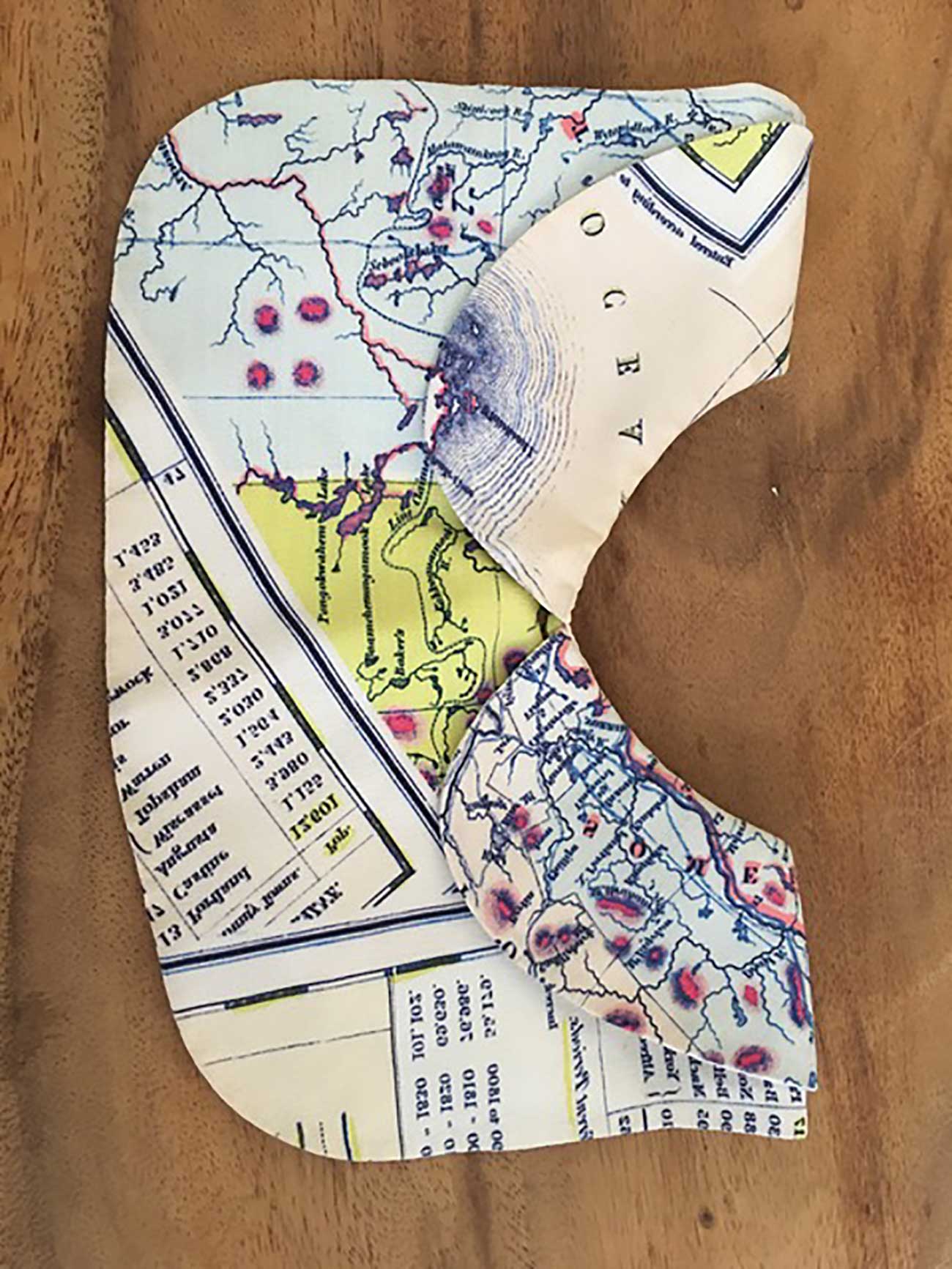
Stand-up collar
This secondhand silk collar, with its delicate fabric, old-fashioned shape, and patterns, is nonetheless a symbol of a new and entirely mundane form of modernity—one that the pandemic has significantly accelerated: working from home. The donor explains that it has become her go-to accessory for her daily routine. She would slip it on before every video conference, instantly shifting her private world into the professional one: “It’s the most minimal symbol of a shift in fashion—or in the world,” she tells us.
Blue-collar workers in production facilities, white-collar workers in administration: work attire is regulated to meet standards of comfort or safety, for example, or to conform to more diffuse but equally prescriptive social codes, such as the suit-and-tie required of executives. Referring to people in this way—by metonymy, through a sartorial attribute that links them to a socio-professional category based on the economic sector in which they work—shows just how deeply ingrained these norms are. While clothes may not make the monk, they certainly make the worker and mark the rhythm of their workday. We swap out our work overalls for Sunday best, or our carefully ironed white shirt for weekend sweatpants.
But the professional dress code has been significantly disrupted by the practice of video conferencing and by how we frame our computer screens: we can attend a meeting in slippers or turn our kitchen into an office. The boundaries between professional and personal spaces, work and leisure, social appearances and private life are breaking down, blurring, and merging. For better or for worse—and not just in terms of fashion!
Wearing this collar, then, restores that division: a small daily ritual that marks a pause in the flow of the day’s activities, distinguishing how we behave and manage our appearance in different social contexts. The rule is accepted, and it’s reassuring. The Claudine collar—a true “model garment” that owes its name to the heroine of Colette’s novel—is for obedient children… but not too obedient. The collar thus takes on a deceptively well-behaved air! The nautical charts suggested by the fabric’s print—with its broken lines and faded pastel colors—invite a whimsical exploration of an ancient or lost world, a gentle escape from the confines of the screen, work, and even our confined daily lives!
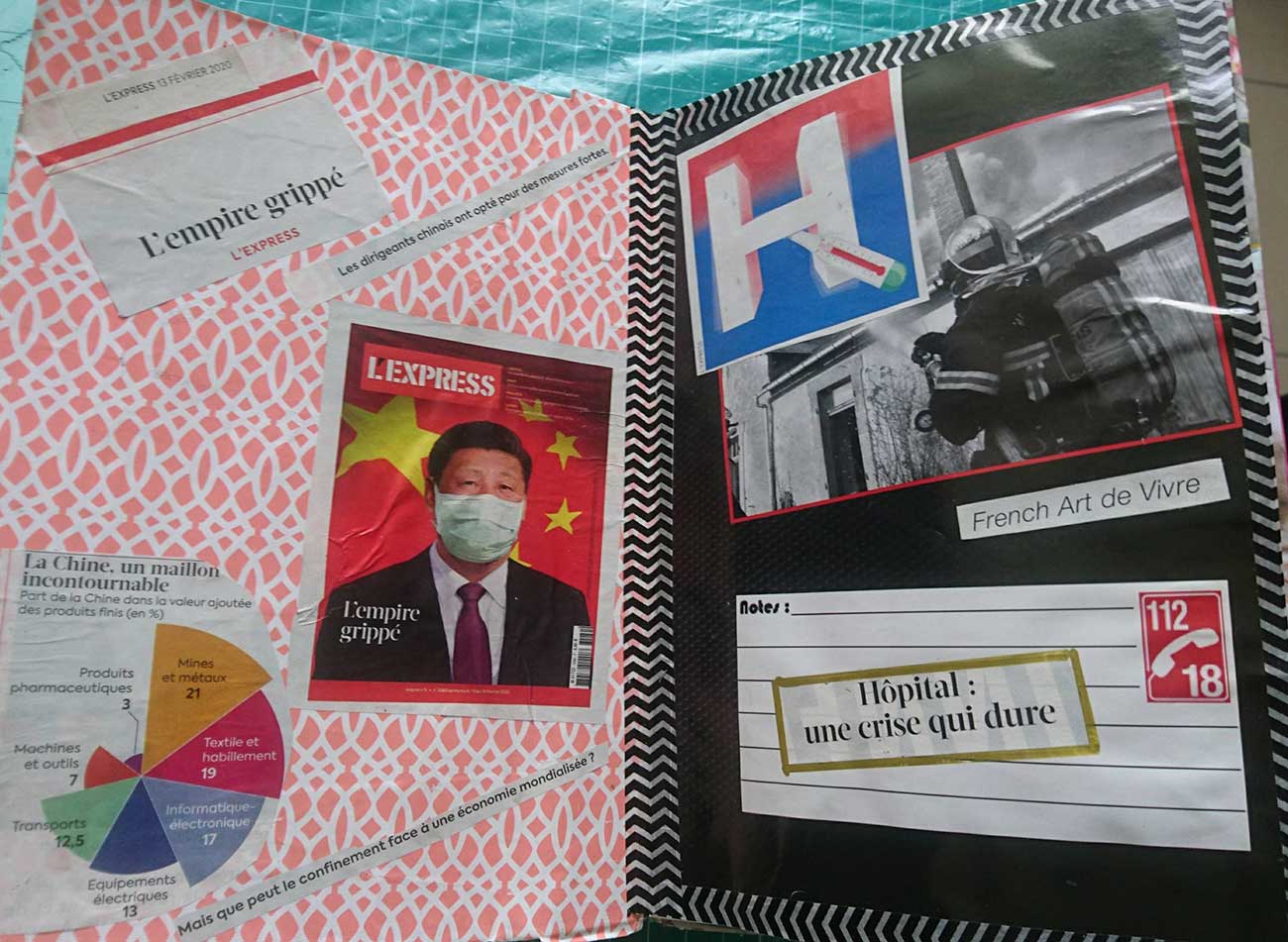
Junk Journal
Spring 2020 ushered in a new trend: the lockdown diary. Celebrities who take center stage in the media or on social media to try their hand at this new style are met with reactions ranging from irony to outright hostility: critics denounce the garish and self-indulgent packaging of a reality that is dark and tragic for many. Nevertheless, the controversy does not discourage them—quite the contrary. Lockdown spontaneously sparked a flood of personal writing. Day-to-day life was recorded in handwritten or typed pages, photo albums, comic strips, video montages, songs, and artwork displayed on the walls of one’s apartment or on one’s Facebook account.
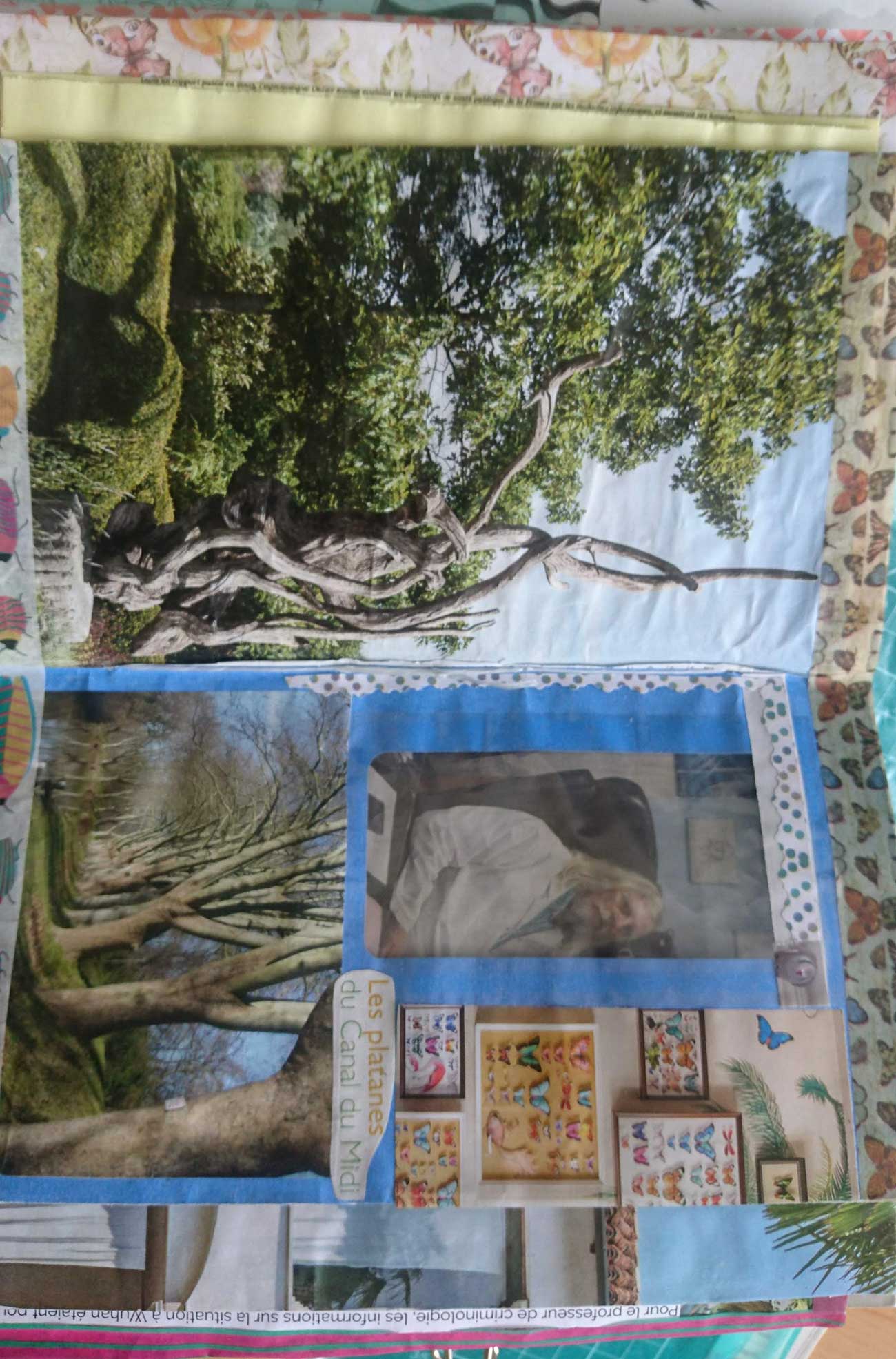
So here it is—rather than a haute couture outfit, a junk journal: that’s the name the donor gives to this album, made entirely from recycled materials she found around her home. Visible seams, patches of mismatched torn scraps, pieces held together with tape or glue, haphazard lamination… Long live the trashy style! “This junk journal,” she tells us, “allowed me to channel my doubts about lockdown, my anger, and other feelings, but above all to reflect on the situation and my intentions for life after this.” ” To make sense of this experience—which is both intimate and universal—she has juxtaposed pieces of her private life (personal messages, shopping lists) with fragments of public writings of various kinds (newspaper clippings, magazine photographs, excerpts from gardening manuals, letters received…). At its core, this approach harkens back to the origins of the personal diary, often conceived as an exercise in introspection, to train the mind in the critical examination of oneself and the world. But here, introspection becomes an outlet: self-expression is perceived instead in the collision of fragments of a chaotic and patchwork reality!
“Journaling is first and foremost a way of life and a form of writing,” says Philippe Lejeune, an expert on autobiographical genres. In this case, it’s a way of writing about one’s inner life because we’re confined to a life… indoors. Somewhere between the journal of a stationary journey, the logbook of a voyage by sight through the turbulence of an upended daily life, and the field notebook of an ethnologist studying himself, lockdown diaries are revitalizing the genre with extraordinary inventiveness and vigor, weaving together a unique, multi-voiced autobiography of an era that is racing by at breakneck speed!
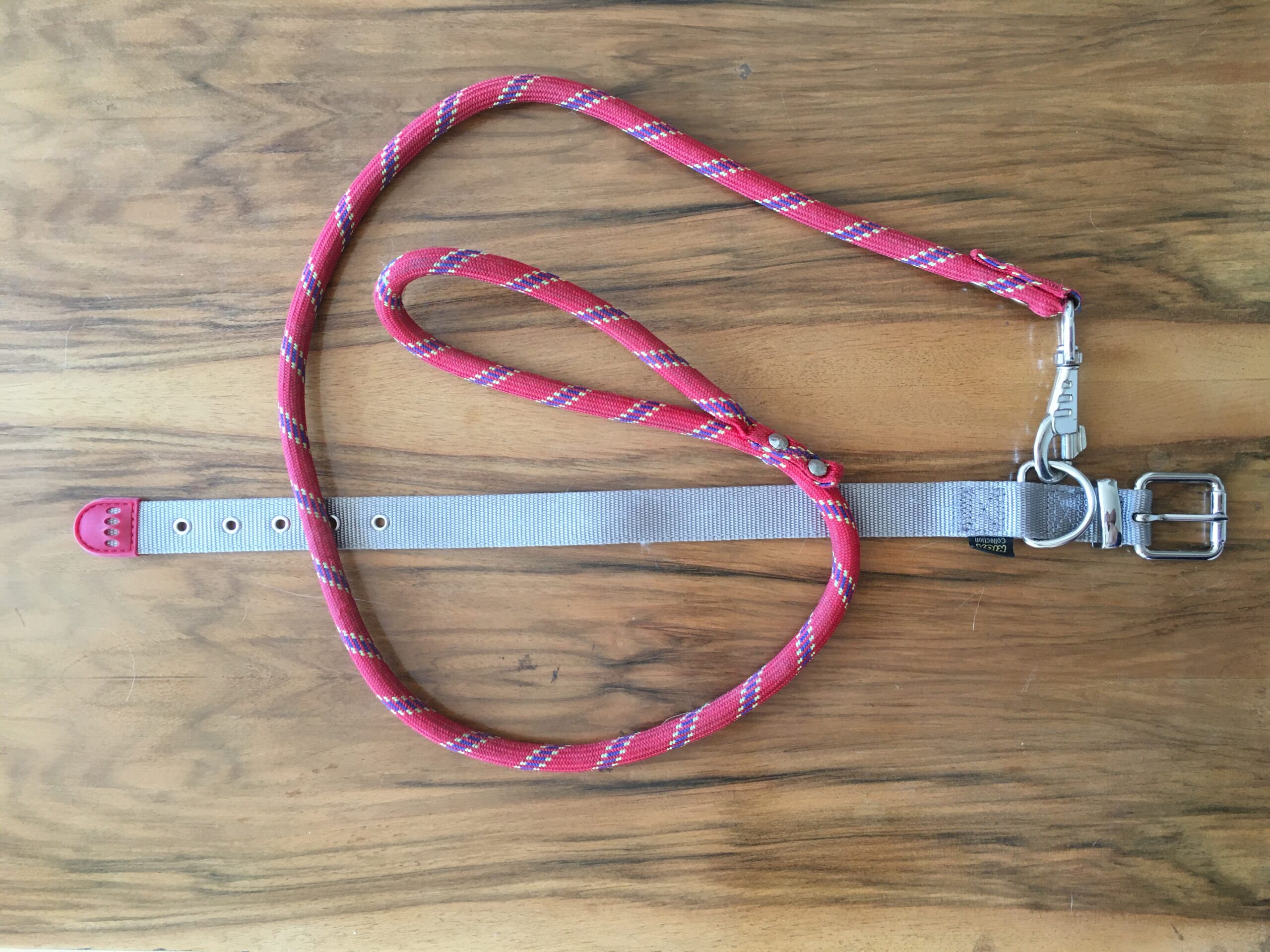
A leash and a collar
A leash and a collar. These are two objects that, more than any others, symbolize the relationship of domination that is animal domestication. Yet one of our donors, a frontline nurse, wanted to pass on this item that “binds [him] to the living being with whom [he] was confined and whom [he] thanks from the bottom of [his] heart: [his] dog.” Domination became a plea for freedom, for it was a privilege that legally granted temporary freedom of movement. Never has the concept of “companionship”—to which pets are generally assigned—been more present, and more turned on its head.
The presence of animals warded off loneliness when “companionship”—precisely—was sorely lacking. While many donors mentioned the beneficial presence of common pets such as dogs and cats, others cited more surprising examples: some accounts describe the careful observation of migratory birds that bring life to the still, deserted outdoors, while others count with a gentle eye the living creatures that inhabit the enclosed home—creatures usually considered pests: mosquitoes, moths, various insects… As a result, the accepted dichotomy between the wild and the domestic has been somewhat upended.
Moreover, and paradoxically, it was the domestic nature of the pet that made it possible to escape one’s domestic space! Walking one’s pet ranked fifth among the permitted reasons for going out, attesting to its prevalence and to the quiet entry of this unique relationship between humans and animals into the legislative and political sphere. People could thus legally go out with their dogs—and sometimes even get away with a few workarounds… So much so that videos of fake dogs began circulating online, their DIY construction once again showcasing incredible creativity. In some apartment buildings, people were even seen offering their services to walk their neighbors’ dogs—and, let’s face it, to get themselves out of the house!
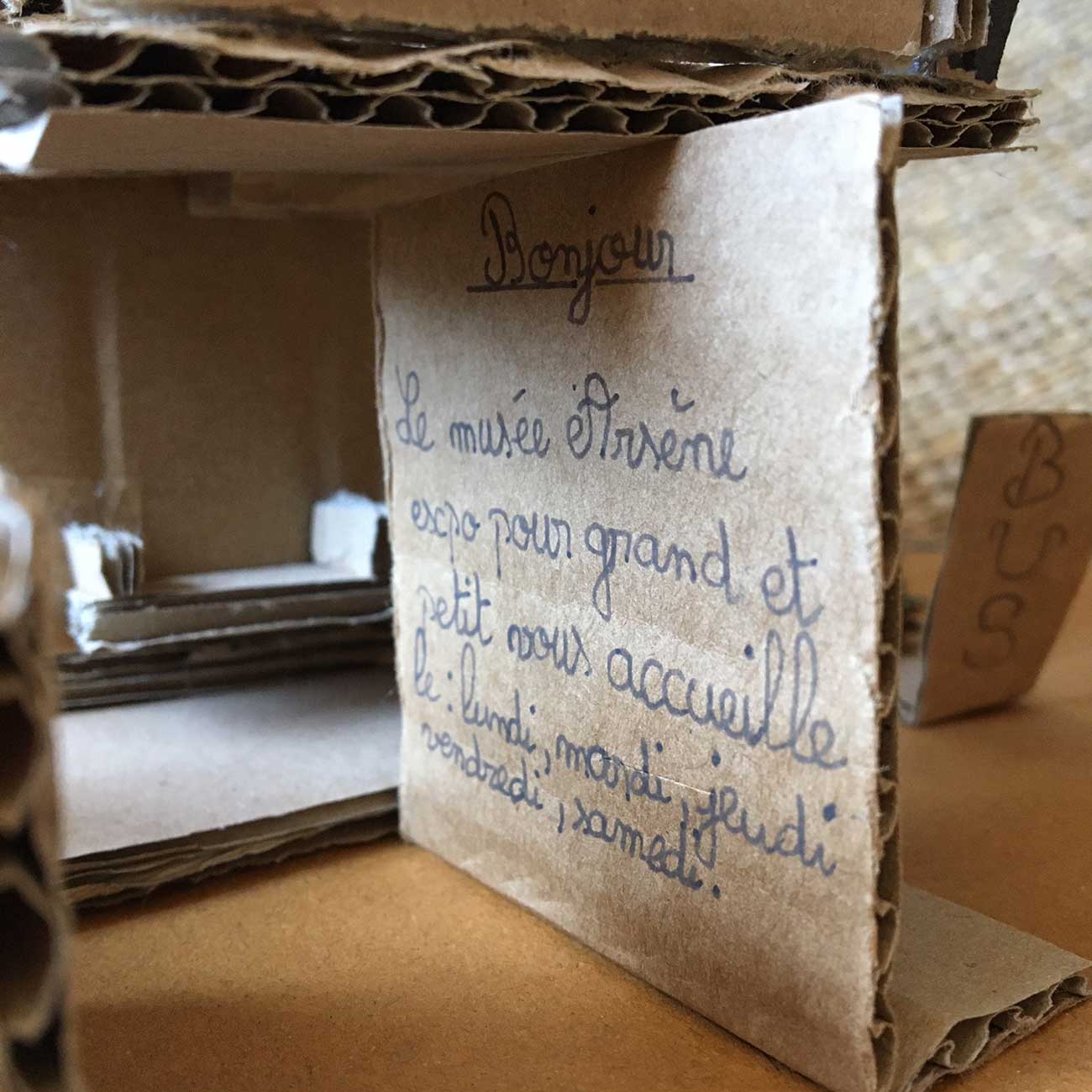
Envelopes of Canceled Banknotes and a Miniature Cardboard Museum
Isabelle is 70 years old, lives 80 km from Paris, and loves the performing arts, especially dance and contemporary circus. “It’s the privilege of a comfortable retirement,” she tells us; she attends more than fifty shows a year and devotes her leisure budget to these artistic outings in Paris. She has laid out these show tickets on a table, like so many preparations for canceled trips, because for her, going to the theater is “going on vacation.”
Arsène is 11 years old. He built himself a ping-pong table, a foosball table, and… a museum. It’s “a miniature museum you can visit. It has two floors, and everything is made of cardboard that’s been cut out, glued together, and colored.” So after the home theater, here comes the home museum. The exhibition halls and the artworks on display are reproduced with touching attention to detail, and there’s even—as Arsène points out—Hokusai’s *The Great Wave*!
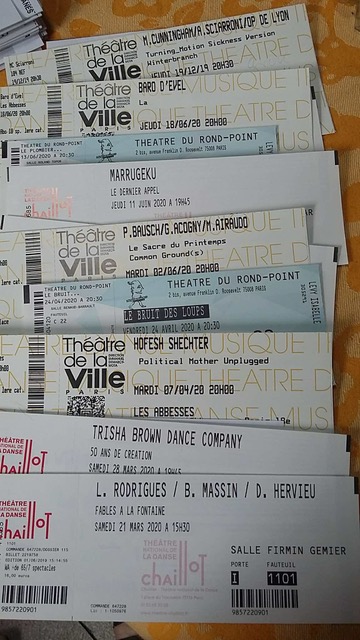
Isabelle can no longer leave her home to go to the theater; Arsène brings the museum to his home. Lockdown means limited outings in public spaces and restricted daily activities. It also means a pause in the relationship between art and society, between artists and audiences, and between institutions and users. For what these two accounts show us is the paradox of all cultural activity: it is a singular experience shared by many; it is a suspended moment of shared inner reflection in the same time and space. “Alone Together,” as Chet Baker used to say! What these accounts teach us is that, beyond the personal disappointment of seeing one’s routines upended, the fact that this measure applies to everyone sometimes calls on us to think beyond ourselves. For Isabelle, “lockdown is therefore a wallet full of unused tickets, for which I won’t ask for a refund so that I can make a modest contribution to the survival of the various artists I was planning to see.” And for Arsène, the museum is above all a way to imagine visitors—young and old—who will come to his museum.
For our part, we hope to reconnect with our audience and look forward to seeing you again.
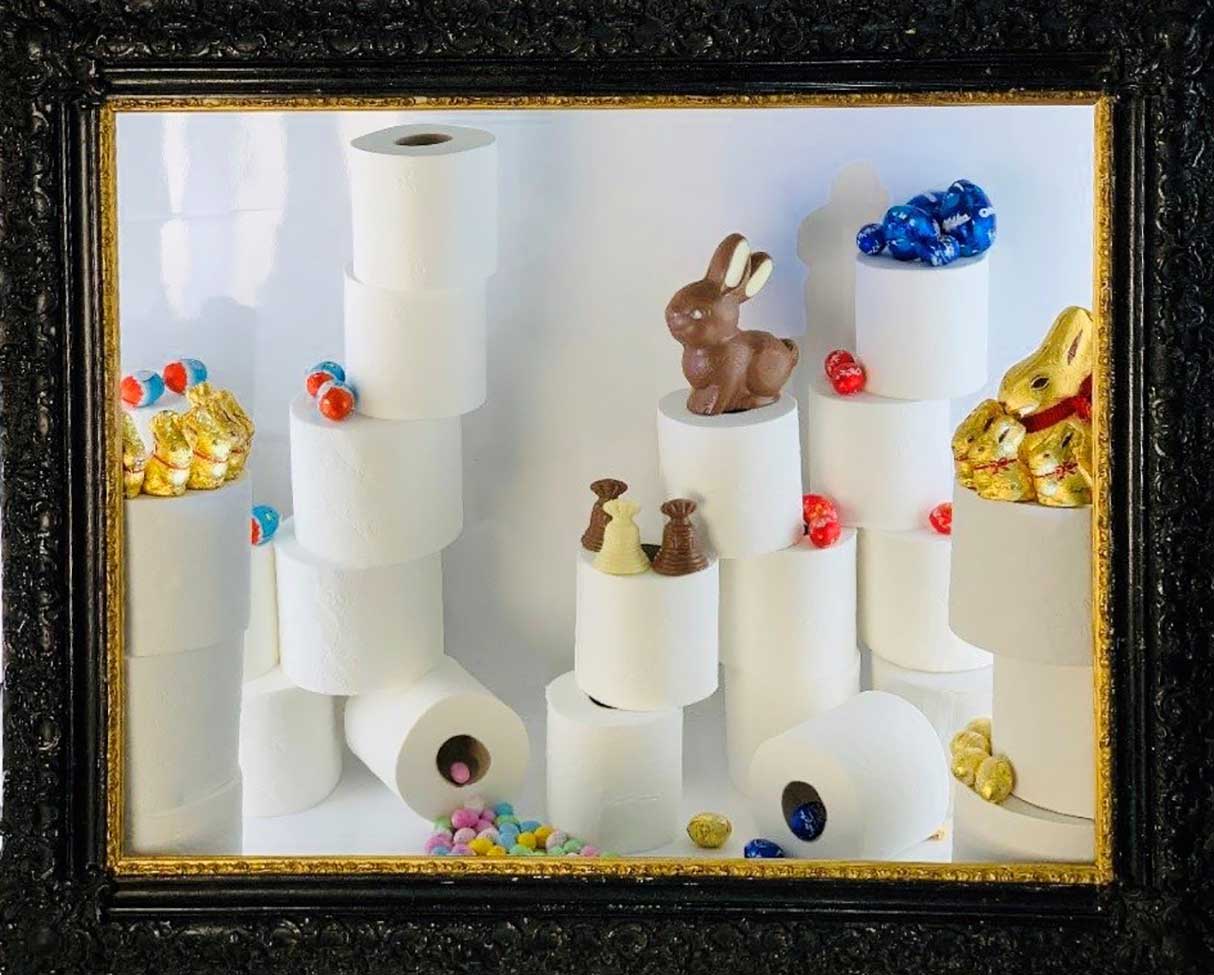
Imaginary Easter Egg Hunt
Sometimes the importance of an object isn’t measured by its nobility. Here, humor counteracts the triviality of the home’s most intimate space.
Transforming our everyday space to adapt it to the new lifestyles imposed by lockdown isn’t limited to functional or decorative rearrangements. Many participants in the collection sent us playful proposals for ephemeral characters, invented to enliven our domestic world, even in the most mundane details of our daily lives—such as compositions made from beard hairs that have fallen to the bottom of the sink or a masked Mona Lisa painted on toilet paper… These scenes take an unexpected turn as the days go by, and transform our confined space into a museum-like setting, much like “scenes” that, as in theater and opera, serve as interludes to punctuate the mundane or repetitive plot of our everyday lives.
This piece, titled “Imaginary Egg Hunt,” features Easter chocolates with gleaming gold accents majestically displayed on toilet paper rolls serving as pedestals. While the former are usually hunted for during the Easter season, the latter are—in theory—hunted for far less often… and yet! Let’s recall last spring’s scenes of panic-buying, the television footage capturing empty supermarket shelves or lingering on shopping carts overflowing with this paper that had suddenly become so coveted, so precious, right alongside flour and pasta. Let’s recall the somewhat absurd calls for moderation directed at overly cautious consumers: because people were hesitant, they were told to be reasonable and not take too much—yet they still took a little extra… just in case…
Humor thus mocks what is, in fact, a recurring sign or symptom of crisis: the impulse to buy, driven by a far more sinister obsession—the fear of running out—is a true indicator of our collective psychology and of each individual’s perception of a threat. A fear of scarcity that might seem laughable, but which unfortunately also reflects social inequalities, since in the most vulnerable households, securing basic necessities—especially hygiene products—was sometimes very difficult. With its deliberate flashiness and unapologetic bad taste, the exhibition good-naturedly satirizes the excesses—sometimes amusing, sometimes dark—of mass consumption, in keeping with the subversive principles of kitsch. Just what’s needed to chase away… melancholy!
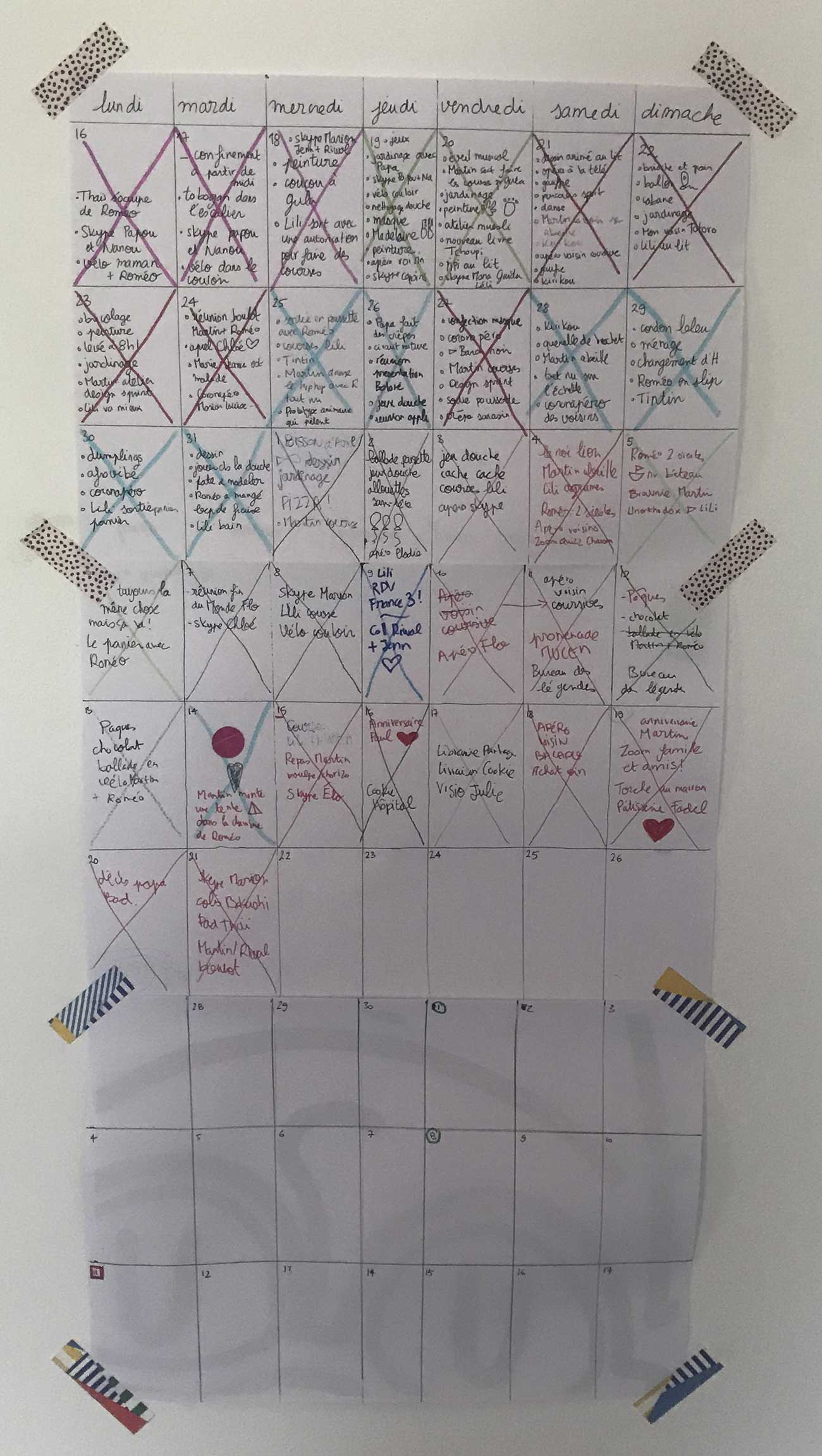
Lockdown Schedule
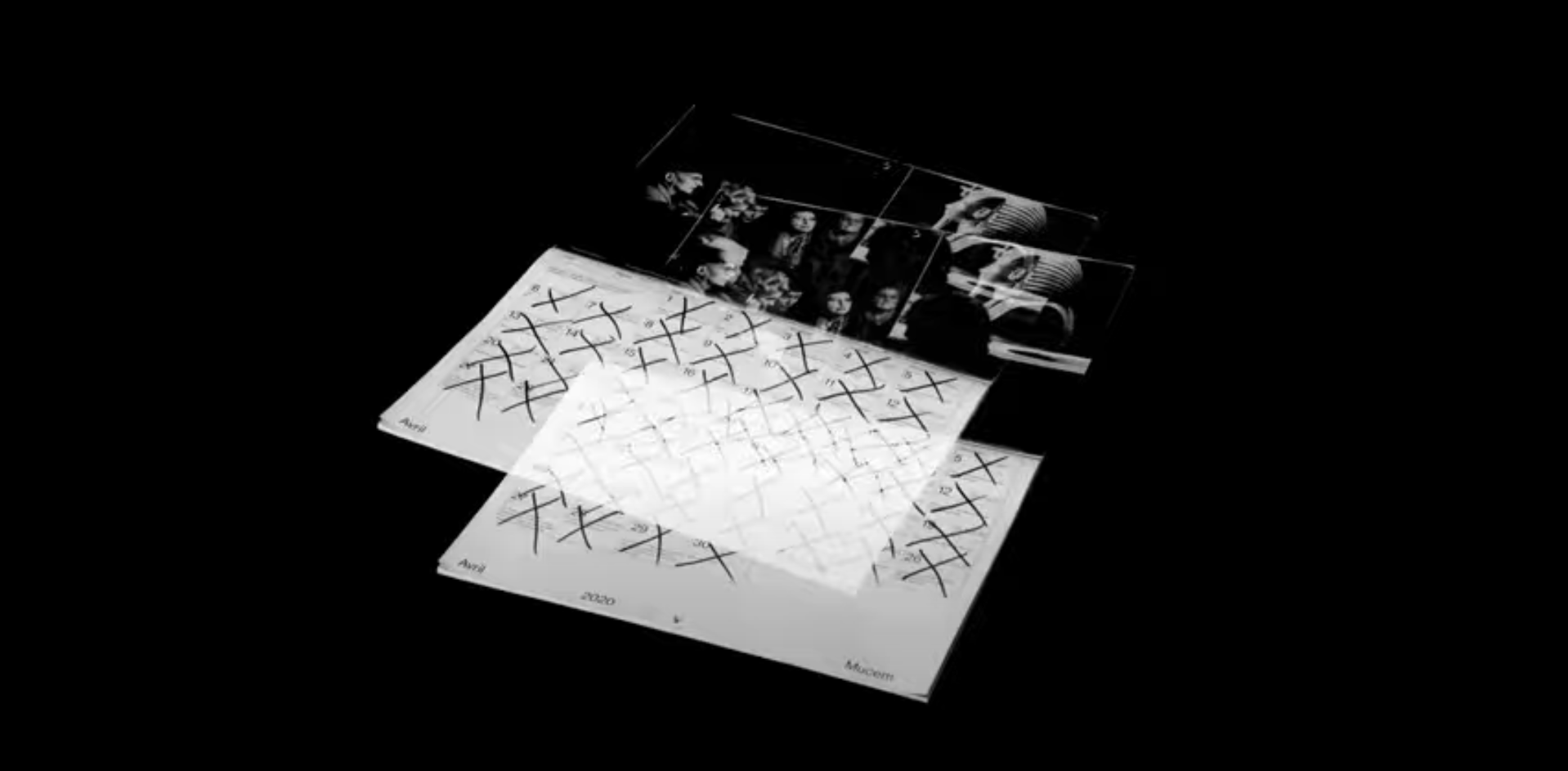
This calendar was kept during the spring 2020 lockdown. Each box, confined within its narrow frame, captures the family activities carried out that day. The layout of the small boxes becomes a metaphor for lockdown itself, whose etymology refers to finitude and imposed limits: it is the experience of daily life confined within a restricted space. Carefully crossed out with each passing day—almost like prison graffiti or a sick leave log—the successive boxes measure the passage of time. More had to be added with tape each time an extension of the lockdown was announced. However, one more day is also one day less: each colored cross, drawn in a naive and joyful manner, brings us closer to the end, and, as its creator tells us, “it’ll be a nice memory when all this is over!” ” Displayed on the fridge, like a shopping list, this calendar is quite the opposite: it’s not about noting what we have to do, but what we’ve done. It’s a way to leave the period we’re currently living through behind us, in the past, and to make ordinary events memorable.
Living in the age of lockdown, then, also means measuring time, organizing it, breaking it down into segments, and filling it as our usual points of reference tend to fade away and time expands and stretches out. Work and sleep, but without the subway, the rhythm of the day loses its metronomic regularity. We are caught up in contradictory perceptions of time: the rhythm of the pandemic marked by its curves; the time of the health emergency, whose anticipated resolution takes the form of an ever-postponed horizon, much like the empty boxes on this calendar; the time of a motionless acceleration, where remote communication gives us a sense of both ubiquity and stagnation. The daily rituals we invent to ward off these paradoxes take many forms. The collection has thus brought together a vast number of personalized variations on these calendars that mark our daily lives. Diaries—written, drawn, filmed, and even embroidered; calendars, planners, lists, and activity charts presented as posters, collages, or patchworks; wooden lockers; pictorial series; or decorative furniture… The personal or collective journal became a true genre during lockdown, at the intersection of the daily schedule and autobiography. The diversity and originality of these creations are a wonderful source of inspiration for another seasonal calendar as we enter early December: the Advent calendar!
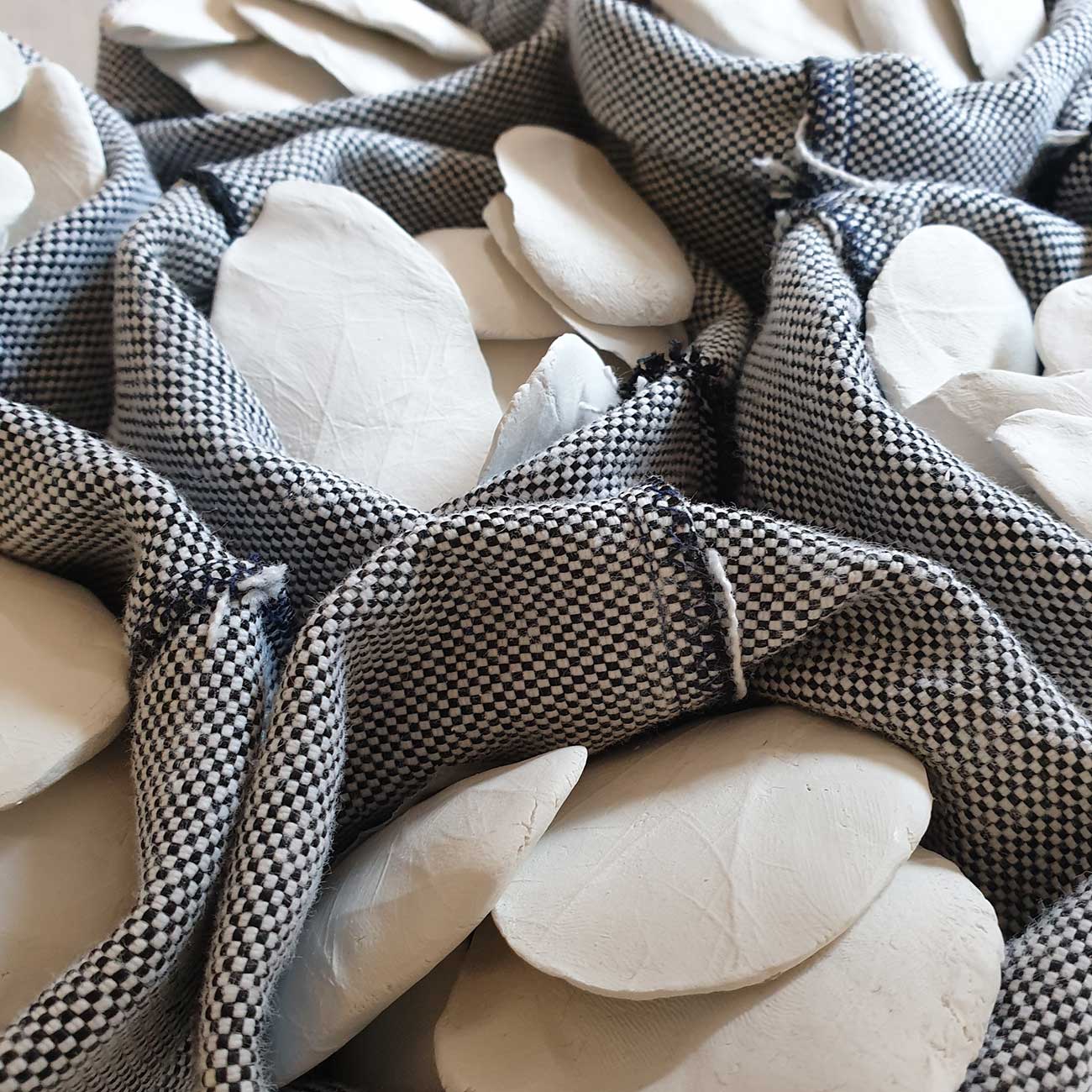
Imprints of handshakes in unglazed porcelain
This photograph depicts a work created during last spring’s lockdown for an art collective launched on social media, *The Diary of a Pangolin (in the Time of the Coronavirus)*, which brought together a variety of creations inspired by this small anteater: At the time, the pandemic had brought this animal sudden and unfortunate notoriety, as it was briefly hypothesized that it might serve as an intermediate host for the transmission of the virus to humans.
A fine arts student, the artist who created this work is also a home health nurse. She asked her loved ones and her patients to make impressions of their handshakes. These impressions resemble the precious scales of a pangolin, stored in small bags. From nursing to art, from the act of caring to the act of creation, this piece reflects both a life journey and a shared experience: that of physical contact that has become impossible.
“Man is an animal endowed with language,” Aristotle tells us, but linguistics, anthropology, philosophy, and even medicine have also taught us just how much we accompany our words with gestures. The pandemic has served as a harsh reminder of the importance of this nonverbal communication. Whether a simple social convention or an intimate gesture of affection, the handshake and its variations—hugs, embraces, kisses on the cheek—are now off-limits, replaced by “barrier” gestures designed to prevent the spread of disease. Bows, nods, hands placed on the chest or clasped in prayer, elbow bumps, and foot taps are inspiring new forms of greeting that transcend cultural, geographic, and generational boundaries.
The ambivalence of our gestures—which can convey respect, care, and gentleness, or, conversely, threats, risks, and withdrawal—is evident in this work. The benevolence of the caring gesture of holding hands actually makes the photograph by Isaac Lauwrence—which inspired this work—much more sinister: for the scales stored in the bags are in fact those from a record-breaking customs seizure in 2018. The pangolin is, in fact, the most poached animal in the world due to the supposed therapeutic properties attributed to it. This serves as a way to highlight just how much the upheavals imposed on the animal world and ecosystems—including illicit trafficking, industrial farming, deforestation, loss of natural habitat, and accelerated movement— in the name of what we associate with our quality of life, actually increase the risk of zoonotic transmission—the spread of diseases from animals to humans—which is the source of many epidemics.
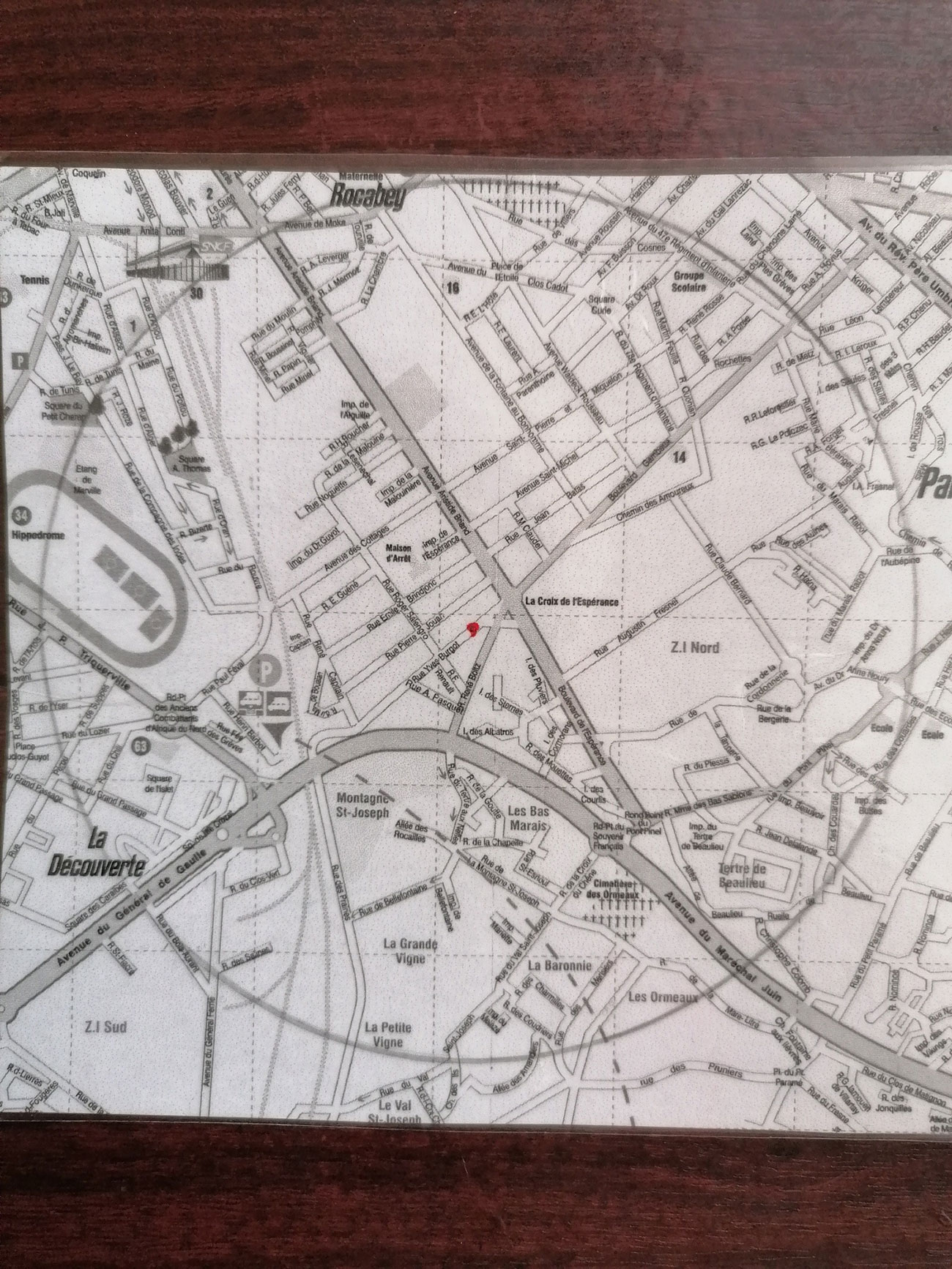
Outbound Perimeter Map
Here is a map of a city whose name is not specified. The map’s scale isn’t indicated either, but we can guess it at a glance because it speaks to an experience we all share: the circle represents the one-kilometer radius around one’s home within which daily outings are permitted. Drawn with a compass, it brings to mind our long-ago geometry lessons as schoolchildren. Unfolded on the table, viewed from above, the neighborhood map also reflects a mental space—and the perplexities we’ve all felt: Is the perimeter calculated “as the crow flies”—an expression that evokes an enviable freedom—or based on a ground-level route that magically multiplies distances? The twists and turns of the urban layout, the names of the streets, and the public amenities mark out the vistas, offering unexpected points of interest within the space that is, after all, so familiar in our immediate surroundings.
For the first time, an epidemic has affected the entire planet. The human community has found itself unexpectedly united in the face of the virus’s spread; the scale is global. At the national level, the entire country has been placed under lockdown. While our personal situations are not all the same, we are all restricted in our movements. We all share this experience. But paradoxically, what defines this moment—what we remember—is not these national or global scales. Rather, it is the everyday reality of the spaces we inhabit. Each of us has our own sphere, our own walks, our own journeys, and our own strategies for getting around restrictions as well.
Does this mean that the proliferation of these individual relationships to space has eroded any sense of community among us? Not necessarily! What we have shared is the internalization of this boundary, the discovery of the unexplored yet nearby; it is a different relationship to the neighborhood, to our surroundings, and to public space: walking, detours, and pauses become the concrete, physical exercise of how we individually or collectively navigate the laws of urgency.
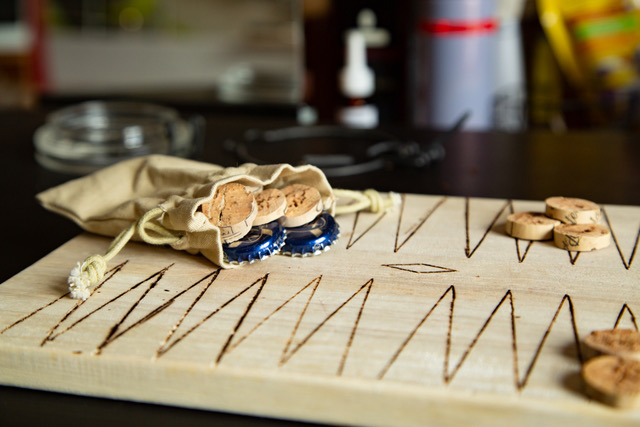
Backgammon Game on a Cutting Board
This photo shows a backgammon set pyrographed onto a cutting board. The engraver’s hesitations are a testament to the care taken in its creation. The pieces, taken out of their little pouch, are corks and glass can tabs. From the pleasures of a meal to those of backgammon, the cheese platter has become a game board: the solitude of lockdown plays with the idea of blurring the lines between social interactions.
The Mucem has received several examples of creations that have helped people fill their free time by practicing new skills. The act of crafting an object takes on a whole new dimension. In this case, the self-taught artisan is an engineer who has played this game extensively online; he even developed a virtual app for it. Even as lockdown keeps us glued to our screens more than ever, he has stepped away from the virtual world to meticulously craft this game board, using a soldering iron as a pyrograph. The creation of this backgammon board is the result of a series of repurposings and transformations: of the medium (the board), the tool (the soldering iron), from the virtual to the physicality of wood, and from professional work to a leisure activity. As its creator tells us, “I found it very important to learn how to make the most of boredom (…) for me, it’s a positive representation of this strange period.” DIY reinvents objects and their functions with a freedom and ingenuity that open up new ways of sharing.
This form of entertainment is therefore, in the full sense of the word, a form of culture. For the act of diverting is precisely the original meaning of the word “entertainment,” which first refers to diverting a cultural heritage, and then, by extension, to diverting someone from their concerns—for example, by engaging in pleasant activities deemed secondary or trivial, such as games. On the contrary, entertainment is essential to our lives, philosophy retorts! For Blaise Pascal, it serves to escape the anxiety of our human condition, and for Roger Caillois, play suspends the conventions of reality to allow us to discover new rules and imagine new ways of sharing. It serves no purpose, and that is precisely why it is so useful.
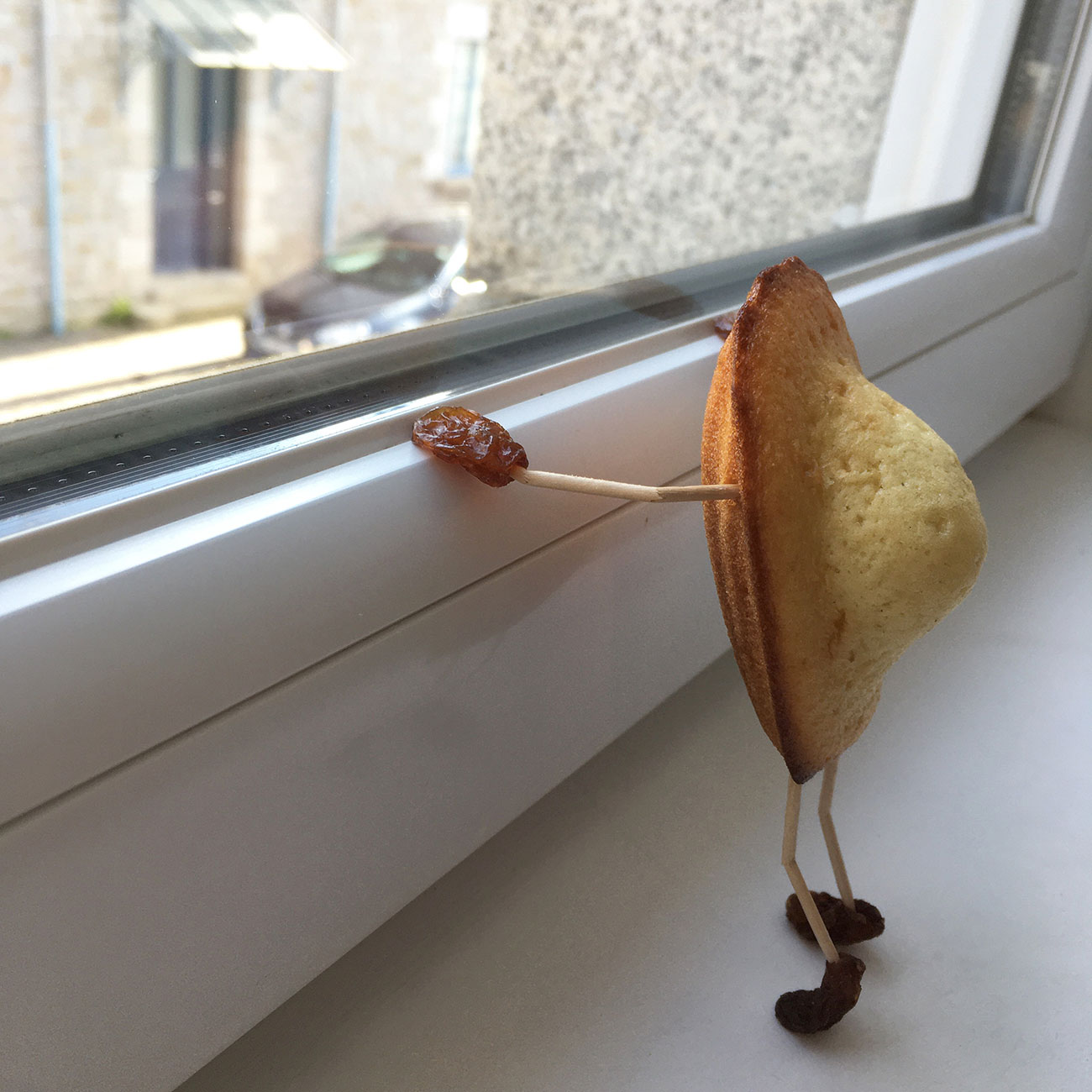
Untitled
This photomontage is part of a series of variations on a famous little cake. “The madeleine,” says the creator of this image, “is so instantly recognizable that no words are needed to express what it represents or suggests: a certain sweetness, warmth, and kindness associated with childhood.” Many participants in the “Living in the Time of Lockdown” collection submitted depictions of comforting pastimes such as cooking, but also personal creations that, in the spirit of “art pauvre” or “modest arts,” enliven and re-enchant everyday life by repurposing the simplest objects beyond their original function: we look at them differently, we see differently, and we see ourselves differently through them. The street is no longer the same when viewed through the eyes of a madeleine, and that madeleine at her window—that’s us, too.
Round and mischievous, standing on the tips of her grape-like toes, she looks out a window—a boundary that separates us from the outside world, yet also connects us to it—with a mixture of melancholy and curiosity. This ambivalence of thresholds—the boundaries between the inside and the outside—has been highlighted in many ways throughout the collection: the horizon is bounded, yet our gaze is sharper; objects diverted from their intended use make us feel estranged, prompting us to question our relationship with the outside world and with ourselves. They become revelations.
Writer Marcel Proust’s madeleine has become legendary: it is the taste of a pastry that involuntarily brings the past to the surface; it is the emotion evoked by an ordinary object or a seemingly insignificant sensation that triggers “the immense edifice of memory” and restores a buried truth. Much like the madeleine, museum objects also hold a sensory memory that is both intimate and collective. They do not reveal an absolute truth, but they suggest a new perspective and raise new questions about the experience of lockdown: it is so that we may observe and reflect together that the Mucem has launched this call for donations.
Discover more features
Immerse yourself in the vastness of the Mucem’s collections and follow the surprising themes imagined by our curators. Discoveries and a change of scenery guaranteed!
 Discover
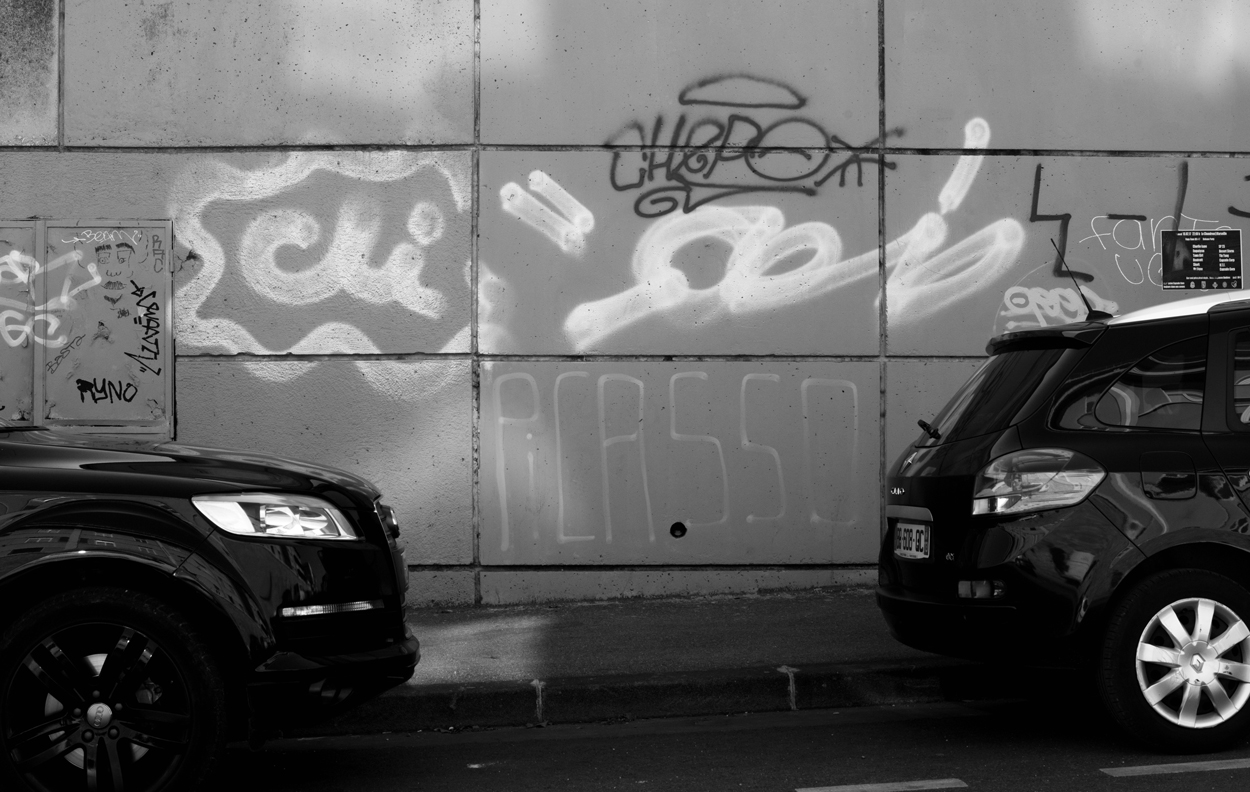
Tagging and Graffiti: “Illegal Art” at the Museum
Between 2001 and 2006, Claire Calogirou, a research associate, conducted several field surveys on the topics of hip-hop, dance, tagging, and graffiti. As for graffiti, 958 items were added to the Mucem inventory, representing an impressive collection of graffitied signs, posters, stickers, markers, spray paint cans, magazines, sketches, photographs, videos, and more. This rich body of research offers insights into social relations in urban settings, the issue of the appropriation of public space, and its reclamation through practices rooted in street culture.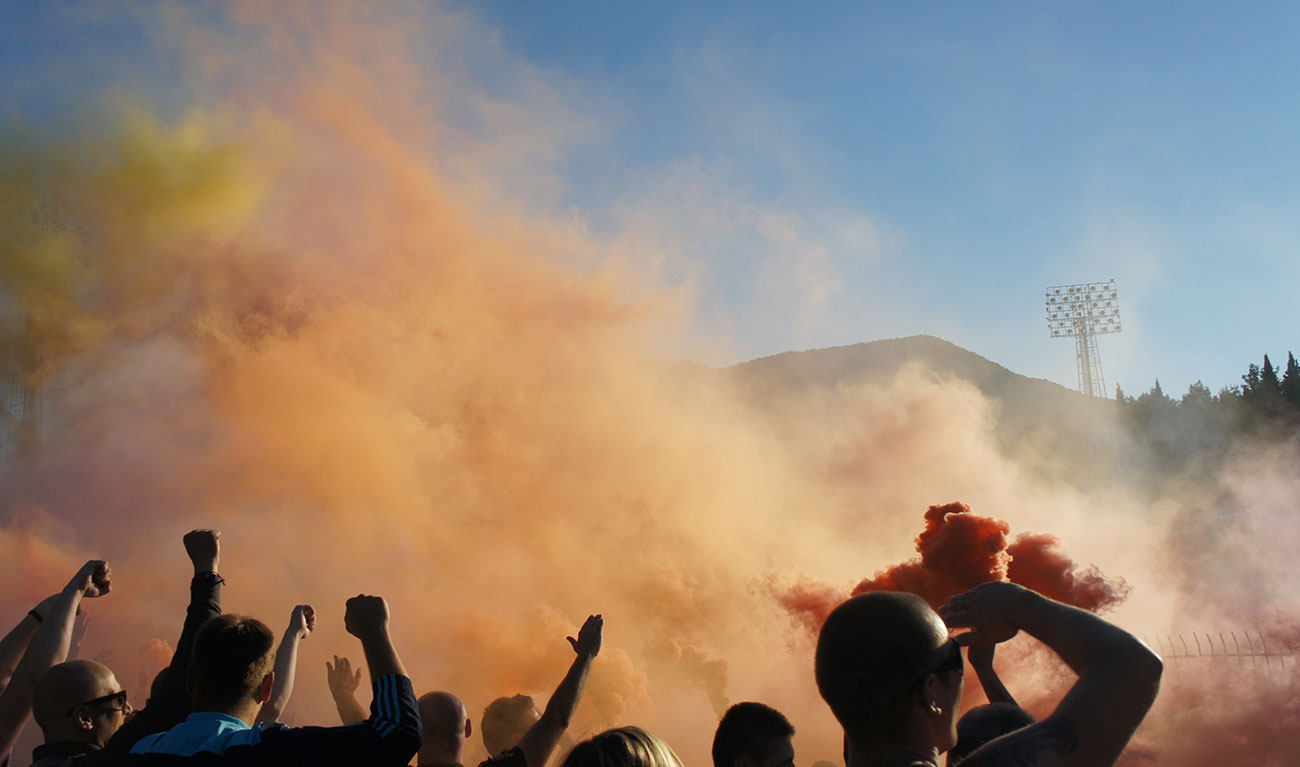 Discover
Soccer & Identities
A Mediterranean Survey and Data Collection Project
The “Football & Identities” survey and data collection project represents three years of research, conducted from 2014 to 2016, in 10 countries in the Mediterranean region: Algeria, Bosnia and Herzegovina, Spain, France, Israel, Italy, Morocco, Palestine, Tunisia, and Turkey.
Four humanities researchers—Christian Bromberger, Abderrahim Bourkia, Sébastien Louis, and Ljiljana Zeljkovic—sometimes accompanied by a curator —Florent Molle—and photographers—Giovanni Ambrosio and Yves Inchiermann—collected more than 400 objects, approximately 3,000 photographs, and over 6 hours of video footage. Upon their return from the field and after review, the collected objects and photographs will be presented to the Mucem’s acquisitions committees to determine whether they will be added to the public collections and made available to the public.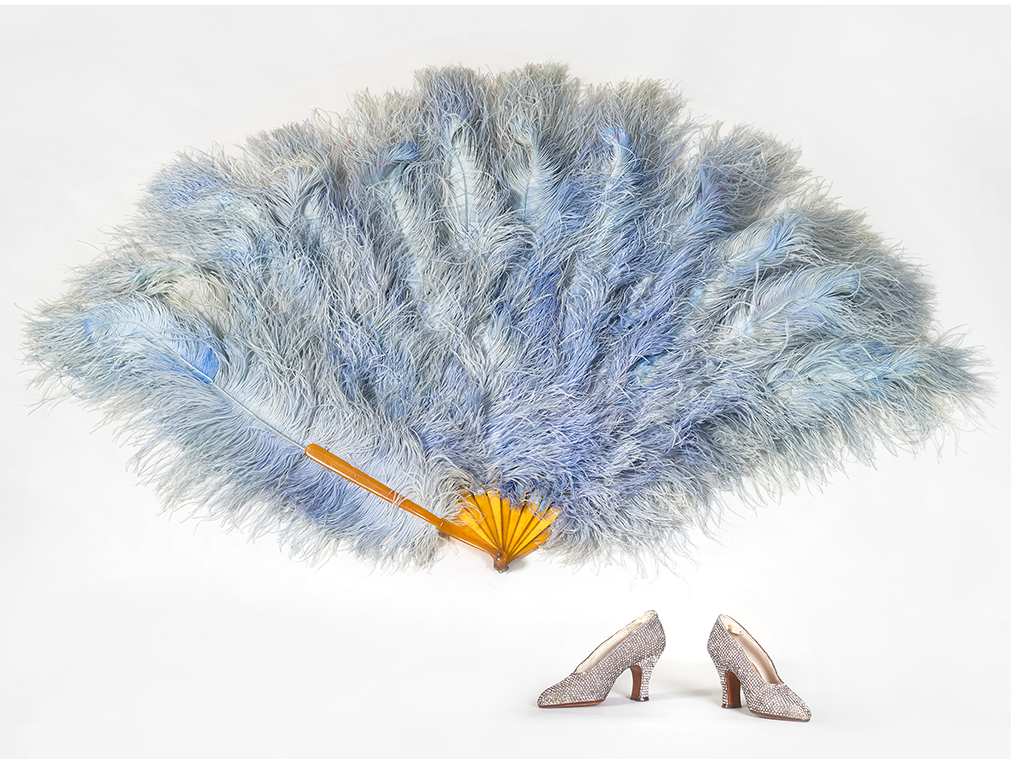 Discover
Celebrity!
Cult Objects and the Star System in the Mucem Collections
A dress, a console table, a belt buckle, a soccer jersey, a pair of shoes, a swimsuit, a radio: here is a list of simple everyday objects that bear witness to their era. This list would have a very different impact if we added the names of the people to whom they belonged: Edith Piaf’s dress, Pink Floyd’s mixing console, Saint Vincent Palotti’s belt buckle, Cristiano Ronaldo’s soccer jersey, Mistinguett’s shoes, Miss France’s swimsuit, Psykose’s “cataposte.” From being mundane, these objects take on power, sparkling with the glamour of fame. They become desirable and “magical.” But these relics come at a price that is, too, far from trivial…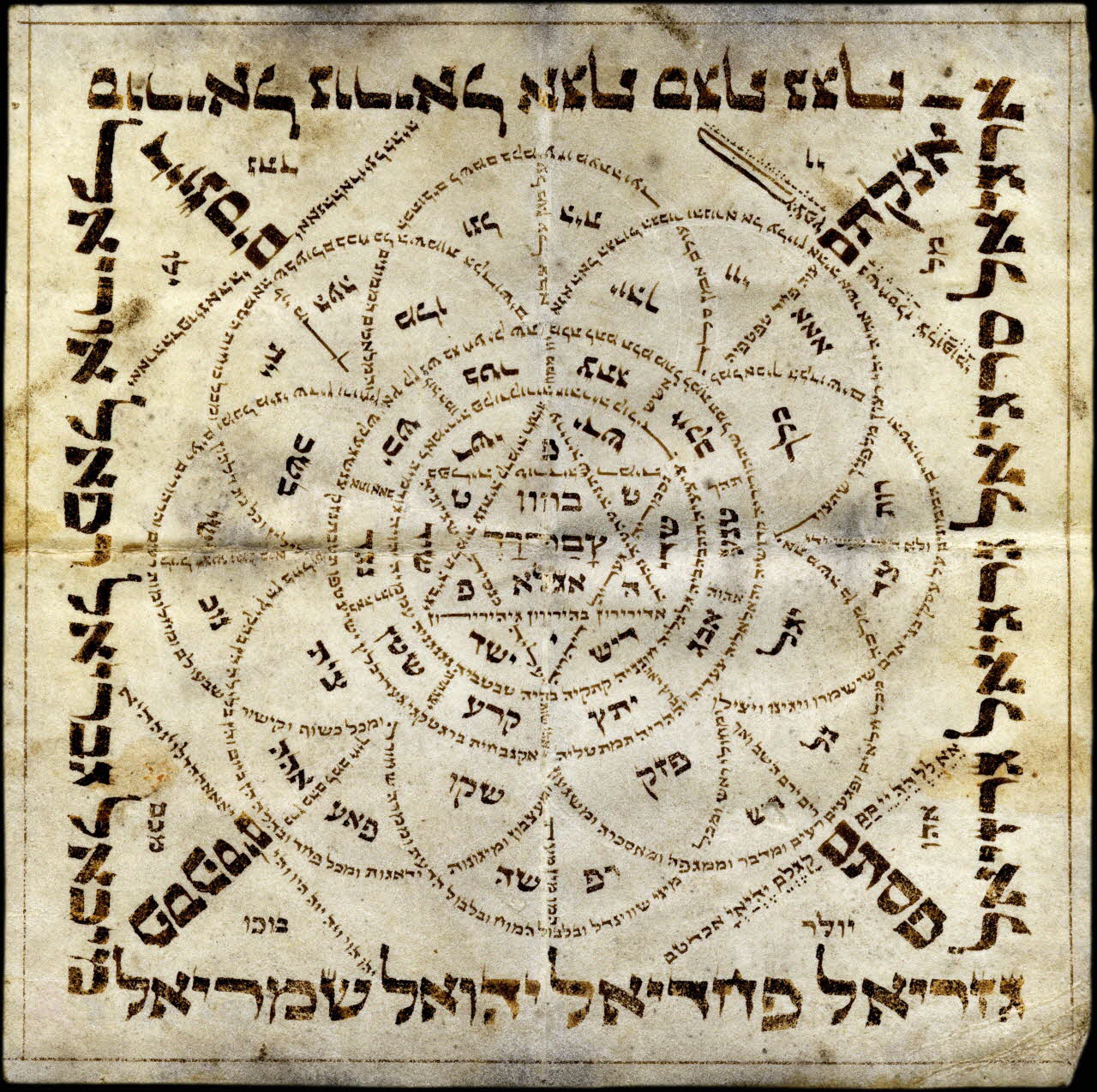 Discover
Watch out for wizards!
Magic and witchcraft: some of us consider them laughable superstitions, others believe in them, and many are undecided. But believing in them has a bad reputation among rational minds: such beliefs were fine for our ancestors—especially in rural areas—or are still acceptable in developing countries—but certainly not here, not today, and definitely not in the city. Yet observing the behavior of our contemporaries shows that scientific progress has not brought an end to mysteries and beliefs, neither in post-industrial France nor elsewhere. Often powerless in the face of misfortune, suffering, and anxiety, people are not satisfied with the answers provided by science. Science leaves a seemingly irreducible space for other principles and other ways of understanding the world.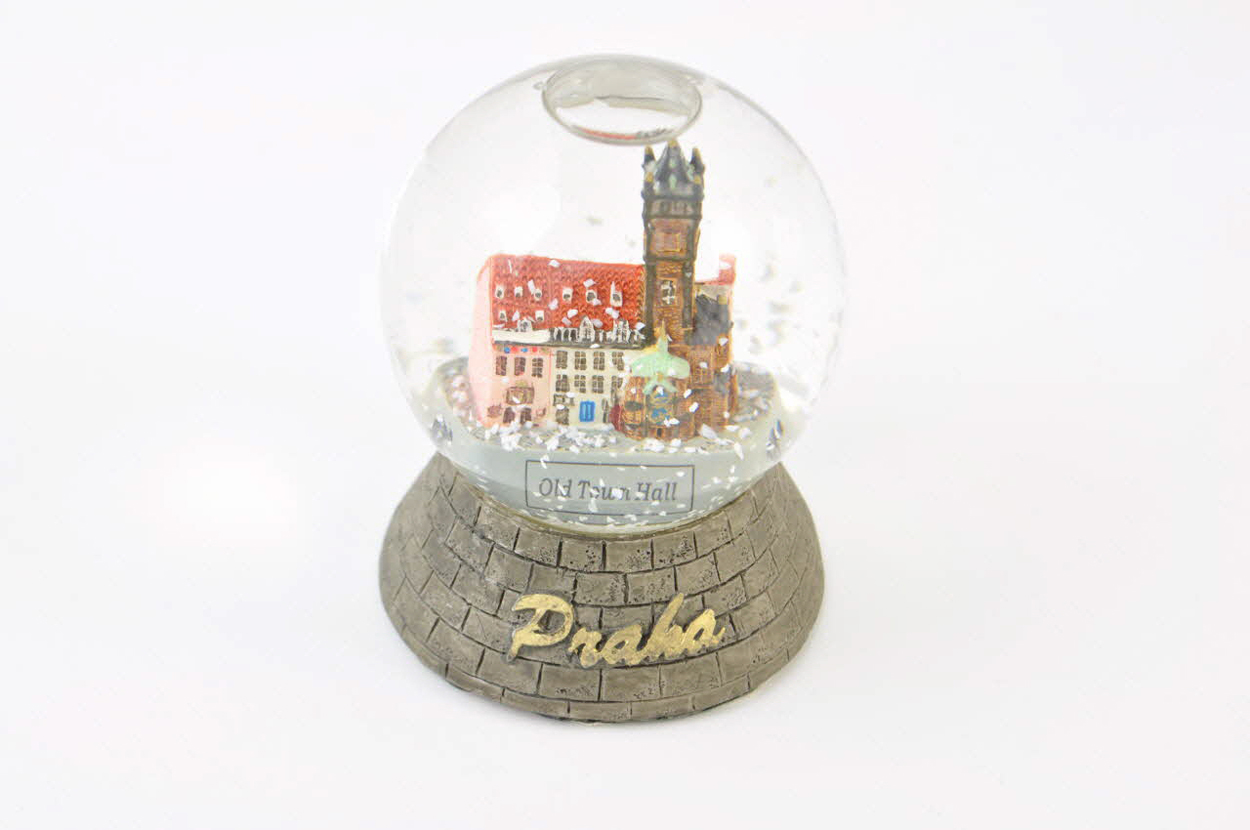 Discover
A Whimsical Alphabet Book!
What are these objects doing at the Mucem?
As its name suggests, the Mucem is a museum of civilizations. In other words, it focuses on everything produced and used by European and Mediterranean societies, from the dawn of humanity to the present day. In the museum’s view, a funerary sculpture from Ancient Egypt speaks just as much about the ritual practices surrounding death during the reign of the pharaohs as a wreath of glass-bead flowers reflects the attachment to the deceased in France during the first half of the 20th century.
Every object, no matter how humble or kitschy, thus bears witness to the society from which it originated. That is why, since its founding, the museum has made it its mission to seek out and preserve a wide variety of possible and imaginable artifacts in order to preserve their memory. In particular, it has worked systematically by organizing annual collection surveys. For a given theme, within a defined geographic area, Mucem researchers gather testimonies, images, and objects. This is how the artifacts below found their way into the national collections.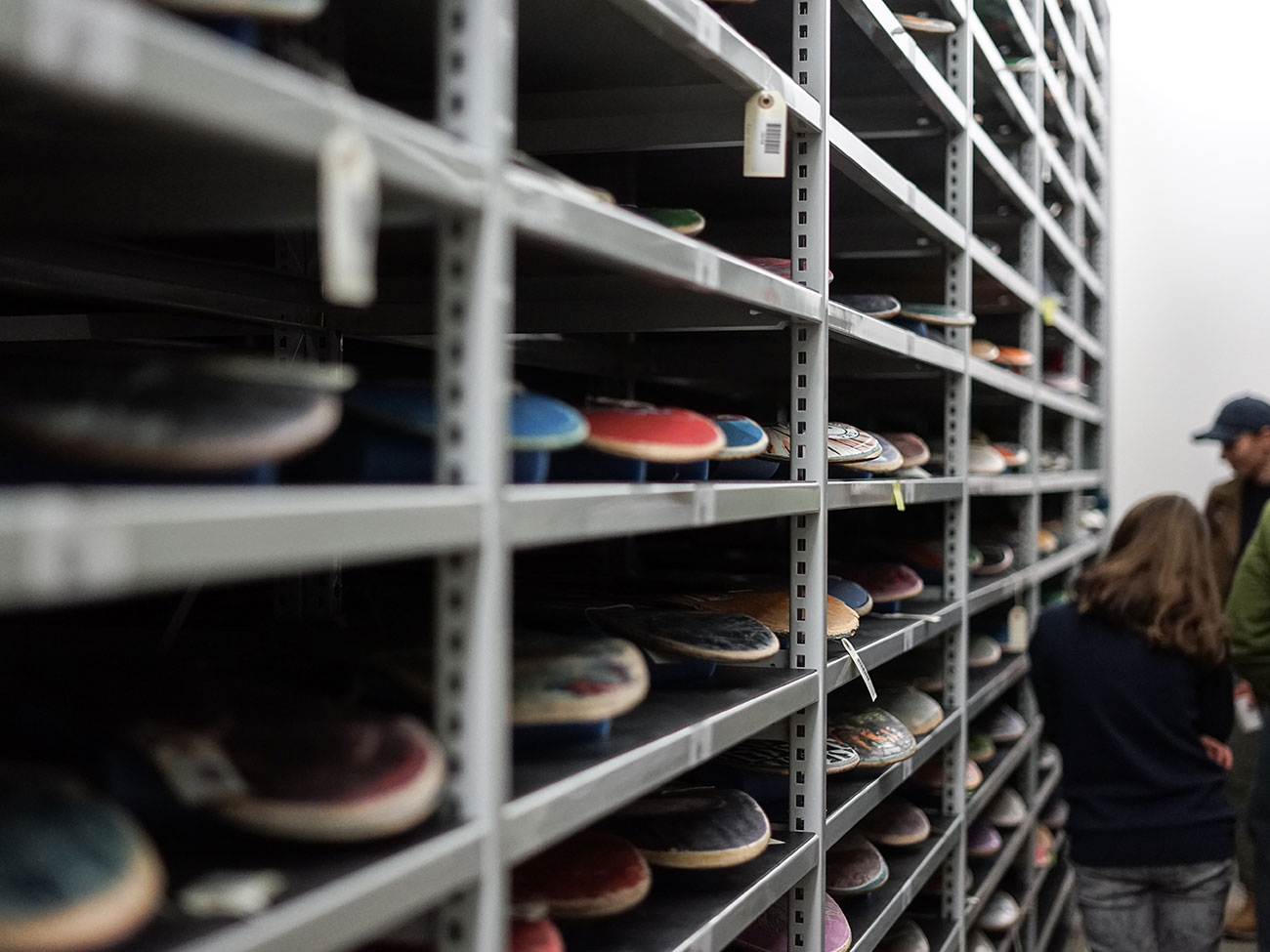 Discover
From California's Beaches to the Mucem: Skateboarding Culture at the Museum
José de Matos, Tony Hawk, Mark Gonzales… these names, which resonate with anyone who has ever skated, belong to legendary skateboarders whose legacies are represented in various forms in the Mucem’s collections. Some of them have donated skateboards, equipment, or memorabilia to the museum, while others are represented through skateboards bearing their names.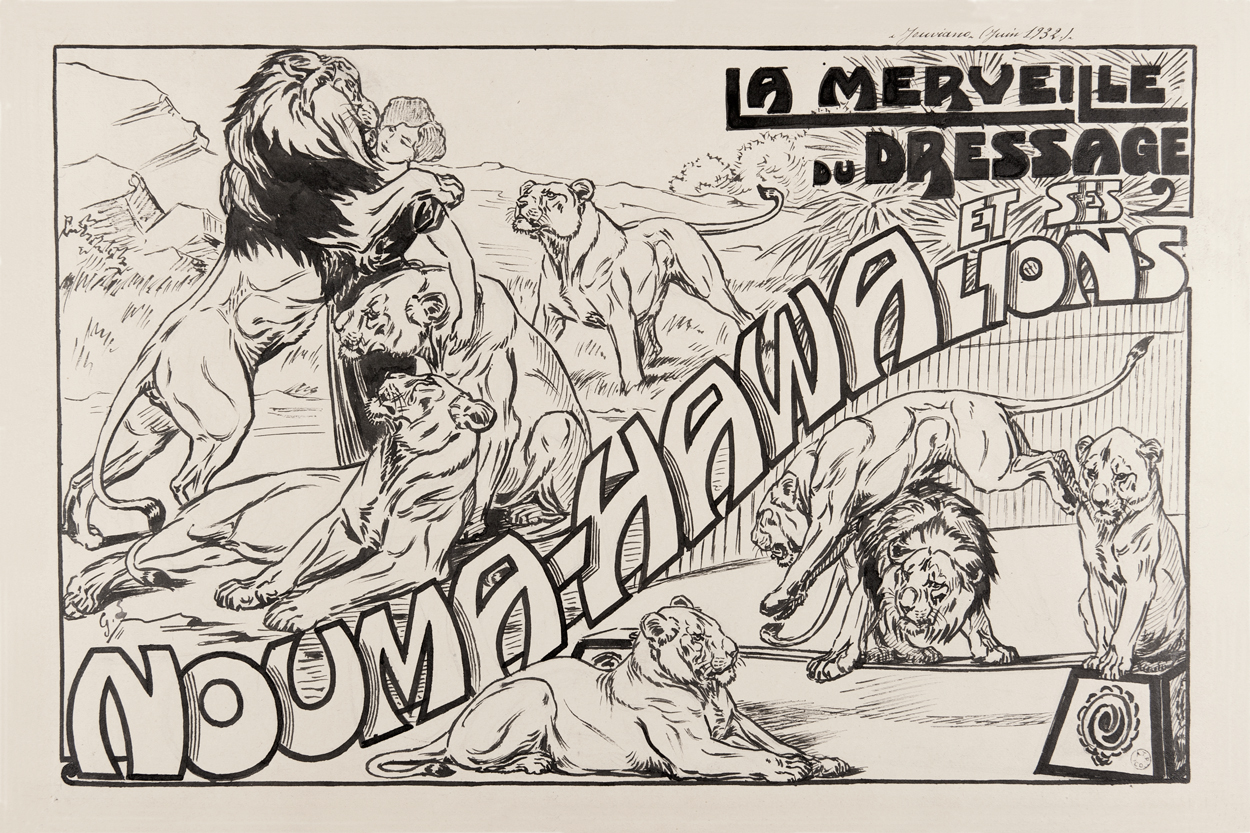 Discover
Draw Me a Lion
Gustave Soury's Animal Art
Gustave Soury (1844–1966) was an illustrator, painter, poster artist, and advertising artist who specialized in animal art for circuses and fairground menageries.
His vast and meticulous body of work, dominated by the figure of the big cats, reflects not only his passion but also our urban society’s fascination with exotic animals, their frightening wildness, and their endearing tenderness.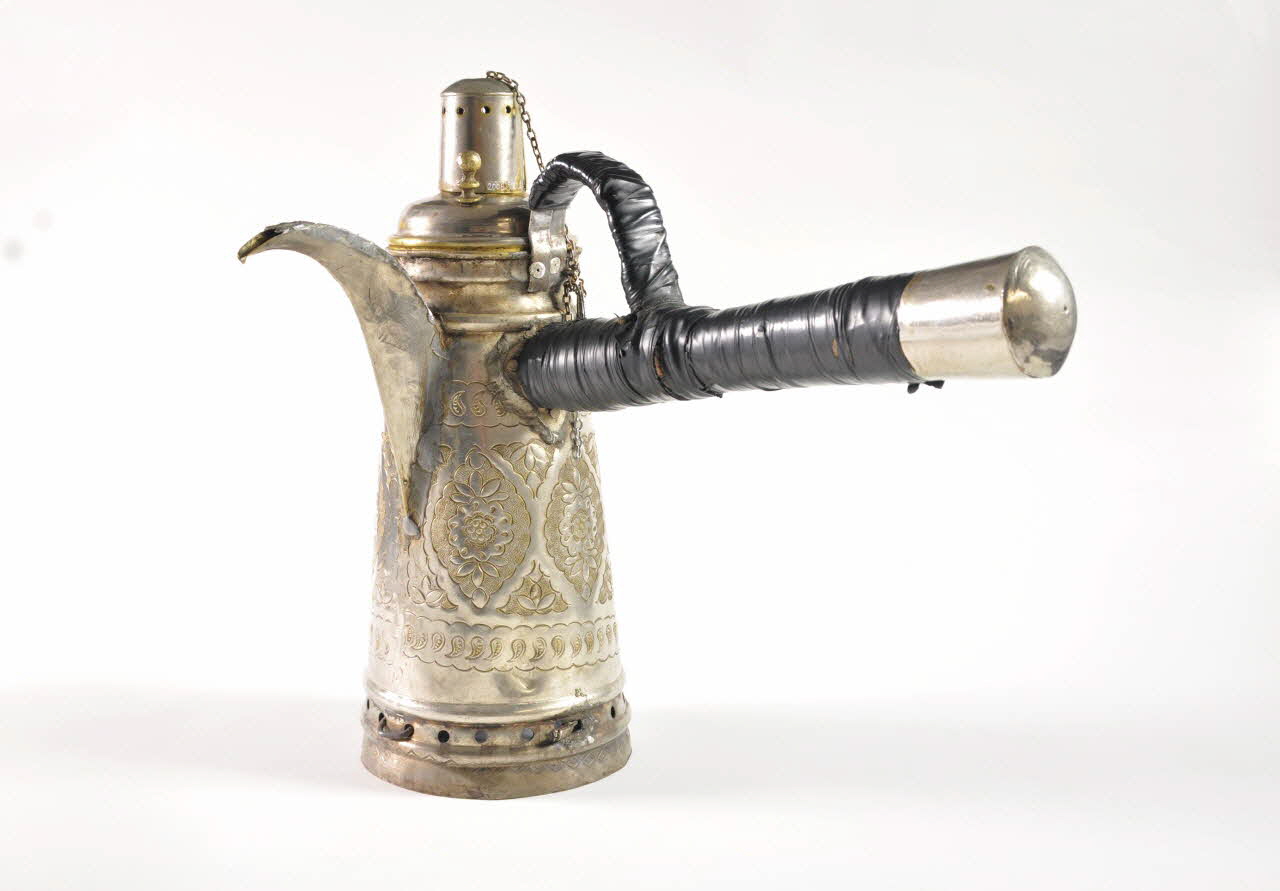 Discover
Coffee
Coffee (qahwa in Arabic, a term also used to refer to wine) reached us via the Arab and Ottoman worlds. From the highlands of Abyssinia, where coffee cultivation is documented as early as the 12th century, coffee crossed the Red Sea to be first cultivated along the coast of “Happy Arabia” (present-day Yemen) and then in the tropical climates of the territories of the great colonial empires beginning in the 17th century. Called the “devil’s drink” because of the black color of its grounds—in which people believed they could read the future—coffee was at times discredited by doctors for its harmful effects on health (it was considered an unnatural and addictive beverage).
Today, coffee is the second most widely consumed beverage in the world after water, but it still competes with tea.
The Mucem’s extensive collections related to coffee illustrate the various ways this beverage has been prepared and consumed since the 18th century, both at home and in public spaces. They also highlight how cafés have become places of social interaction.