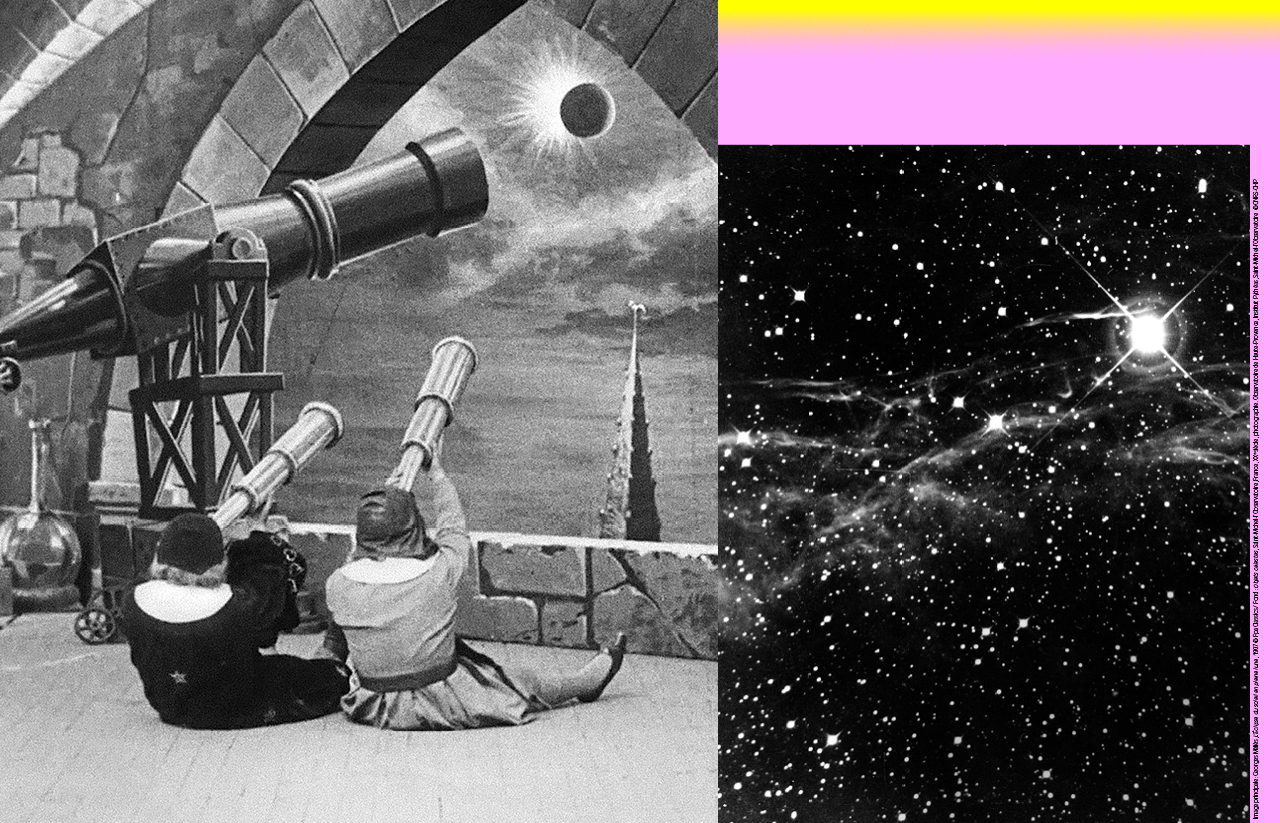
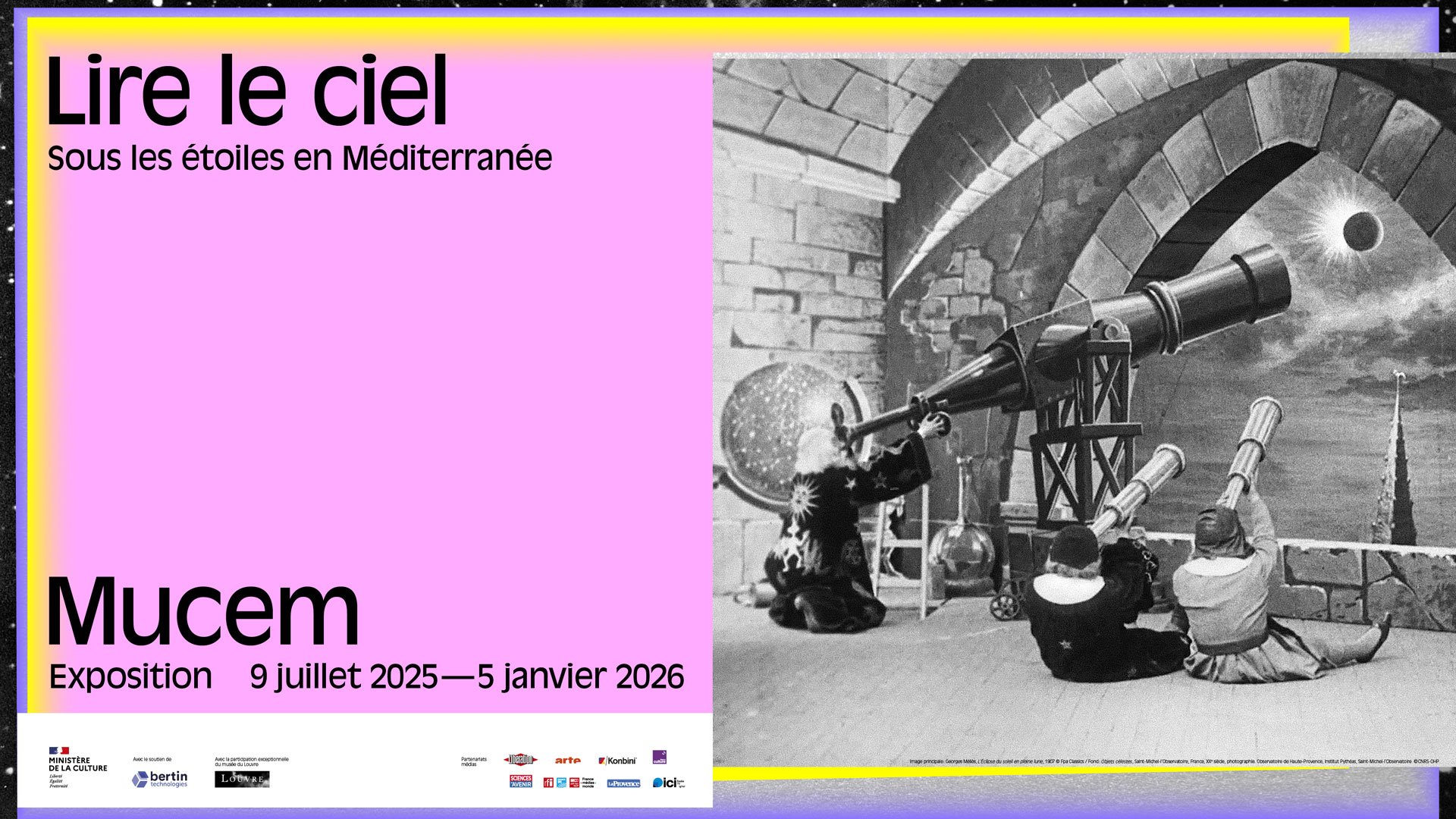
Trailer for the exhibition “Reading the Sky—Under the Stars in the Mediterranean”
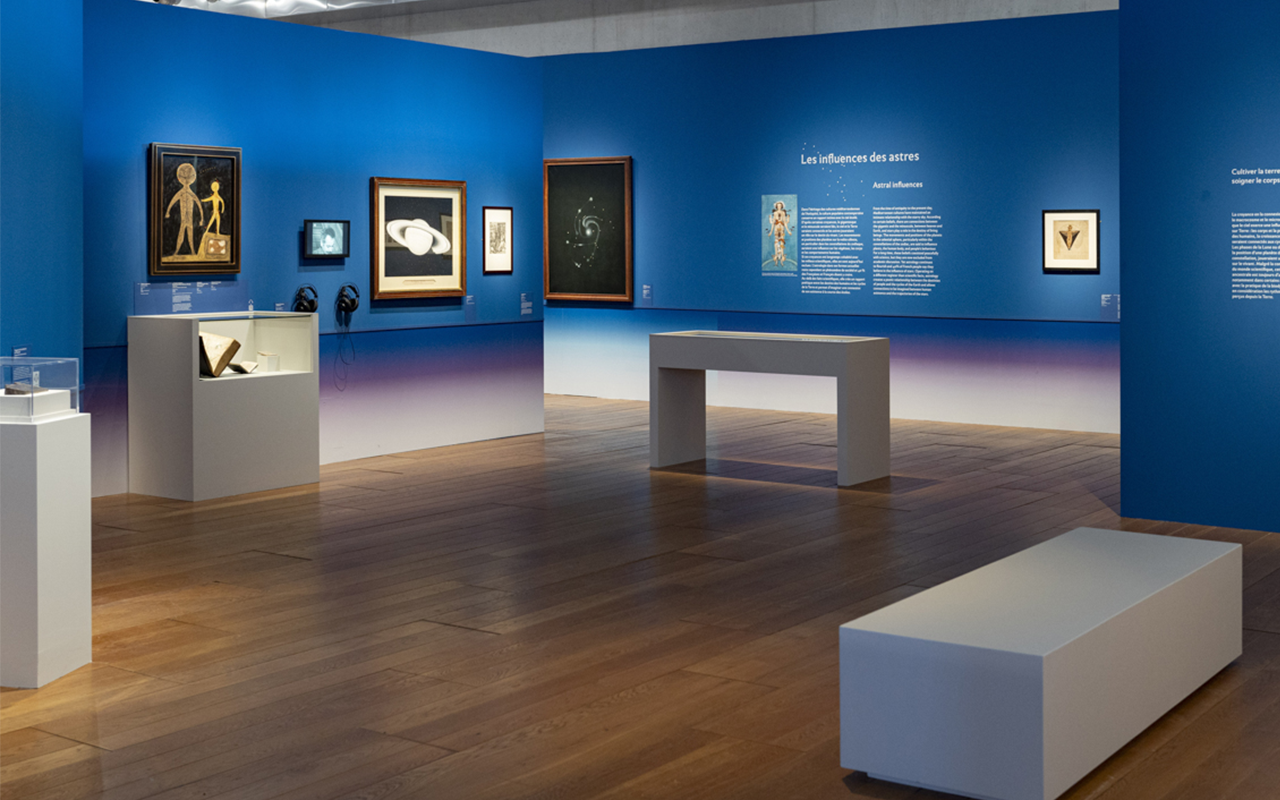
From the Moon to the Shepherd Star, from the Big Dipper constellation to Saturn's rings, the celestial vault and the stars that inhabit it are the object of immense fascination.
The “Reading the Sky” exhibition focuses on the understanding of the night sky in the Mediterranean, as seen from Earth. From the first surveys of the ancient Mesopotamian sky to the vogue for contemporary astrology, via medieval Arab-Muslim astronomy and the Galilean revolution, the societies of the Mediterranean basin have referred to the stars to situate themselves in the cosmos and organize their lives on Earth. Knowledge and beliefs circulated between the two shores, creating a common culture of the sky that still nourishes our contemporary approach to the stars.
Interview with exhibition curators Juliette Bessette and Enguerrand Lascols
This exhibition tells the story of astronomy and astrology in the Mediterranean. Why did Mediterranean societies seek to read the sky so early on?
Enguerrand Lascols: There are many “sky cultures” in the history of mankind, but for this exhibition we’ve concentrated on the societies of the Mediterranean basin. The earliest known texts describing the starry sky date from Mesopotamia in the 3rd millennium BC, naming the stars and creating the first constellations. The ancient Greek world then took up and enriched this knowledge. In the Middle Ages, scholars from the Arab-Muslim world translated these ancient texts and developed new knowledge to better understand the cosmos, the stars that inhabit it, and their movements and cycles.
Juliette Bessette: Observing these regular cycles had a practical function. It enabled us to organize our daily lives, for example by watching for the appearance of a star on the horizon to mark the start of summer, favourable for certain types of agricultural crops. The stars were also invaluable guides on the high seas, with no other landmarks. But the sky was also a vast terrain for poetry, spirituality and the imagination!
Our knowledge of the sky and stars seems to be the fruit of a continuous dialogue, since Antiquity, between scientific knowledge and popular culture…
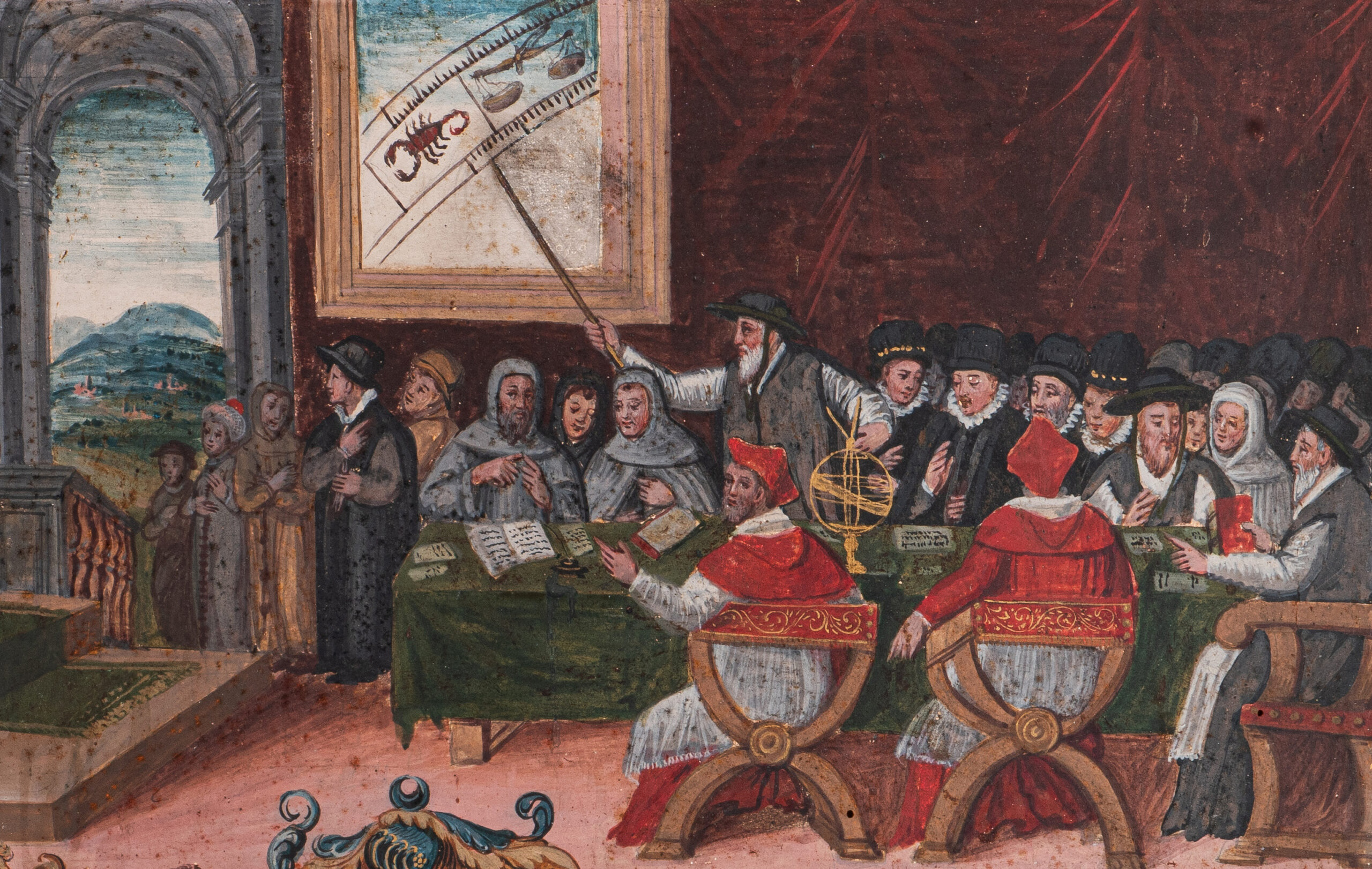
J.B. What really interested us was this interweaving. Until the Galilean revolution in the 17th century, astrology and astronomy worked together. The study of the stars and their movements served to forge scientific knowledge, but this knowledge was also used to establish influences on human affairs, sometimes omens concerning an entire society. Nostradamus, active near Marseille, in Salon-de-Provence, relied on the astronomical knowledge of his time to make calculations and formulate his prophecies.
E.L. More generally, popular imagination and wisdom are partly based on this knowledge, but they also create their own specific approaches to the sky. In fact, this dialogue enables us to highlight some very important parts of the Mucem collection, inherited from the Musée National des Arts et Traditions Populaires. The objects and stories on display bear witness to the fascination with the starry sky that can be seen in the decor of the objects, the tales that were passed down orally, and so on.
The exhibition features exceptional treasures spanning 3,000 years of history: what do you consider to be the highlights of this journey?
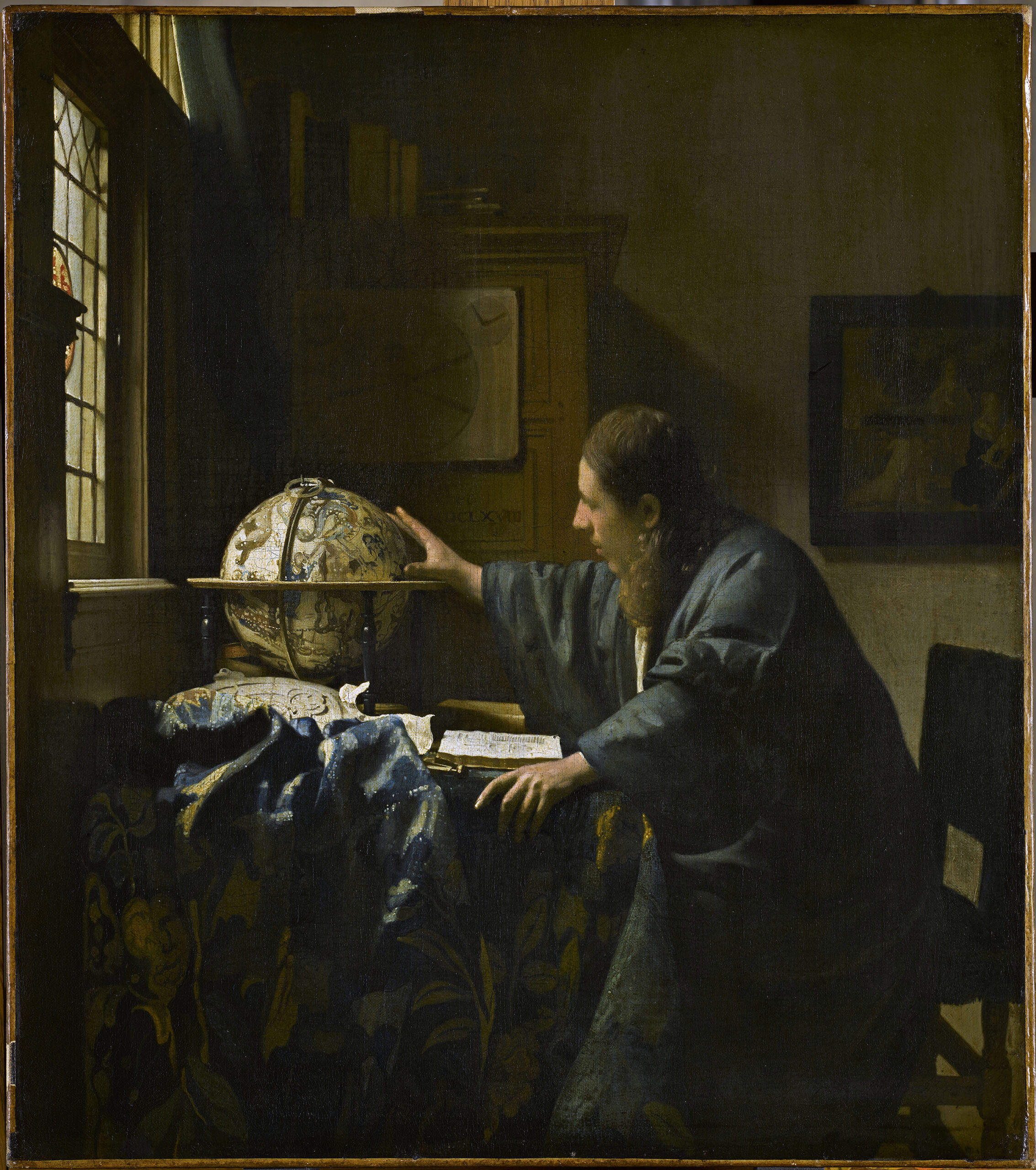
E.L. We are delighted to welcome some very fine loans from national and regional museums, as well as from Greece and Italy. Masterpieces from all eras are being brought together, which is a major event, as many of these works have never before been shown in Marseille. In this respect, the Louvre is an exceptional partner, lending us some forty major works, including Vermeer’s The Astronomer, a marvel of art history. The Bibliothèque nationale de France is lending us masterpieces of Arab-Muslim book art. The Musée d’Orsay has also been very generous, as have regional collections: Boulogne-sur-Mer with an extremely rare medieval manuscript, Chambéry with L’Astronome by Giordano… We are also presenting a fresco from Pompeii, and a silver celestial globe bearing one of the oldest known representations of the constellations. For the Mucem collections, the major event is the presentation of the cabinet of a very famous Parisian clairvoyant in the 1960s-1970s, the magician Belline, which will be completely reassembled, as if we were there!
From the current vogue for astrology to environmental issues, the exhibition also speaks of our world today…
J.B. We asked ourselves the question: what distinguishes an exhibition on the stars in 2025 from one created 25 years earlier? So we chose to keep an earthly point of view at all times, to draw attention to our own condition, our own environment, and to differentiate ourselves, for example, from the theme of the space race. Today, astrology is an important phenomenon, with around 40% of French people claiming to believe in it. It’s one of many ways of connecting with the stars as we perceive them from Earth, even if it no longer corresponds to current scientific knowledge. Other forms of connection with the night sky are also under threat, as artificial lighting makes it difficult to observe them in cities. We’re among the first generations to lose our connection with the night sky. And even among astrophysicists and astronomy enthusiasts, the movement of the gaze from the sky to the Earth is a common occurrence. Singularly, attention to the stars refocuses us on the preciousness of our environment.
How does contemporary art fit in with the course?
E.L.The exhibition is chronological, but we have chosen to include works by contemporary artists in all sections. This creates very interesting dialogues between the different periods, testifying to the transmission of a common heritage in the Mediterranean, a history of our link to the sky that is already several millennia old, but still very much alive!
J.B. The 16 artists on show have worked in various countries around the Mediterranean, in France, for example, but also in Morocco and Syria. Some are very famous, like Etel Adnan, while others are younger. Their works punctuate the itinerary, offering a variety of current viewpoints on the major themes of the exhibition. Abdelkader Benchamma, for example, revisits the beliefs associated with comets, while Caroline Corbasson works closely with contemporary astrophysics. We are also delighted to welcome a production specially conceived for the exhibition by Sara Ouhaddou, who has been exploring the cohabitation of different perspectives on the stars for several years, and whose research fits perfectly with the aim of “Reading the sky”!
Through this dialogue between the arts and sciences, the exhibition aims to question our current relationship with the starry sky. Since ancient times, observing the regularity of the stars has been used to organize daily life, for example, to find one’s way around or to draw up a calendar. Celestial phenomena are also interpreted as signs that have an influence on daily life: phases of the Moon, comet transits, movements of the planets in front of the constellations, and so on. This link between the macrocosm and the microcosm has played a role in the management of states and governments, and in the study of individual behavior, as astronomy and astrology have long worked hand in hand.
While modern astronomy has helped to challenge many of these beliefs, popular culture continues to weave an intimate bond with the stars, seeing the sky as a medium for projecting its deepest questions. Today, as the stars fade away under the light pollution of our cities, we continue to search for the constellations with our eyes, to contemplate the beauty of the starry sky and to think about our relationship with the environment.
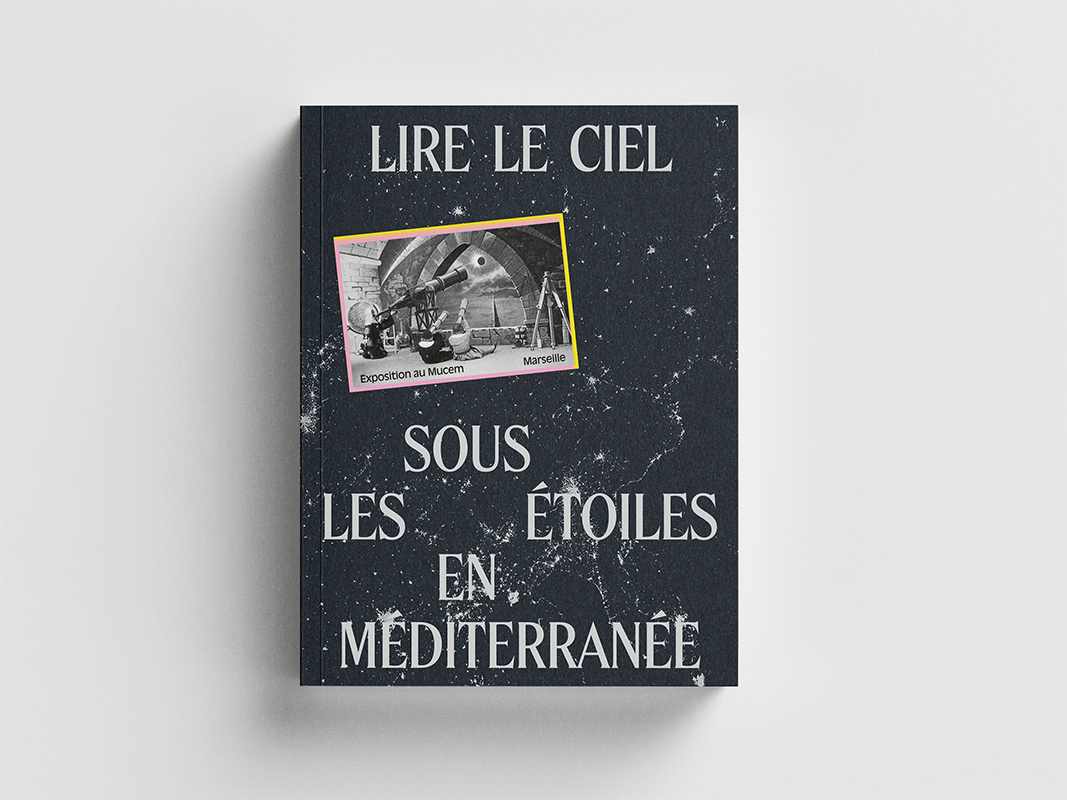
“Reading the Sky” presents exceptional works of art and everyday objects that bear witness to this history, set against contemporary works of art that respond to them. In a transdisciplinary approach dear to the Mucem, the exhibition combines archaeological, scientific and ethnographic objects with works of art, manuscripts and oral heritage. It features more than one hundred works from the Mucem’s collections, and benefits from over two hundred loans from national, regional and international collections.
Around the exhibition
Lending institutions
National and regional museums, private collections :
musée du Louvre, musée d’Orsay, Bibliothèque nationale de France, Bibliothèque nationale de Strasbourg, musée national de la Renaissance, musée national de la Marine, Cabinet des Médailles de Marseille, musée Jacquemart-André, musée d’art et d’histoire du Judaïsme, Institut du monde arabe, bibliothèque des Annonciades de Boulogne, musée des Beaux-Arts de Reims, musées de Marseille, musée du Petit-Palais d’Avignon, bibliothèque Inguimbertine de Carpentras, musée des Beaux-Arts de Chambéry, musée des Augustins de Toulouse, musée des Beaux-Arts de Caen, observatoire de Paris, observatoire de la Côte d’Azur, observatoire de Haute-Provence, laboratoire d’astrophysique de Marseille, collection Kugel, collection Michel Frandino, Cinémathèque française, Muséum d’histoire naturelle, Musée des Arts Précieux
International museums :
Galileo Museum, Florence; National Archaeological Museum, Naples; State Archives, Siena; Benaki Museum, Athens
Contemporary art :
Etel Adnan, Juliette Agnel, Abdelkader Benchamma, Clément Cogitore, Thierry Cohen, Caroline Corbasson, Vanessa del Campo, Mohssin Harraki, Bernard Moninot, Matthieu Pernot, Camille Pradon, AnaÏs Tondeur, Armelle Tulunda, Fabienne Verdier, with special productions by Sara Ouhaddou and Jean Mallard.
Police station
Juliette Bessette, art historian, University of Lausanne
Enguerrand Lascols, Heritage Curator, Mucem
Scenography
Agence Nathalie Crinière: Manon Grange and Héloïse Lévêque
Scientific Committee
Frédérique Aït-Touati, historian of science and ideas (CNRS, CRAL) Isabel Bonora Andujar, curator, Department of Greek, Etruscan and Roman Antiquities (Musée du Louvre)
Khalid Chakor-Alami, in charge of Arabic and Persian manuscripts (Bibliothèque nationale de France)
Emmanuel Hugot, astrophysicist (Aix-Marseille University, CNRS, CNES, Laboratoire d’astrophysique de Marseille)
With the exceptional participation of the Louvre
From the Moon to the Shepherd Star, from the Big Dipper constellation to Saturn's rings, the celestial vault and the stars that inhabit it are the object of immense fascination.
The “Reading the Sky” exhibition focuses on the understanding of the night sky in the Mediterranean, as seen from Earth. From the first surveys of the ancient Mesopotamian sky to the vogue for contemporary astrology, via medieval Arab-Muslim astronomy and the Galilean revolution, the societies of the Mediterranean basin have referred to the stars to situate themselves in the cosmos and organize their lives on Earth. Knowledge and beliefs circulated between the two shores, creating a common culture of the sky that still nourishes our contemporary approach to the stars.
Trailer for the exhibition “Reading the Sky—Under the Stars in the Mediterranean”
Interview with exhibition curators Juliette Bessette and Enguerrand Lascols
This exhibition tells the story of astronomy and astrology in the Mediterranean. Why did Mediterranean societies seek to read the sky so early on?
Enguerrand Lascols: There are many “sky cultures” in the history of mankind, but for this exhibition we’ve concentrated on the societies of the Mediterranean basin. The earliest known texts describing the starry sky date from Mesopotamia in the 3rd millennium BC, naming the stars and creating the first constellations. The ancient Greek world then took up and enriched this knowledge. In the Middle Ages, scholars from the Arab-Muslim world translated these ancient texts and developed new knowledge to better understand the cosmos, the stars that inhabit it, and their movements and cycles.
Juliette Bessette: Observing these regular cycles had a practical function. It enabled us to organize our daily lives, for example by watching for the appearance of a star on the horizon to mark the start of summer, favourable for certain types of agricultural crops. The stars were also invaluable guides on the high seas, with no other landmarks. But the sky was also a vast terrain for poetry, spirituality and the imagination!
Our knowledge of the sky and stars seems to be the fruit of a continuous dialogue, since Antiquity, between scientific knowledge and popular culture…
J.B. What really interested us was this interweaving. Until the Galilean revolution in the 17th century, astrology and astronomy worked together. The study of the stars and their movements served to forge scientific knowledge, but this knowledge was also used to establish influences on human affairs, sometimes omens concerning an entire society. Nostradamus, active near Marseille, in Salon-de-Provence, relied on the astronomical knowledge of his time to make calculations and formulate his prophecies.
E.L. More generally, popular imagination and wisdom are partly based on this knowledge, but they also create their own specific approaches to the sky. In fact, this dialogue enables us to highlight some very important parts of the Mucem collection, inherited from the Musée National des Arts et Traditions Populaires. The objects and stories on display bear witness to the fascination with the starry sky that can be seen in the decor of the objects, the tales that were passed down orally, and so on.
The exhibition features exceptional treasures spanning 3,000 years of history: what do you consider to be the highlights of this journey?
E.L. We are delighted to welcome some very fine loans from national and regional museums, as well as from Greece and Italy. Masterpieces from all eras are being brought together, which is a major event, as many of these works have never before been shown in Marseille. In this respect, the Louvre is an exceptional partner, lending us some forty major works, including Vermeer’s The Astronomer, a marvel of art history. The Bibliothèque nationale de France is lending us masterpieces of Arab-Muslim book art. The Musée d’Orsay has also been very generous, as have regional collections: Boulogne-sur-Mer with an extremely rare medieval manuscript, Chambéry with L’Astronome by Giordano… We are also presenting a fresco from Pompeii, and a silver celestial globe bearing one of the oldest known representations of the constellations. For the Mucem collections, the major event is the presentation of the cabinet of a very famous Parisian clairvoyant in the 1960s-1970s, the magician Belline, which will be completely reassembled, as if we were there!
From the current vogue for astrology to environmental issues, the exhibition also speaks of our world today…
J.B. We asked ourselves the question: what distinguishes an exhibition on the stars in 2025 from one created 25 years earlier? So we chose to keep an earthly point of view at all times, to draw attention to our own condition, our own environment, and to differentiate ourselves, for example, from the theme of the space race. Today, astrology is an important phenomenon, with around 40% of French people claiming to believe in it. It’s one of many ways of connecting with the stars as we perceive them from Earth, even if it no longer corresponds to current scientific knowledge. Other forms of connection with the night sky are also under threat, as artificial lighting makes it difficult to observe them in cities. We’re among the first generations to lose our connection with the night sky. And even among astrophysicists and astronomy enthusiasts, the movement of the gaze from the sky to the Earth is a common occurrence. Singularly, attention to the stars refocuses us on the preciousness of our environment.
How does contemporary art fit in with the course?
E.L.The exhibition is chronological, but we have chosen to include works by contemporary artists in all sections. This creates very interesting dialogues between the different periods, testifying to the transmission of a common heritage in the Mediterranean, a history of our link to the sky that is already several millennia old, but still very much alive!
J.B. The 16 artists on show have worked in various countries around the Mediterranean, in France, for example, but also in Morocco and Syria. Some are very famous, like Etel Adnan, while others are younger. Their works punctuate the itinerary, offering a variety of current viewpoints on the major themes of the exhibition. Abdelkader Benchamma, for example, revisits the beliefs associated with comets, while Caroline Corbasson works closely with contemporary astrophysics. We are also delighted to welcome a production specially conceived for the exhibition by Sara Ouhaddou, who has been exploring the cohabitation of different perspectives on the stars for several years, and whose research fits perfectly with the aim of “Reading the sky”!
Through this dialogue between the arts and sciences, the exhibition aims to question our current relationship with the starry sky. Since ancient times, observing the regularity of the stars has been used to organize daily life, for example, to find one’s way around or to draw up a calendar. Celestial phenomena are also interpreted as signs that have an influence on daily life: phases of the Moon, comet transits, movements of the planets in front of the constellations, and so on. This link between the macrocosm and the microcosm has played a role in the management of states and governments, and in the study of individual behavior, as astronomy and astrology have long worked hand in hand.
While modern astronomy has helped to challenge many of these beliefs, popular culture continues to weave an intimate bond with the stars, seeing the sky as a medium for projecting its deepest questions. Today, as the stars fade away under the light pollution of our cities, we continue to search for the constellations with our eyes, to contemplate the beauty of the starry sky and to think about our relationship with the environment.
“Reading the Sky” presents exceptional works of art and everyday objects that bear witness to this history, set against contemporary works of art that respond to them. In a transdisciplinary approach dear to the Mucem, the exhibition combines archaeological, scientific and ethnographic objects with works of art, manuscripts and oral heritage. It features more than one hundred works from the Mucem’s collections, and benefits from over two hundred loans from national, regional and international collections.
Around the exhibition
Lending institutions
National and regional museums, private collections :
musée du Louvre, musée d’Orsay, Bibliothèque nationale de France, Bibliothèque nationale de Strasbourg, musée national de la Renaissance, musée national de la Marine, Cabinet des Médailles de Marseille, musée Jacquemart-André, musée d’art et d’histoire du Judaïsme, Institut du monde arabe, bibliothèque des Annonciades de Boulogne, musée des Beaux-Arts de Reims, musées de Marseille, musée du Petit-Palais d’Avignon, bibliothèque Inguimbertine de Carpentras, musée des Beaux-Arts de Chambéry, musée des Augustins de Toulouse, musée des Beaux-Arts de Caen, observatoire de Paris, observatoire de la Côte d’Azur, observatoire de Haute-Provence, laboratoire d’astrophysique de Marseille, collection Kugel, collection Michel Frandino, Cinémathèque française, Muséum d’histoire naturelle, Musée des Arts Précieux
International museums :
Galileo Museum, Florence; National Archaeological Museum, Naples; State Archives, Siena; Benaki Museum, Athens
Contemporary art :
Etel Adnan, Juliette Agnel, Abdelkader Benchamma, Clément Cogitore, Thierry Cohen, Caroline Corbasson, Vanessa del Campo, Mohssin Harraki, Bernard Moninot, Matthieu Pernot, Camille Pradon, AnaÏs Tondeur, Armelle Tulunda, Fabienne Verdier, with special productions by Sara Ouhaddou and Jean Mallard.
Police station
Juliette Bessette, art historian, University of Lausanne
Enguerrand Lascols, Heritage Curator, Mucem
Scenography
Agence Nathalie Crinière: Manon Grange and Héloïse Lévêque
Scientific Committee
Frédérique Aït-Touati, historian of science and ideas (CNRS, CRAL) Isabel Bonora Andujar, curator, Department of Greek, Etruscan and Roman Antiquities (Musée du Louvre)
Khalid Chakor-Alami, in charge of Arabic and Persian manuscripts (Bibliothèque nationale de France)
Emmanuel Hugot, astrophysicist (Aix-Marseille University, CNRS, CNES, Laboratoire d’astrophysique de Marseille)
With the exceptional participation of the Louvre
Related activities or events
View full agenda- Free
Flash Tours
Our mediators welcome you for free flash visits, on presentation of your exhibition ticket, to discover Mucem's exhibitions in a different way.
Please meet in the exhibition hall at the scheduled tour time for a guided tour led by the education team: Flash tours are held every Saturday and Sunday, as well as every day (except Tuesday) during Zone B school breaks and on certain holidays, on the dates listed.
European Heritage Days on September 19 and 20, 2026 During European Heritage Days, come discover the Mucem’s exhibitions and architecture through special tours. Meet directly in front of the exhibitions, which are exceptionally free to visit. — Méditerranées: 2:00 p.m. and 2:30 p.m. — The Architecture of the Mucem: 2:00 p.m. and 2:30 p.m. — Mossi Traoré, Fashion Too: 3:00 p.m. and 3:30 p.m. — Popular? : 3:00 p.m. and 3:30 p.m.
Through October 11 — Méditerranées: 2:00 p.m. and 2:30 p.m. — Mossi Traoré, fashion too: 3:00 p.m. and 3:30 p.m.Le Saturday, Oct 10, 2026
Jusqu'au Sunday, Dec 27, 2026de 14h à 16h
J4
- Free
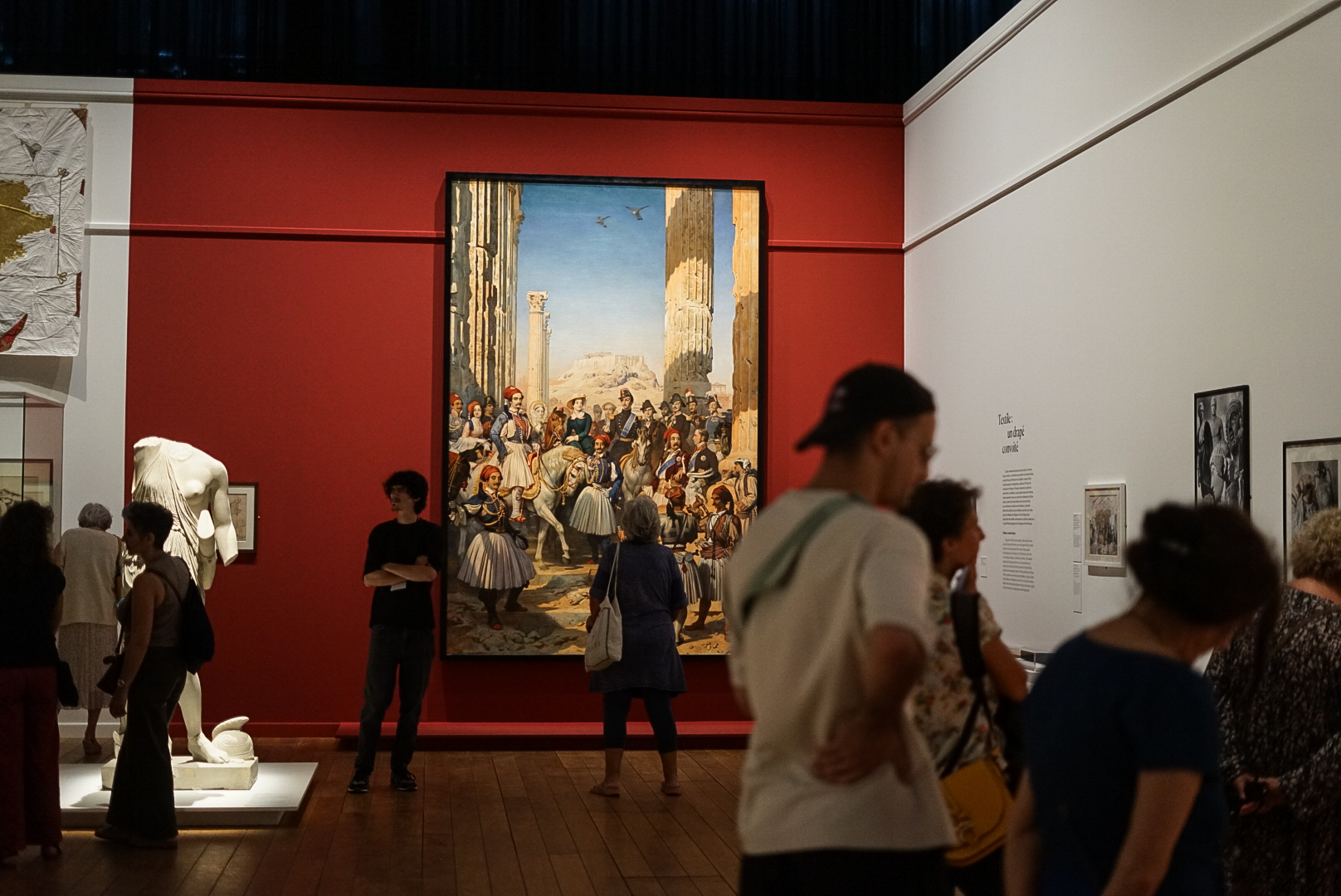
Sunday free admission
Every first Sunday of the month, the Mucem opens its exhibition doors free of charge!Le Sunday, Nov 1, 2026
Jusqu'au Sunday, Dec 5, 2027de 10h à 18h
J4 & Fort Saint-Jean / Georges Henri Rivière building
With the support of

Media partners





In partnership with
The “Lire le Ciel” exhibition can be seen at Aix en Provence TGV station from July 7 to August 29, 2025, Marseille Saint Charles from September 19 to November 5, 2025 and Paris Gare de Lyon from October 15 to December 10, 2025.
Read more
A subsidiary of SNCF Réseau, SNCF Gares & Connexions specializes in railway stations, from design to operation and marketing. With its 3,000 French stations, it is committed to constantly improving the quality of its operations, inventing new services and modernizing its assets on behalf of its 10 million daily passengers and visitors. Every year, nearly 300 exhibitions, interventions and artistic events are designed specifically for stations throughout France, in partnership with leading institutions.