New worlds in the cosmos" that could harbor life
Lecture by Didier Queloz, Nobel Prize in Physics 2019, and star gazing
On October 6 1995, Didier Queloz and Michel Mayor discovered the first exoplanet.
To mark the 30th anniversary of this extraordinary discovery – once thought to be unique to our solar system, we now know that planets are common objects, present around almost every star in the galaxy – astrophysicist and Nobel Prize winner Didier Queloz will review the latest advances in this field. He will also discuss the methods used to search for biological signatures; this field of research, at the crossroads of astronomy, chemistry and biology, opens up unprecedented perspectives on the possibility of life elsewhere in the universe – and, in so doing, on what it means to be alive here on Earth.
Introduction by Marc Ferrari, Director of the Observatoire de Haute-Provence, and the curators of the exhibition “Lire le ciel. Under the stars in the Mediterranean”, Juliette Bessette and Enguerrand Lascols.
This meeting will be followed by a stargazing session organized by the Andromède association in the Place d’Armes of Fort Saint-Jean (weather permitting).
In collaboration with the Observatoire de Haute-Provence.
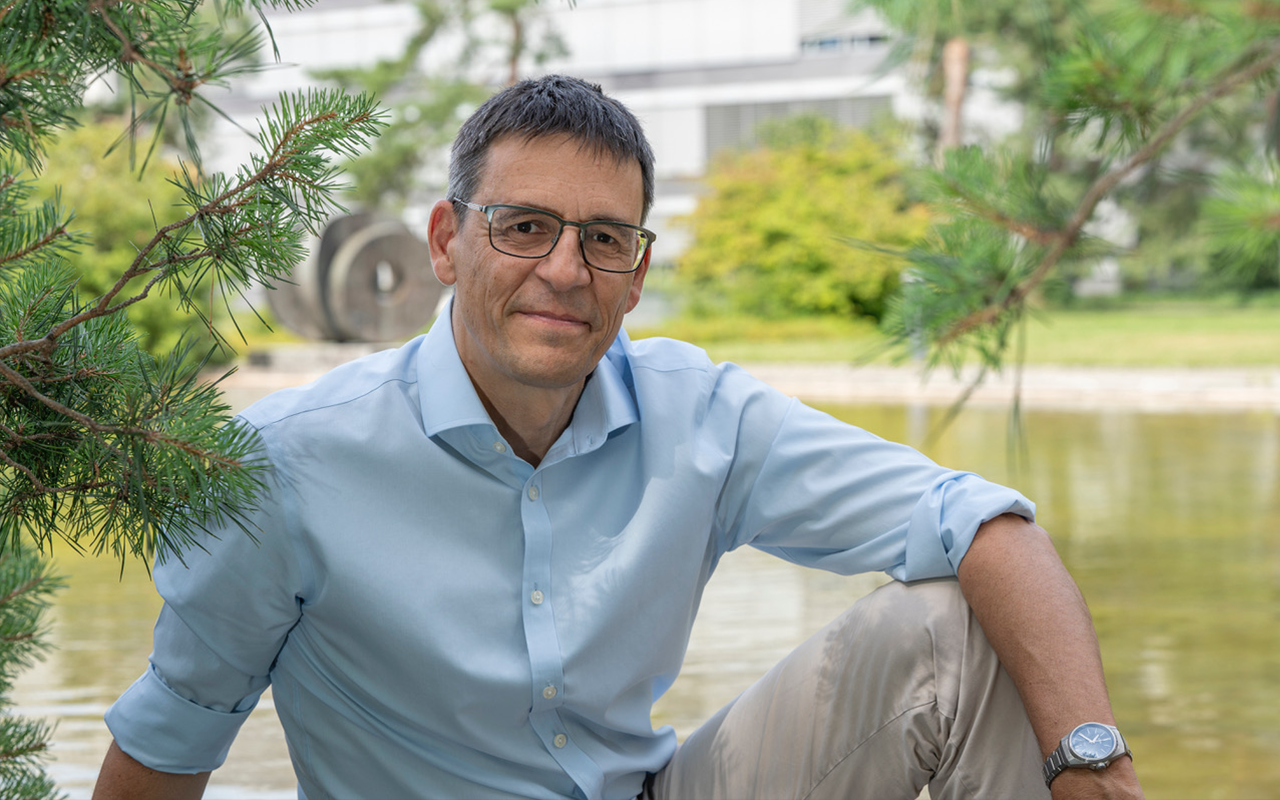
Didier Queloz
Winner of the Nobel Prize in Physics in 2019, Didier Queloz is behind the “exoplanet revolution” in astrophysics. He is a Fellow of the Royal Society, Jacksonian Professor of Natural Philosophy at Cambridge University and, since September 2021, Professor of Physics at ETH Zürich. He is also a Fellow of Trinity College, Cambridge.
On October 6 1995, Didier Queloz and Michel Mayor discovered the first exoplanet.
To mark the 30th anniversary of this extraordinary discovery – once thought to be unique to our solar system, we now know that planets are common objects, present around almost every star in the galaxy – astrophysicist and Nobel Prize winner Didier Queloz will review the latest advances in this field. He will also discuss the methods used to search for biological signatures; this field of research, at the crossroads of astronomy, chemistry and biology, opens up unprecedented perspectives on the possibility of life elsewhere in the universe – and, in so doing, on what it means to be alive here on Earth.
Introduction by Marc Ferrari, Director of the Observatoire de Haute-Provence, and the curators of the exhibition “Lire le ciel. Under the stars in the Mediterranean”, Juliette Bessette and Enguerrand Lascols.
This meeting will be followed by a stargazing session organized by the Andromède association in the Place d’Armes of Fort Saint-Jean (weather permitting).
In collaboration with the Observatoire de Haute-Provence.
Didier Queloz
Winner of the Nobel Prize in Physics in 2019, Didier Queloz is behind the “exoplanet revolution” in astrophysics. He is a Fellow of the Royal Society, Jacksonian Professor of Natural Philosophy at Cambridge University and, since September 2021, Professor of Physics at ETH Zürich. He is also a Fellow of Trinity College, Cambridge.