A Gender-Based Approach to Writing Practices in Prisons: Interdisciplinary Analyses Based on Two Corpora of Prison Graffiti
As part of the “Les Chantiers féministes” seminar organized by the Norbert Elias Center, this event offers a gender-based approach to writing practices in prisons:
The “Caravan Unit” at Saint-Anne Prison in Avignon: Graffiti by Women?
Bruno Bertherat, Associate Professor of Contemporary History, University of Avignon.
Led by a team of archivists, historians, linguists, and photographers, the project focusing on the graffiti at the Saint-Anne Prison in Avignon—which closed in 2003—aims to reconstruct the life of a prison world integrated into its urban environment shortly before its disappearance. The photographic collection of this graffiti, compiled in October 2018 and preserved at the Avignon Municipal Archives, serves as the starting point for a study that will be followed by a series of interviews with people who lived in and around the prison. The project has three objectives: to preserve the collected sources, to produce scholarly work, and to showcase these sources and the findings through a variety of media formats—particularly digital and audiovisual—accessible to a broad audience.
It was in this context that a second survey was conducted in one of the prison cells in November 2021, which we have dubbed the “trailer cell.” The gendered nature of its graffiti—which is particularly well-preserved but anonymous—is a stereotype that warrants further examination.
Les Baumettes at the Museum: Graffiti by Women in the Visiting Rooms
Jean-Fabien Philippy, Project Officer with the Scientific and Collections Department at Mucem
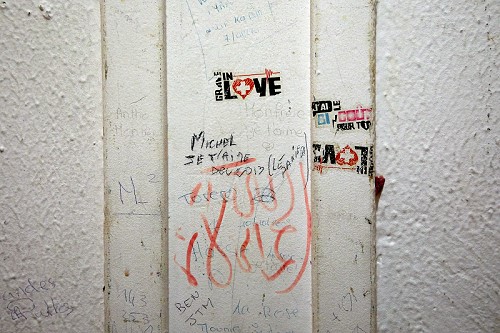
The study “Graffiti and Art in Prisons” (2029–2021), conducted at the Marseille correctional facility—and more specifically at the so-called “historic” Baumettes site—consists of two parts: first, the creation of a photographic archive in partnership with the PACA General Heritage Inventory service, focusing on the prison itself (its buildings, architecture, and graffiti); and second, a collection of items displayed in the cells—objects created or repurposed by the inmates and related to their daily lives.
Among all the images of the men’s detention center, one collection—that of the visiting room—stands out as unique. It is the only place within the prison where inmates can have contact with the outside world—particularly with their families—and where the writings found there are mixed, originating from both men and women.
In partnership with: Avignon University, AMU, the Norbert Elias Center, and the Avignon Municipal Archives
Participants
With Bruno Bertherat, project leader for “Prison Graffiti” (Norbert Elias Center/University of Avignon), Stéphanie Fonvielle (Norbert Elias Center/amU), Chantal Wionet (Norbert Elias Center/University of Avignon), Jean-Fabien Philippy (Mucem, Project Officer attached to the Scientific and Collections Department), and, subject to confirmation, Aure Lecres (Avignon Municipal Archives).
Session organized as part of the“Les Chantiers féministes” seminar hosted by the Norbert Elias Center.
Moderator: Stéphanie Fonvielle, Associate Professor (HDR) – Language Sciences, Norbert Elias Center – UMR 8562 (AMU-AU-CNRS), Aix-Marseille University: Inspé, and Chantal Wionet, Associate Professor, Avignon University, Language Sciences (Norbert Elias Center/Avignon University)
A Gender-Based Approach to Writing Practices in Prisons: Interdisciplinary Analyses Based on Two Corpora of Prison Graffiti
As part of the “Les Chantiers féministes” seminar organized by the Norbert Elias Center, this event offers a gender-based approach to writing practices in prisons:
The “Caravan Unit” at Saint-Anne Prison in Avignon: Graffiti by Women?
Bruno Bertherat, Associate Professor of Contemporary History, University of Avignon.
Led by a team of archivists, historians, linguists, and photographers, the project focusing on the graffiti at the Saint-Anne Prison in Avignon—which closed in 2003—aims to reconstruct the life of a prison world integrated into its urban environment shortly before its disappearance. The photographic collection of this graffiti, compiled in October 2018 and preserved at the Avignon Municipal Archives, serves as the starting point for a study that will be followed by a series of interviews with people who lived in and around the prison. The project has three objectives: to preserve the collected sources, to produce scholarly work, and to showcase these sources and the findings through a variety of media formats—particularly digital and audiovisual—accessible to a broad audience.
It was in this context that a second survey was conducted in one of the prison cells in November 2021, which we have dubbed the “trailer cell.” The gendered nature of its graffiti—which is particularly well-preserved but anonymous—is a stereotype that warrants further examination.
Les Baumettes at the Museum: Graffiti by Women in the Visiting Rooms
Jean-Fabien Philippy, Project Officer with the Scientific and Collections Department at Mucem
The study “Graffiti and Art in Prisons” (2029–2021), conducted at the Marseille correctional facility—and more specifically at the so-called “historic” Baumettes site—consists of two parts: first, the creation of a photographic archive in partnership with the PACA General Heritage Inventory service, focusing on the prison itself (its buildings, architecture, and graffiti); and second, a collection of items displayed in the cells—objects created or repurposed by the inmates and related to their daily lives.
Among all the images of the men’s detention center, one collection—that of the visiting room—stands out as unique. It is the only place within the prison where inmates can have contact with the outside world—particularly with their families—and where the writings found there are mixed, originating from both men and women.
In partnership with: Avignon University, AMU, the Norbert Elias Center, and the Avignon Municipal Archives
Participants
With Bruno Bertherat, project leader for “Prison Graffiti” (Norbert Elias Center/University of Avignon), Stéphanie Fonvielle (Norbert Elias Center/amU), Chantal Wionet (Norbert Elias Center/University of Avignon), Jean-Fabien Philippy (Mucem, Project Officer attached to the Scientific and Collections Department), and, subject to confirmation, Aure Lecres (Avignon Municipal Archives).
Session organized as part of the“Les Chantiers féministes” seminar hosted by the Norbert Elias Center.
Moderator: Stéphanie Fonvielle, Associate Professor (HDR) – Language Sciences, Norbert Elias Center – UMR 8562 (AMU-AU-CNRS), Aix-Marseille University: Inspé, and Chantal Wionet, Associate Professor, Avignon University, Language Sciences (Norbert Elias Center/Avignon University)