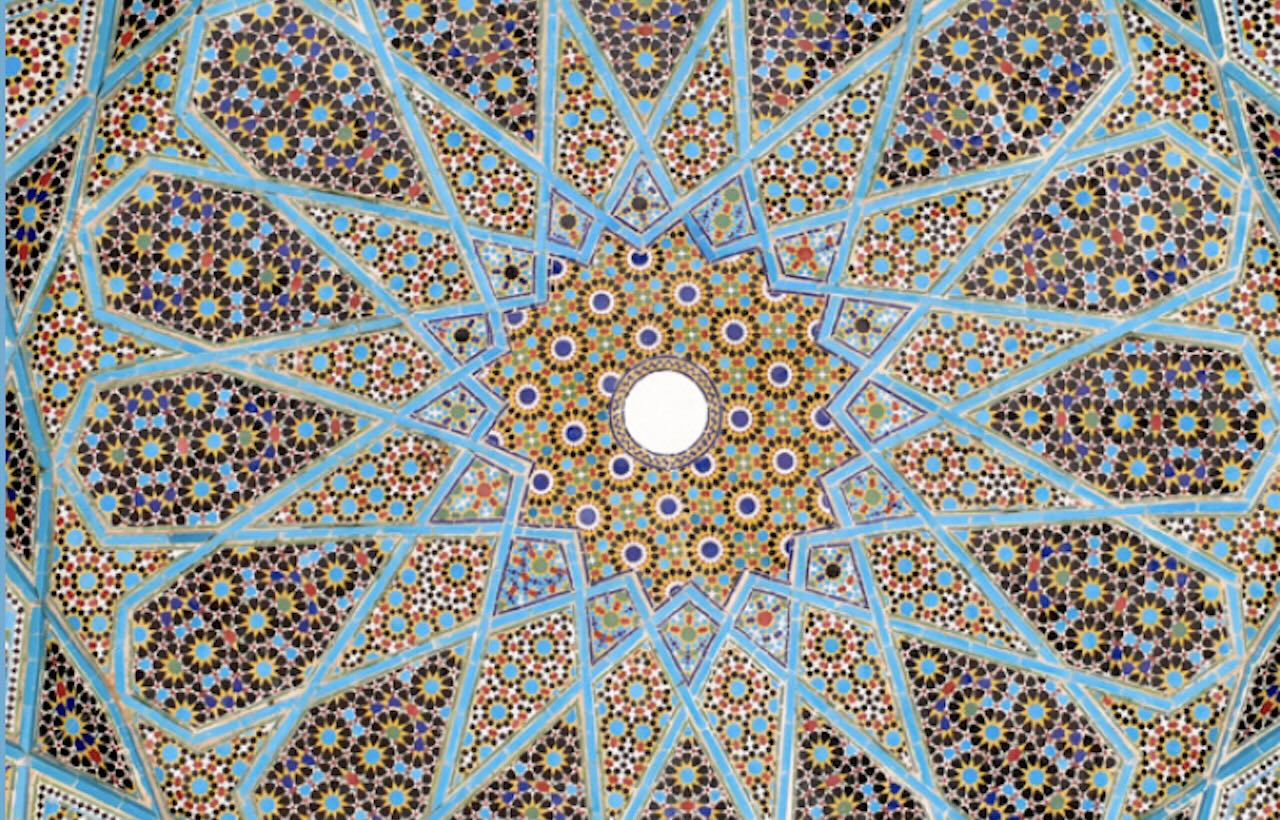
Exploring the artistic, anthropological, and social dimensions of Islamic art: a first day devoted to manuscripts and writing, as well as everyday objects.
Universal and present in all cultures, ornamentation runs through the history of art and extends into all areas of creative expression. From music to architecture, from the decorative arts to religious and sacred practices, its ubiquity renders it almost invisible. Yet it is not limited to an aesthetic function: it enriches our experience of the world and contributes to the construction of communal life. In societies with a Muslim tradition, it has developed particularly extensively, even extending into writing, notably in connection with the role accorded to figurative representation.
The first day of the conference will take place at the Pharo (Aix-Marseille University, Gastaut Auditorium) on September 30, 2026.
In partnership with the French Institute of Islamic Studies, Aix-Marseille University, TDMAM (AMU-CNRS, UMR 7297), CPAF (Texts and Documents from the Ancient and Medieval Mediterranean), and the Mediterranean Center for the Humanities and Social Sciences
Thursday, October 1
Manuscripts and Writing. A session chaired by Jawdath Jabbour.
From 9:00 a.m. to 9:45 a.m.
Lale Uluç, Boğaziçi University, Istanbul
“Embellishing the Book: Ornament, Ostentation, and the Making of Desirable Objects”
From 9:45 a.m. to 10:30 a.m.
Alya Karame, Orient Institute, Beirut“The Ornament of Memory and the Qur’anic Manuscript”
From 10:45 a.m. to 11:30 a.m.
Noha Abou-Khatwa, American University in Cairo“Mediators of Taste: Ornament, Artistic Agency, and Patronage in Circassian Mamluk”
“Manuscripts from Cairo”
From 11:30 a.m. to 12:15 p.m.
Francesco Chiabotti, INALCO, Paris
“On Ornamentation in the Moroccan Manuscript (18the–20thth) centuries). Ekphrasis and
“Muslim mysticism”
Everyday Objects. A session chaired by Mireille Jacotin.
From 2:00 p.m. to 3:45 p.m.
Sterenn Lemaguer, CEFREPA, Aix-Marseille University“Between Sight and Scent: Ornamentation and Multisensory Experience in Incense Burners”
Seljuk zoomorphic figures (11thth–13the centuries)”
From 2:45 p.m. to 3:30 p.m.
Catherine Richarté-Manfredi, INRAP“Medieval Islamic Ceramics: A Scientific Revolution in the Service of
Art and Power: Technical Transfers, Innovations, and Symbolism Between the East and
“The West”
From 3:45 p.m. to 4:30 p.m.
Malika Assam, IREMAM, Aix-Marseille University
“Skins, Bodies, Objects: The Making and Uses of ‘Berber/Amazigh Aesthetics’”
From 4:30 p.m. to 5:15 p.m.
Gwenaëlle Fellinger, The Louvre“When Animals Meet Plants: Zoomorphic Metal Ornamentation in
The Islamic West in the 10thand and 11thth centuries”
Friday, October 2
Architecture. A session chaired by Pierre Caye.
From 9:00 a.m. to 9:45 a.m.
Alexandre Kazerouni, ENS Ulm
“Mirror Ornaments and Their Use in Contemporary Iranian Art”
From 9:45 a.m. to 10:30 a.m.
Navina Haidar, Department of Islamic Art, The Metropolitan Museum of Art
“The Jali in Mughal architecture. The concept of filtered light and ornamental windows”
and screens in Indo-Islamic architecture”
From 10:45 a.m. to 11:30 a.m.
Nasser Rabbat, Aga Khan Professor and Director of the Aga Khan Program for Islamic Architecture at MIT
“The Tectonics of Ornament”
From 11:30 a.m. to 12:15 p.m.
Alka Patel, CNRS, LA3M
“On Ornament in Moroccan Manuscripts (18th–20th Centuries): Ekphrasis and
“Muslim mysticism”
Fabrics, rugs, embroidery. A session chaired by Juliette Dumas.
From 2:00 p.m. to 2:45 p.m.
Mireille Jacotin, Chief Heritage Curator, RAIF, Mucem
“Ottoman Lampas and Embroidery – 16thth–19the centuries—from the Mucem collection”
From 2:45 p.m. to 3:30 p.m.
Hadi Maktabi, Oxford University“Gol Farang: An Aromatic Narrative of Frankish Flowers on Oriental Carpets”
From 3:45 p.m. to 4:30 p.m.
Bermet Nishanova, University of California
“Reexamining Lisa Golombek’s ‘Textile Aesthetic’ and Ornamentation in the Middle Ages”
“Islamic Objects”
From 4:30 p.m. to 5:15 p.m.
Meredyth Winter, Courtauld Institute of Art“Value & Ornament in Medieval Islamic Weaving Practices”