What will our gardens look like in 20 years’ time? Why can the “punk garden” help us curb climate change? What practical solutions are there to curb drought in the here and now?
On the weekend of June 15 and 16, to mark its 10th anniversary, the Mucem will be hosting a major sharing and exchange event for all plant lovers concerned by environmental issues and the protection of living organisms.
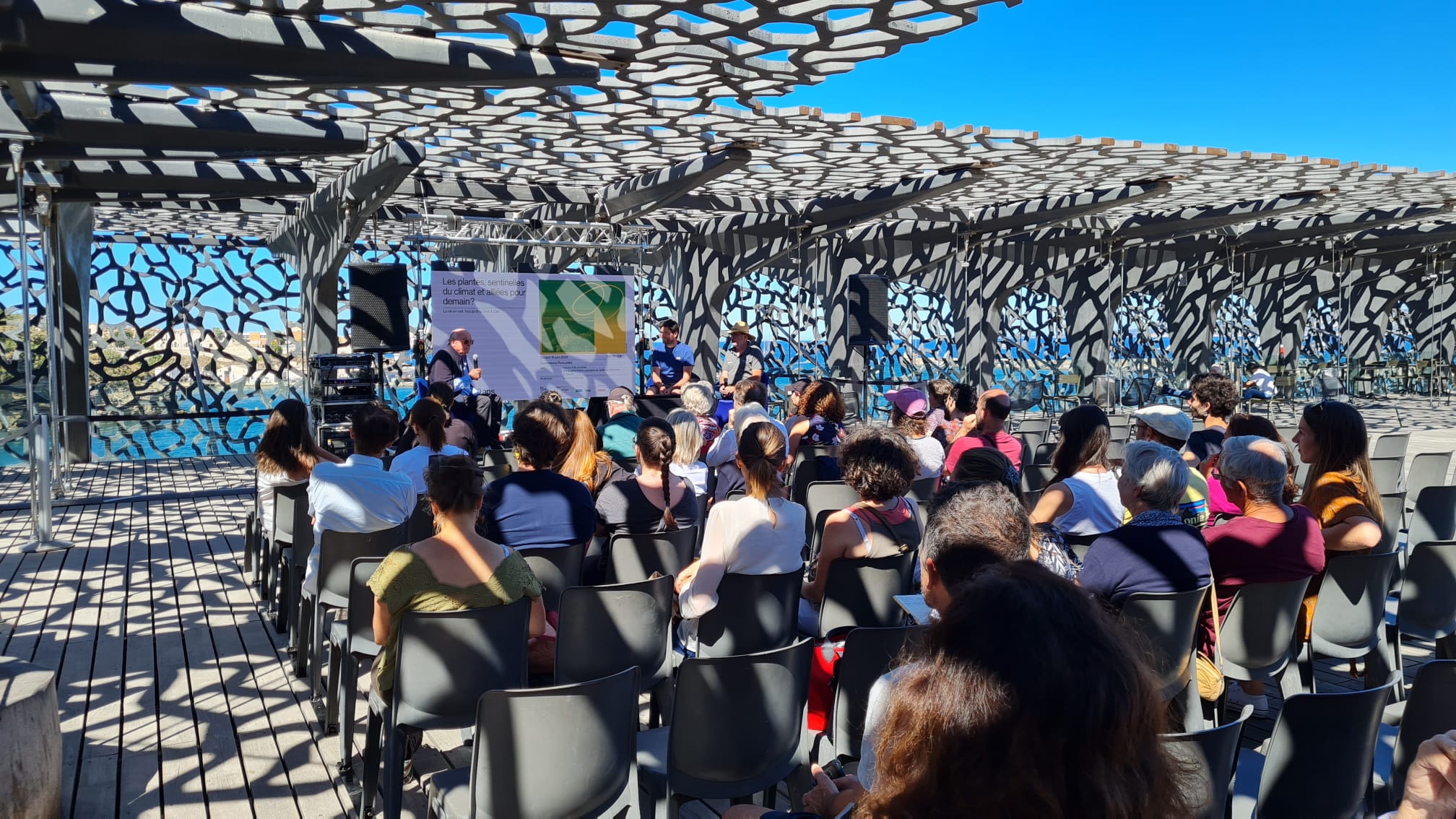
Over the next two days, we’ll be in the Jardin des Migrations at Fort Saint-Jean for open-air conferences, clever workshops and gourmet moments with ethnobotanists and farmers, landscape gardeners and scientists, city dwellers and country dwellers… Together, we’ll try to better understand how we can fight climate change on our own scale, and ensure that our plants go hand in hand with our futures.
With : Francis Hallé, Jean-Laurent Félizia, Eric Lenoir, Perrine Bulgheroni, Gabriel Willem, Samuel Bonvoisin, Isé Crébely, Bruno Cayron and L’école comestible.
A program designed by the Mucem in collaboration with Maxime de Rostolan (engineer, activist, ecological entrepreneur).
Maxime de Rostolan trained as an engineer. After a 2-year world tour on the trail of local water issues, he headed the Deyrolle publishing house. He then discovered biomimicry and permaculture, and founded the Fermes d’Avenir association, with which he promotes agroecology. In 2019, he launched the citizen lobbying movement La Bascule and, more recently, the Planteurs project, which creates participatory nurseries dedicated to agroforestry, and Sailcoop, the first passenger sailing cooperative.
He regularly contributes to the programming of events and festivals.Wild nomadic cooking workshop
As part of “Plein air! Saturday Workshops 2024”
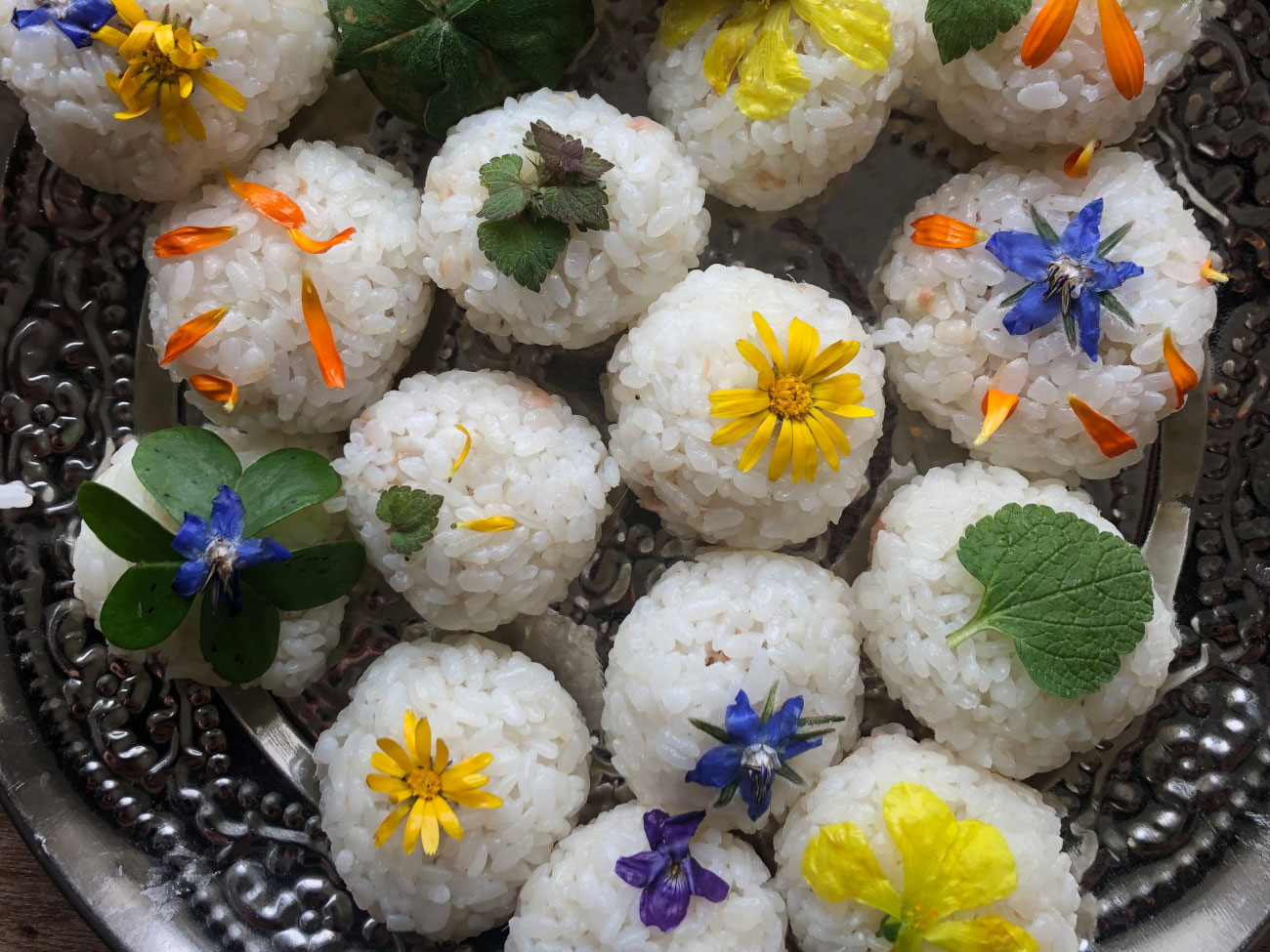
Let’s discover the wild edible plants that have colonized the gardens of Fort Saint-Jean, brought to us by the wind, the birds or the gardeners’ compost.
We’ll also take the opportunity to discover the companion plants that man installs in his gardens to benefit from their perfumes in cooking and their beneficial properties.
Before concluding this workshop, we’ll go and concoct some simple and delicious preparations rich in nutrients and new flavours.
Buy your tickets
Plants, climate sentinels and allies for tomorrow?
While climate change pushes our ecosystems to the limit, the plant kingdom is adapting and shows no signs of giving up: plants continue to surprise us and encourage us to see the world through their prism. From tropical forests to Mediterranean landscapes, Francis Hallé and Jean-Laurent Félizia scrutinize the weak and strong signals that offer advice on how to live in harmony with living things.
As privileged observers of this fragile but highly resilient natural world, they will share their thoughts on this changing world.
Botanist and biologist Francis Hallé specializes in trees and tropical forests. For five decades, he has campaigned for the protection and creation of natural areas. A professor at the universities of Orsay, Brazzaville, Kinshasa and Montpellier, he has written and illustrated numerous books that show the beauty of plants and the intelligence of their environment. A fervent defender of primary forests, in 2021 he wrote Pour une forêt primaire en Europe de l’Ouest (Actes Sud, 2021), a plea to revive these threatened yet essential spaces in Europe. In the same year, he takes us on a voyage of discovery of the most breathtaking canopies in Le radeau des cimes (Actes Sud, 2021).
Jean-Laurent Félizia is a landscape architect. In 1999, he founded the company “Mouvements et paysages” and has been involved in the creation and supervision of numerous gardens in the Mediterranean region, including the Mucem in Marseille. He is also a director of the Domaine du Rayol, where he has been head gardener since its creation.
Garden walk
Éric Lenoir (nurseryman, landscape gardener, author of Petit traité du jardin punk) invites you on a landscape walk through the Mucem gardens.
Meet in front of the ticket office, Place d’Armes, from 10 a.m.
Éric Lenoir is a landscape gardener, nurseryman and author. A graduate of the Ecole Du Breuil, over the years he has specialized in wild and aquatic environments and urban ecology, while never losing sight of his initial training in more traditional gardens. His approach is off the beaten track, with a resolutely singular outlook. Trained in the old-fashioned way, but open to the most modern techniques, he draws inspiration for his work from his travels, encounters, years of observing nature and his own experience. His methodologies and proposals often break with the conventions of the landscape world, but are based on careful observation of environmental conditions and the ecosystems concerned, both human and non-human. For several years now, he has given priority to services with a social and/or ecological component.
He is the author of several books, including Plantes aquatiques et de terrains humides (Ulmer Editions), Petit traité du jardin punk (Prix St Fiacre 2019) and Grand traité du jardin punk (Terre Vivante Editions). In these last two books, he defines the concept of the punk garden, which explores methods demonstrating that the lack of resources, knowledge and economic means does not prevent landscape creation, the possibility of improving public space or bringing more biodiversity back into gardens. On the contrary, he proves by example that simple, inexpensive, low-interventionist principles can meet many of today’s environmental challenges in relation to landscape and gardens. He is also the author of various articles, including a report on the Gardens of Chernobyl, published in the magazine L’art des jardins. Since 2012, he has created the experimental garden Le Flérial, whose 14 hectares require just five days’ maintenance a year, and more recently La Haie de Morgon, a 1.7-hectare semi-collective garden dedicated to education and experimentation around domestic food production in harsh realistic conditions.
The edible school
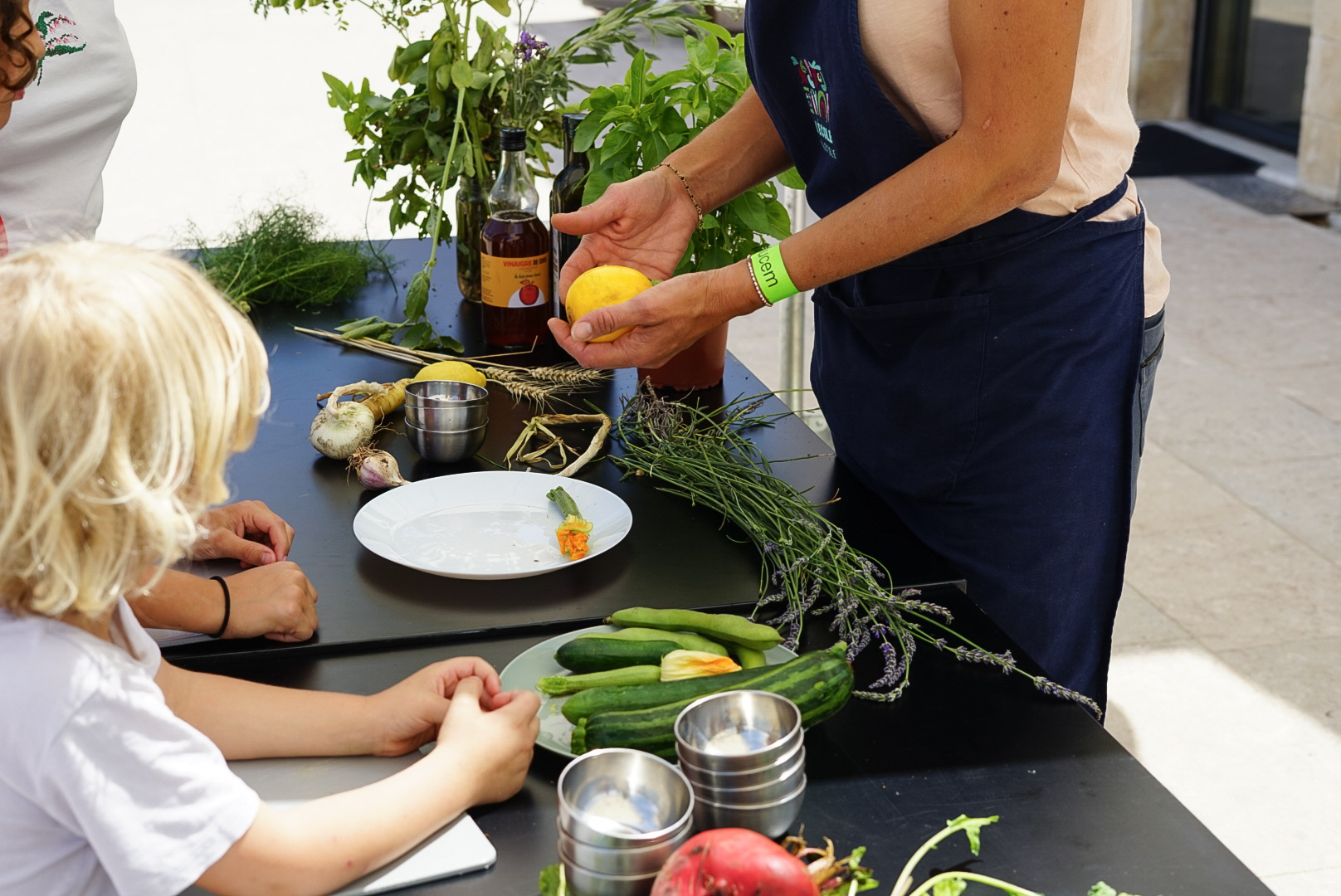
Welcome to L’école comestible! Around a Provençal market gardener and his seasonal crate, you’ll discover the food circuit from earth to plate, and enjoy tasty preparations based on fresh vegetables.
Meet 30 minutes before in front of the ticket office, Place d’Armes – Workshops open to children aged 5 and over (parents obligatory up to age 7).
L’école comestible is a non-profit organization dedicated to bringing healthy, sustainable and tasty food into schools nationwide, by offering educational workshops during school hours to support teachers and educate children from an early age.
Through the discovery of tastes, foods, vegetable crops and simple culinary practices, we aim to improve the way children eat on a daily basis and the relationship they have with food, with others, with nature and with the earth.
Extensively deployed in the Ile-de-France region and the Aix-Marseille Academy, the association is also present in Burgundy, Brittany, Occitania and Hauts-de-France. The delicious revolution is underway!Clean garden or punk garden?
Both sentinels and victims of global warming, plants are the first link in the living chain that mankind can reasonably shape to halt climate change and the erosion of biodiversity. To meet this objective, there are two “schools” of thought: the first relies on our ability to constrain the plant kingdom and standardize the most efficient practices, what we call the “clean garden”. The second, on the other hand, favors natural, spontaneous evolution to invent new ways of inhabiting our lands – this is the “punk garden”. But in the latter case, where do we place the cursor on the scale of non-action, so as not to simply suffer?
Perrine Bulgheroni first worked in a law firm in Tokyo, then headed the legal department of a company in Hong Kong. At the same time, she worked on a voluntary basis for the Office of the High Commissioner for Refugees and evolved in the world of top-level sport, delving deeper into questions linked to the body, diet and health during seven years spent in Japan and China, where she discovered the art of massage and meditation. At the age of 30, she began studying to become a psychotherapist, and changed direction. She practised for several years, and ran relaxation training courses in schools, as well as in companies.
In 2003, she co-founded the Bec Hellouin organic farm in Normandy. The primary aim of this adventure was to feed her children with healthy products produced by her own hands. Over the years, the Ferme Biologique du Bec Hellouin has grown and gained recognition, thanks in particular to the various scientific studies carried out there. Perrine’s discovery of permaculture has a deep resonance; she has studied it in Japan, England and Cuba.
Perrine works on the development of organic farming as a regional councillor for Haute-Normandie (2010 – 2016) and collaborates with various players in the agricultural world. She was certified as an applied permaculture teacher on May 7, 2013. Her commitment to permaculture and society was recognized by her appointment to the Chevalier de l’Ordre National du Mérite in 2018.
Perrine is now a permaculture speaker and consultant. She is involved in the development of modern micro and cooperative farms, corporate permaculture projects and the dissemination of permaculture principles.
Perrine is the author of La relaxation en famille (2008) published by Presses de la Renaissance, Permacuture, Guérir la terre, nourrir les hommes published by Editions Actes Sud (2014) and Vivre avec la Terre published by Editions Actes Sud (2019).
Éric Lenoir is a landscape gardener, nurseryman and author. A graduate of the Ecole Du Breuil, over the years he has specialized in wild and aquatic environments and urban ecology, while never losing sight of his initial training in more traditional gardens. His approach is off the beaten track, with a resolutely singular outlook. Trained in the old-fashioned way, but open to the most modern techniques, he draws inspiration for his work from his travels, encounters, years of observing nature and his own experience. His methodologies and proposals often break with the conventions of the landscape world, but are based on careful observation of environmental conditions and the ecosystems concerned, both human and non-human. For several years now, he has given priority to services with a social and/or ecological component.
He is the author of several books, including Plantes aquatiques et de terrains humides (Ulmer Editions), Petit traité du jardin punk (Prix St Fiacre 2019) and Grand traité du jardin punk (Terre Vivante Editions). In these last two books, he defines the concept of the punk garden, which explores methods demonstrating that the lack of resources, knowledge and economic means does not prevent landscape creation, the possibility of improving public space or bringing more biodiversity back into gardens. On the contrary, he proves by example that simple, inexpensive, low-interventionist principles can meet many of today’s environmental challenges in relation to landscape and gardens. He is also the author of various articles, including a report on the Gardens of Chernobyl, published in the magazine L’art des jardins. Since 2012, he has created the experimental garden Le Flérial, whose 14 hectares require just five days’ maintenance a year, and more recently La Haie de Morgon, a 1.7-hectare semi-collective garden dedicated to education and experimentation around domestic food production in harsh realistic conditions.
Gabriel Willem, musician and market gardener / "Paysan et fier de l'être" (Farmer and proud of it)
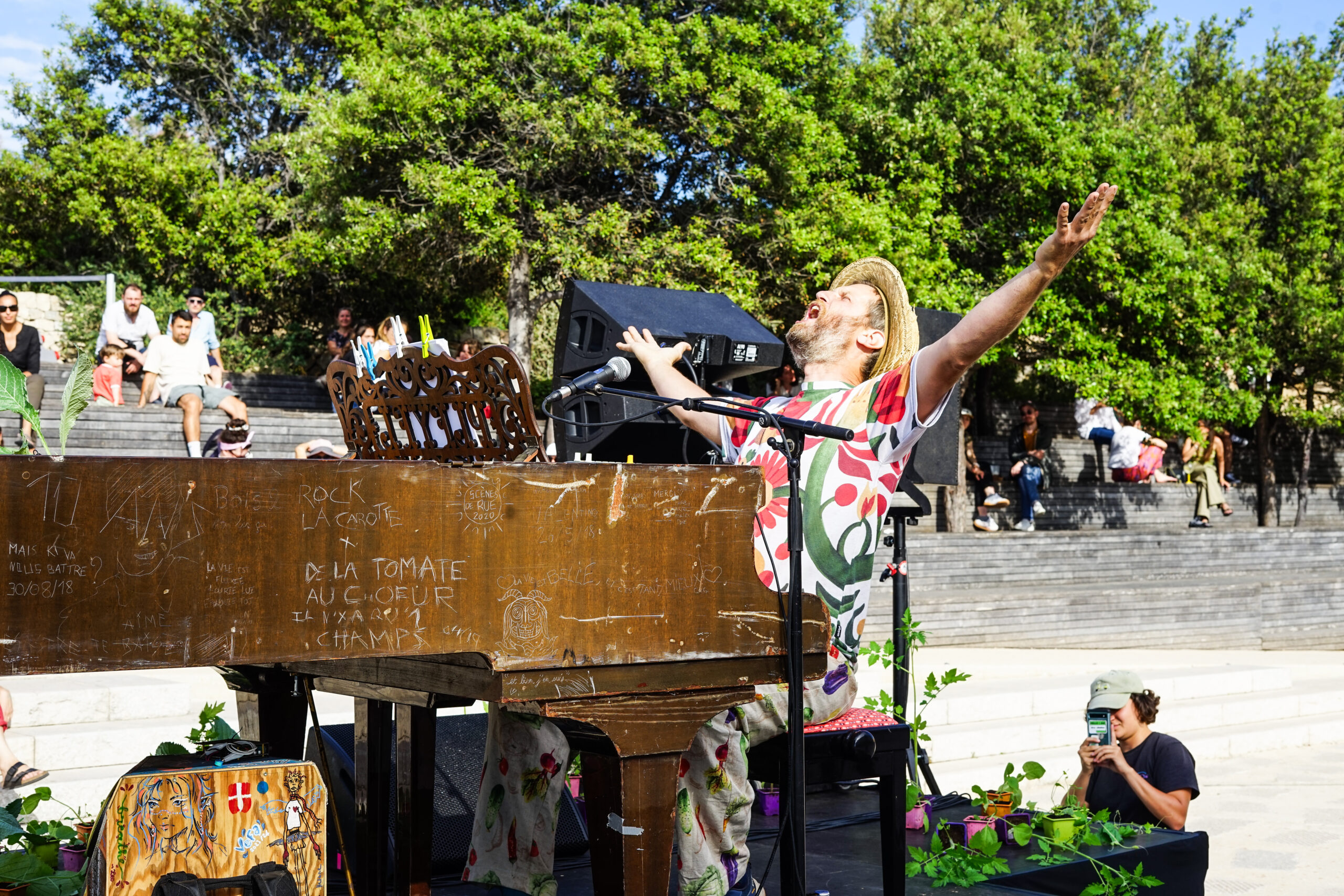
A farmer and a musician, Gabriel and his piano will take you from the fields to the clouds, making your body sway to the rhythms of the land.
Gabriel Willem is a musician – a market gardener – a winemaker, or simply a human being. With his grand piano, he wanders through his vineyards or his garden, sometimes a singer, sometimes a showman. One thing’s for sure: he’ll make you experience a unique and totally atypical moment.
Find out moreDown to earth!
While the latest heatwaves have given us a glimpse of the future in terms of drought, the whims of the water cycle are already confronting us with an immense challenge… How can we meet the needs of agriculture, industry and domestic households in the face of this almost uncontrollable upheaval? Faced with the risks of resource monopolization, short-termist and techno-solutionist choices, experiments in the field open up paths of resilience, common sense and hope for our blue gold.
Samuel Bonvoisin is an agricultural engineer specializing in the relationship between landscapes, climate and water cycles. In 2022, he co-founded the association Pour Une Hydrologie Régénérative, which advocates the implementation of territorial policies to regenerate water cycles.
Éric Lenoir is a landscape gardener, nurseryman and author. A graduate of the Ecole Du Breuil, over the years he has specialized in wild and aquatic environments and urban ecology, while never losing sight of his initial training in more traditional gardens. His approach is off the beaten track, with a resolutely singular outlook. Trained in the old-fashioned way, but open to the most modern techniques, he draws inspiration for his work from his travels, encounters, years of observing nature and his own experience. His methodologies and proposals often break with the conventions of the landscape world, but are based on careful observation of environmental conditions and the ecosystems concerned, both human and non-human. For several years now, he has given priority to services with a social and/or ecological component.
He is the author of several books, including Plantes aquatiques et de terrains humides (Ulmer Editions), Petit traité du jardin punk (Prix St Fiacre 2019) and Grand traité du jardin punk (Terre Vivante Editions). In these last two books, he defines the concept of the punk garden, which explores methods demonstrating that the lack of resources, knowledge and economic means does not prevent landscape creation, the possibility of improving public space or bringing more biodiversity back into gardens. On the contrary, he proves by example that simple, inexpensive, low-interventionist principles can meet many of today’s environmental challenges in relation to landscape and gardens. He is also the author of various articles, including a report on the Gardens of Chernobyl, published in the magazine L’art des jardins. Since 2012, he has created the experimental garden Le Flérial, whose 14 hectares require just five days’ maintenance a year, and more recently La Haie de Morgon, a 1.7-hectare semi-collective garden dedicated to education and experimentation around domestic food production in harsh realistic conditions.
Your dream vegetable garden, advice from experienced growers
Whether your vegetable garden is large or small, private or shared, “à l’arrache” or “au cordeau”, its nourishing vocation makes you the heir to one of the oldest human traditions… An ancestral know-how that some people practice on a daily basis and never stop improving by experimenting on their farms.
Perrine Bulgheroni Jean-Martin Fortier, like Isé Crébely and Bruno Cayron, excel in the art and craft of growing vegetables, and will be sharing their old garden recipes.
A computer graphics designer, Bruno Cayron took the plunge into a whole new life as a market gardener, setting up in 2004 in Tourves in the Var, his native département, on a plot of uncultivated vines considered ungrateful. An atypical terroir, a hard, stony soil unsuited to market gardening, which nonetheless became over the years a real strength, even a signature. Little by little, year after year, on their farm “Le Cayre de Valjancelle”, Bruno Cayron and his partner Isé Crébely rehabilitate plants, creating a new language of shapes, colors and flavors. In all, 4 hectares of open-field cultivation, including 5,000 m² of cold greenhouses. They produce a wide range of vegetables, including “forgotten” varieties such as parsnips, salsify and rutabagas. But also more original varieties such as purple carrots or orange cauliflower, zapallito, asparagus lettuce. Collections of peppers, eggplants, radishes and carrots. And, of course, a wide range of herbs. And they’ve built their reputation on old-fashioned tomatoes and the forty or so varieties they grow.
Perrine Bulgheroni first worked in a law firm in Tokyo, then headed the legal department of a company in Hong Kong. At the same time, she worked on a voluntary basis for the Office of the High Commissioner for Refugees and evolved in the world of top-level sport, delving deeper into questions linked to the body, diet and health during seven years spent in Japan and China, where she discovered the art of massage and meditation. At the age of 30, she began studying to become a psychotherapist, and changed direction. She practised for several years, and ran relaxation training courses in schools, as well as in companies.
In 2003, she co-founded the Bec Hellouin organic farm in Normandy. The primary aim of this adventure was to feed her children with healthy products produced by her own hands. Over the years, the Ferme Biologique du Bec Hellouin has grown and gained recognition, thanks in particular to the various scientific studies carried out there. Perrine’s discovery of permaculture has a deep resonance; she has studied it in Japan, England and Cuba.
Perrine works on the development of organic farming as a regional councillor for Haute-Normandie (2010 – 2016) and collaborates with various players in the agricultural world. She was certified as an applied permaculture teacher on May 7, 2013. Her commitment to permaculture and society was recognized by her appointment to the Chevalier de l’Ordre National du Mérite in 2018.
Perrine is now a permaculture speaker and consultant. She is involved in the development of modern micro and cooperative farms, corporate permaculture projects and the dissemination of permaculture principles.
Perrine is the author of La relaxation en famille (2008) published by Presses de la Renaissance, Permacuture, Guérir la terre, nourrir les hommes published by Editions Actes Sud (2014) and Vivre avec la Terre published by Editions Actes Sud (2019).
What will our gardens look like in 20 years’ time? Why can the “punk garden” help us curb climate change? What practical solutions are there to curb drought in the here and now?
On the weekend of June 15 and 16, to mark its 10th anniversary, the Mucem will be hosting a major sharing and exchange event for all plant lovers concerned by environmental issues and the protection of living organisms.
Over the next two days, we’ll be in the Jardin des Migrations at Fort Saint-Jean for open-air conferences, clever workshops and gourmet moments with ethnobotanists and farmers, landscape gardeners and scientists, city dwellers and country dwellers… Together, we’ll try to better understand how we can fight climate change on our own scale, and ensure that our plants go hand in hand with our futures.
With : Francis Hallé, Jean-Laurent Félizia, Eric Lenoir, Perrine Bulgheroni, Gabriel Willem, Samuel Bonvoisin, Isé Crébely, Bruno Cayron and L’école comestible.
A program designed by the Mucem in collaboration with Maxime de Rostolan (engineer, activist, ecological entrepreneur).
Maxime de Rostolan trained as an engineer. After a 2-year world tour on the trail of local water issues, he headed the Deyrolle publishing house. He then discovered biomimicry and permaculture, and founded the Fermes d’Avenir association, with which he promotes agroecology. In 2019, he launched the citizen lobbying movement La Bascule and, more recently, the Planteurs project, which creates participatory nurseries dedicated to agroforestry, and Sailcoop, the first passenger sailing cooperative.
He regularly contributes to the programming of events and festivals.Wild nomadic cooking workshop
As part of “Plein air! Saturday Workshops 2024”
Let’s discover the wild edible plants that have colonized the gardens of Fort Saint-Jean, brought to us by the wind, the birds or the gardeners’ compost.
We’ll also take the opportunity to discover the companion plants that man installs in his gardens to benefit from their perfumes in cooking and their beneficial properties.
Before concluding this workshop, we’ll go and concoct some simple and delicious preparations rich in nutrients and new flavours.
Buy your tickets
Plants, climate sentinels and allies for tomorrow?
While climate change pushes our ecosystems to the limit, the plant kingdom is adapting and shows no signs of giving up: plants continue to surprise us and encourage us to see the world through their prism. From tropical forests to Mediterranean landscapes, Francis Hallé and Jean-Laurent Félizia scrutinize the weak and strong signals that offer advice on how to live in harmony with living things.
As privileged observers of this fragile but highly resilient natural world, they will share their thoughts on this changing world.
Botanist and biologist Francis Hallé specializes in trees and tropical forests. For five decades, he has campaigned for the protection and creation of natural areas. A professor at the universities of Orsay, Brazzaville, Kinshasa and Montpellier, he has written and illustrated numerous books that show the beauty of plants and the intelligence of their environment. A fervent defender of primary forests, in 2021 he wrote Pour une forêt primaire en Europe de l’Ouest (Actes Sud, 2021), a plea to revive these threatened yet essential spaces in Europe. In the same year, he takes us on a voyage of discovery of the most breathtaking canopies in Le radeau des cimes (Actes Sud, 2021).
Jean-Laurent Félizia is a landscape architect. In 1999, he founded the company “Mouvements et paysages” and has been involved in the creation and supervision of numerous gardens in the Mediterranean region, including the Mucem in Marseille. He is also a director of the Domaine du Rayol, where he has been head gardener since its creation.
Garden walk
Éric Lenoir (nurseryman, landscape gardener, author of Petit traité du jardin punk) invites you on a landscape walk through the Mucem gardens.
Meet in front of the ticket office, Place d’Armes, from 10 a.m.
Éric Lenoir is a landscape gardener, nurseryman and author. A graduate of the Ecole Du Breuil, over the years he has specialized in wild and aquatic environments and urban ecology, while never losing sight of his initial training in more traditional gardens. His approach is off the beaten track, with a resolutely singular outlook. Trained in the old-fashioned way, but open to the most modern techniques, he draws inspiration for his work from his travels, encounters, years of observing nature and his own experience. His methodologies and proposals often break with the conventions of the landscape world, but are based on careful observation of environmental conditions and the ecosystems concerned, both human and non-human. For several years now, he has given priority to services with a social and/or ecological component.
He is the author of several books, including Plantes aquatiques et de terrains humides (Ulmer Editions), Petit traité du jardin punk (Prix St Fiacre 2019) and Grand traité du jardin punk (Terre Vivante Editions). In these last two books, he defines the concept of the punk garden, which explores methods demonstrating that the lack of resources, knowledge and economic means does not prevent landscape creation, the possibility of improving public space or bringing more biodiversity back into gardens. On the contrary, he proves by example that simple, inexpensive, low-interventionist principles can meet many of today’s environmental challenges in relation to landscape and gardens. He is also the author of various articles, including a report on the Gardens of Chernobyl, published in the magazine L’art des jardins. Since 2012, he has created the experimental garden Le Flérial, whose 14 hectares require just five days’ maintenance a year, and more recently La Haie de Morgon, a 1.7-hectare semi-collective garden dedicated to education and experimentation around domestic food production in harsh realistic conditions.
The edible school
Welcome to L’école comestible! Around a Provençal market gardener and his seasonal crate, you’ll discover the food circuit from earth to plate, and enjoy tasty preparations based on fresh vegetables.
Meet 30 minutes before in front of the ticket office, Place d’Armes – Workshops open to children aged 5 and over (parents obligatory up to age 7).
L’école comestible is a non-profit organization dedicated to bringing healthy, sustainable and tasty food into schools nationwide, by offering educational workshops during school hours to support teachers and educate children from an early age.
Through the discovery of tastes, foods, vegetable crops and simple culinary practices, we aim to improve the way children eat on a daily basis and the relationship they have with food, with others, with nature and with the earth.
Extensively deployed in the Ile-de-France region and the Aix-Marseille Academy, the association is also present in Burgundy, Brittany, Occitania and Hauts-de-France. The delicious revolution is underway!Clean garden or punk garden?
Both sentinels and victims of global warming, plants are the first link in the living chain that mankind can reasonably shape to halt climate change and the erosion of biodiversity. To meet this objective, there are two “schools” of thought: the first relies on our ability to constrain the plant kingdom and standardize the most efficient practices, what we call the “clean garden”. The second, on the other hand, favors natural, spontaneous evolution to invent new ways of inhabiting our lands – this is the “punk garden”. But in the latter case, where do we place the cursor on the scale of non-action, so as not to simply suffer?
Perrine Bulgheroni first worked in a law firm in Tokyo, then headed the legal department of a company in Hong Kong. At the same time, she worked on a voluntary basis for the Office of the High Commissioner for Refugees and evolved in the world of top-level sport, delving deeper into questions linked to the body, diet and health during seven years spent in Japan and China, where she discovered the art of massage and meditation. At the age of 30, she began studying to become a psychotherapist, and changed direction. She practised for several years, and ran relaxation training courses in schools, as well as in companies.
In 2003, she co-founded the Bec Hellouin organic farm in Normandy. The primary aim of this adventure was to feed her children with healthy products produced by her own hands. Over the years, the Ferme Biologique du Bec Hellouin has grown and gained recognition, thanks in particular to the various scientific studies carried out there. Perrine’s discovery of permaculture has a deep resonance; she has studied it in Japan, England and Cuba.
Perrine works on the development of organic farming as a regional councillor for Haute-Normandie (2010 – 2016) and collaborates with various players in the agricultural world. She was certified as an applied permaculture teacher on May 7, 2013. Her commitment to permaculture and society was recognized by her appointment to the Chevalier de l’Ordre National du Mérite in 2018.
Perrine is now a permaculture speaker and consultant. She is involved in the development of modern micro and cooperative farms, corporate permaculture projects and the dissemination of permaculture principles.
Perrine is the author of La relaxation en famille (2008) published by Presses de la Renaissance, Permacuture, Guérir la terre, nourrir les hommes published by Editions Actes Sud (2014) and Vivre avec la Terre published by Editions Actes Sud (2019).
Éric Lenoir is a landscape gardener, nurseryman and author. A graduate of the Ecole Du Breuil, over the years he has specialized in wild and aquatic environments and urban ecology, while never losing sight of his initial training in more traditional gardens. His approach is off the beaten track, with a resolutely singular outlook. Trained in the old-fashioned way, but open to the most modern techniques, he draws inspiration for his work from his travels, encounters, years of observing nature and his own experience. His methodologies and proposals often break with the conventions of the landscape world, but are based on careful observation of environmental conditions and the ecosystems concerned, both human and non-human. For several years now, he has given priority to services with a social and/or ecological component.
He is the author of several books, including Plantes aquatiques et de terrains humides (Ulmer Editions), Petit traité du jardin punk (Prix St Fiacre 2019) and Grand traité du jardin punk (Terre Vivante Editions). In these last two books, he defines the concept of the punk garden, which explores methods demonstrating that the lack of resources, knowledge and economic means does not prevent landscape creation, the possibility of improving public space or bringing more biodiversity back into gardens. On the contrary, he proves by example that simple, inexpensive, low-interventionist principles can meet many of today’s environmental challenges in relation to landscape and gardens. He is also the author of various articles, including a report on the Gardens of Chernobyl, published in the magazine L’art des jardins. Since 2012, he has created the experimental garden Le Flérial, whose 14 hectares require just five days’ maintenance a year, and more recently La Haie de Morgon, a 1.7-hectare semi-collective garden dedicated to education and experimentation around domestic food production in harsh realistic conditions.
Gabriel Willem, musician and market gardener / "Paysan et fier de l'être" (Farmer and proud of it)
A farmer and a musician, Gabriel and his piano will take you from the fields to the clouds, making your body sway to the rhythms of the land.
Gabriel Willem is a musician – a market gardener – a winemaker, or simply a human being. With his grand piano, he wanders through his vineyards or his garden, sometimes a singer, sometimes a showman. One thing’s for sure: he’ll make you experience a unique and totally atypical moment.
Find out moreDown to earth!
While the latest heatwaves have given us a glimpse of the future in terms of drought, the whims of the water cycle are already confronting us with an immense challenge… How can we meet the needs of agriculture, industry and domestic households in the face of this almost uncontrollable upheaval? Faced with the risks of resource monopolization, short-termist and techno-solutionist choices, experiments in the field open up paths of resilience, common sense and hope for our blue gold.
Samuel Bonvoisin is an agricultural engineer specializing in the relationship between landscapes, climate and water cycles. In 2022, he co-founded the association Pour Une Hydrologie Régénérative, which advocates the implementation of territorial policies to regenerate water cycles.
Éric Lenoir is a landscape gardener, nurseryman and author. A graduate of the Ecole Du Breuil, over the years he has specialized in wild and aquatic environments and urban ecology, while never losing sight of his initial training in more traditional gardens. His approach is off the beaten track, with a resolutely singular outlook. Trained in the old-fashioned way, but open to the most modern techniques, he draws inspiration for his work from his travels, encounters, years of observing nature and his own experience. His methodologies and proposals often break with the conventions of the landscape world, but are based on careful observation of environmental conditions and the ecosystems concerned, both human and non-human. For several years now, he has given priority to services with a social and/or ecological component.
He is the author of several books, including Plantes aquatiques et de terrains humides (Ulmer Editions), Petit traité du jardin punk (Prix St Fiacre 2019) and Grand traité du jardin punk (Terre Vivante Editions). In these last two books, he defines the concept of the punk garden, which explores methods demonstrating that the lack of resources, knowledge and economic means does not prevent landscape creation, the possibility of improving public space or bringing more biodiversity back into gardens. On the contrary, he proves by example that simple, inexpensive, low-interventionist principles can meet many of today’s environmental challenges in relation to landscape and gardens. He is also the author of various articles, including a report on the Gardens of Chernobyl, published in the magazine L’art des jardins. Since 2012, he has created the experimental garden Le Flérial, whose 14 hectares require just five days’ maintenance a year, and more recently La Haie de Morgon, a 1.7-hectare semi-collective garden dedicated to education and experimentation around domestic food production in harsh realistic conditions.
Your dream vegetable garden, advice from experienced growers
Whether your vegetable garden is large or small, private or shared, “à l’arrache” or “au cordeau”, its nourishing vocation makes you the heir to one of the oldest human traditions… An ancestral know-how that some people practice on a daily basis and never stop improving by experimenting on their farms.
Perrine Bulgheroni Jean-Martin Fortier, like Isé Crébely and Bruno Cayron, excel in the art and craft of growing vegetables, and will be sharing their old garden recipes.
A computer graphics designer, Bruno Cayron took the plunge into a whole new life as a market gardener, setting up in 2004 in Tourves in the Var, his native département, on a plot of uncultivated vines considered ungrateful. An atypical terroir, a hard, stony soil unsuited to market gardening, which nonetheless became over the years a real strength, even a signature. Little by little, year after year, on their farm “Le Cayre de Valjancelle”, Bruno Cayron and his partner Isé Crébely rehabilitate plants, creating a new language of shapes, colors and flavors. In all, 4 hectares of open-field cultivation, including 5,000 m² of cold greenhouses. They produce a wide range of vegetables, including “forgotten” varieties such as parsnips, salsify and rutabagas. But also more original varieties such as purple carrots or orange cauliflower, zapallito, asparagus lettuce. Collections of peppers, eggplants, radishes and carrots. And, of course, a wide range of herbs. And they’ve built their reputation on old-fashioned tomatoes and the forty or so varieties they grow.
Perrine Bulgheroni first worked in a law firm in Tokyo, then headed the legal department of a company in Hong Kong. At the same time, she worked on a voluntary basis for the Office of the High Commissioner for Refugees and evolved in the world of top-level sport, delving deeper into questions linked to the body, diet and health during seven years spent in Japan and China, where she discovered the art of massage and meditation. At the age of 30, she began studying to become a psychotherapist, and changed direction. She practised for several years, and ran relaxation training courses in schools, as well as in companies.
In 2003, she co-founded the Bec Hellouin organic farm in Normandy. The primary aim of this adventure was to feed her children with healthy products produced by her own hands. Over the years, the Ferme Biologique du Bec Hellouin has grown and gained recognition, thanks in particular to the various scientific studies carried out there. Perrine’s discovery of permaculture has a deep resonance; she has studied it in Japan, England and Cuba.
Perrine works on the development of organic farming as a regional councillor for Haute-Normandie (2010 – 2016) and collaborates with various players in the agricultural world. She was certified as an applied permaculture teacher on May 7, 2013. Her commitment to permaculture and society was recognized by her appointment to the Chevalier de l’Ordre National du Mérite in 2018.
Perrine is now a permaculture speaker and consultant. She is involved in the development of modern micro and cooperative farms, corporate permaculture projects and the dissemination of permaculture principles.
Perrine is the author of La relaxation en famille (2008) published by Presses de la Renaissance, Permacuture, Guérir la terre, nourrir les hommes published by Editions Actes Sud (2014) and Vivre avec la Terre published by Editions Actes Sud (2019).
Related highlight

Main sponsor of the 10th anniversary of the Mucem


Media partner