Visit to Fort Saint-Jean: History
Route 1-Too much history
Meet knights, soldiers, sailors and kings!
Starting point: the Vieux-Port entrance to Fort Saint-Jean
-
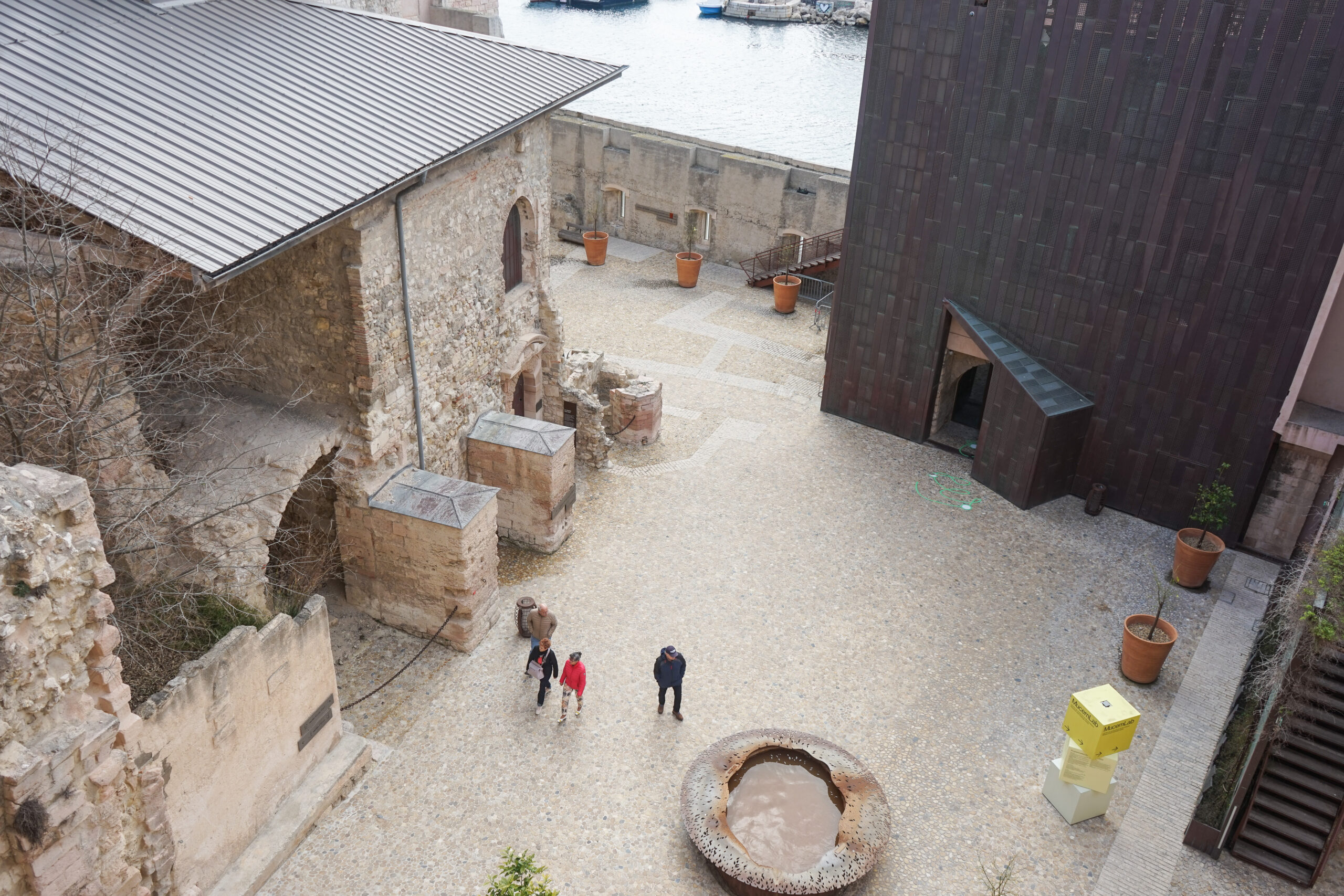
La Cour de la Commande: welcome to the time of the Crusades
- Did you know that the site of Fort Saint-Jean was occupied during the Crusades? Before the fort was built, there was a commandery here, built by the soldier-monks of the Hospitaller Order of Saint John of Jerusalem. The chapel at the Vieux-Port entrance to the fort remains from this era.
-
Climb up to the fort’s Place d’Armes
- From the Fanal Tower to the King René Tower
- One is round, the other square: can you recognize them?
- The Fanal tower (17th c.) served as a lookout and lighthouse: it takes its name from the light placed at its top to guide ships into the port. Its terrace offers a superb view of the open sea!
- The King René Tower (15th c.) was erected after the Spanish took Marseille in 1453 (they even took away the chain that closed the port!) Although it may have been used as a prison, its main function was surveillance and defense: from its terrace overlooking the Old Port, a dozen cannons once contemplated the panorama.
-
Aerial tour of the Chemin de ronde
- By following the Chemin de ronde, you can walk around the ramparts, just as the soldiers made their rounds to guard the fort! Built on the orders of King Louis XIV from 1668, the fort rises 20 metres above the sea and dominates the city: the aim was not only to protect Marseille from external threats, but also to control the city and point cannons at it in the event of an uprising… From the top of the ramparts, on this aerial tour, you can contemplate the Mediterranean, Marseille and its 2,600 years of history!
History of Fort Saint-Jean
15,000 m2 including 1,100 m2 of exhibition space and 12,000 m2 of gardens “A fully restored historic monument, open to all”.
Fort Saint-Jean is a military complex inextricably linked with the history of Marseille. Although its foundations date back to the late 12th century, construction of the fort on the site of the former commandery of Saint-Jean de Jérusalem dates back to the 17th century, when Louis XIV decided to reinforce the city’s defenses. The fort then retained its military vocation for over three centuries. Used as a German munitions depot during the war, it was severely damaged by an accidental explosion in 1944. Classified as a historic monument in 1964, it was placed under the supervision of the French Ministry of Culture. Restoration work began in 2010, to coincide with the opening of the Mucem.
Although Fort Saint-Jean traces its origins back to the 12th century, this former military fort, which is totally inaccessible to the public, had until now had the appearance of an impregnable fortress. In 2013, the fort was opened to the public for the first time in history: fully restored, it is now open free of charge to the people of Marseilles, who have immediately reclaimed the site as a new public space. While some of the buildings host exhibitions, Fort Saint-Jean is first and foremost a new place to live in the heart of the city, offering a wide range of activities, from historical tours to botanical walks through the Jardin des Migrations, and the discovery of spectacular panoramas previously unseen.
Fort Saint-Jean is also home to the Institut méditerranéen des métiers du patrimoine (I2MP), a professional heritage training center.
Route 1-Too much history
Meet knights, soldiers, sailors and kings!
Starting point: the Vieux-Port entrance to Fort Saint-Jean
-
La Cour de la Commande: welcome to the time of the Crusades
- Did you know that the site of Fort Saint-Jean was occupied during the Crusades? Before the fort was built, there was a commandery here, built by the soldier-monks of the Hospitaller Order of Saint John of Jerusalem. The chapel at the Vieux-Port entrance to the fort remains from this era.
-
Climb up to the fort’s Place d’Armes
- From the Fanal Tower to the King René Tower
- One is round, the other square: can you recognize them?
- The Fanal tower (17th c.) served as a lookout and lighthouse: it takes its name from the light placed at its top to guide ships into the port. Its terrace offers a superb view of the open sea!
- The King René Tower (15th c.) was built after the Spanish took Marseille in 1453 (they even took away the chain that closed the port!) Although it may have been used as a prison, its main function was surveillance and defense: from its terrace overlooking the Old Port, a dozen cannons once contemplated the panorama.
-
Aerial tour of the “chemin de ronde
- By following the Chemin de ronde, you can walk around the ramparts, just as the soldiers made their rounds to guard the fort! Built on the orders of King Louis XIV from 1668, the fort rises 20 metres above the sea and dominates the city: the aim was not only to protect Marseille from external threats, but also to control the city and point cannons at it in the event of a revolt… From the top of the ramparts, on this aerial tour, you can contemplate the Mediterranean, Marseille and its 2,600 years of history!
Route 1-Too much history
La Cour de la Commande: welcome to the time of the Crusades
Did you know that the site of Fort Saint-Jean was occupied during the Crusades? Before the fort was built, there was a commandery here, built by the soldier-monks of the Hospitaller Order of Saint John of Jerusalem. The chapel at the Vieux-Port entrance to the fort remains from this era.
Climb up to the fort's Place d'Armes: From the Fanal Tower to the King René Tower
One is round, the other square: can you recognize them?
The Fanal tower (17th c.) served as a lookout and lighthouse: it takes its name from the light placed at its top to guide ships into the port. Its terrace offers a superb view of the open sea!
The King René Tower (15th c.) was built after the Spanish took Marseille in 1453 (they even took away the chain that closed the port!) Although it may have been used as a prison, its main function was surveillance and defense: from its terrace overlooking the Old Port, a dozen cannons once contemplated the panorama.
Aerial tour of the "chemin de ronde
Following the Chemin de ronde, you can walk around the ramparts, as the soldiers made their rounds to guard the fort! Built on the orders of King Louis XIV from 1668, the fort rises 20 metres above the sea and dominates the city: the aim was not only to protect Marseille from external threats, but also to control the city and point cannons at it in the event of an uprising… From the top of the ramparts, on this aerial tour, you can contemplate the Mediterranean, Marseille and its 2,600 years of history!
Mucem, Fort saint-Jean, Cours de la commande, Copyright Julie Cohen 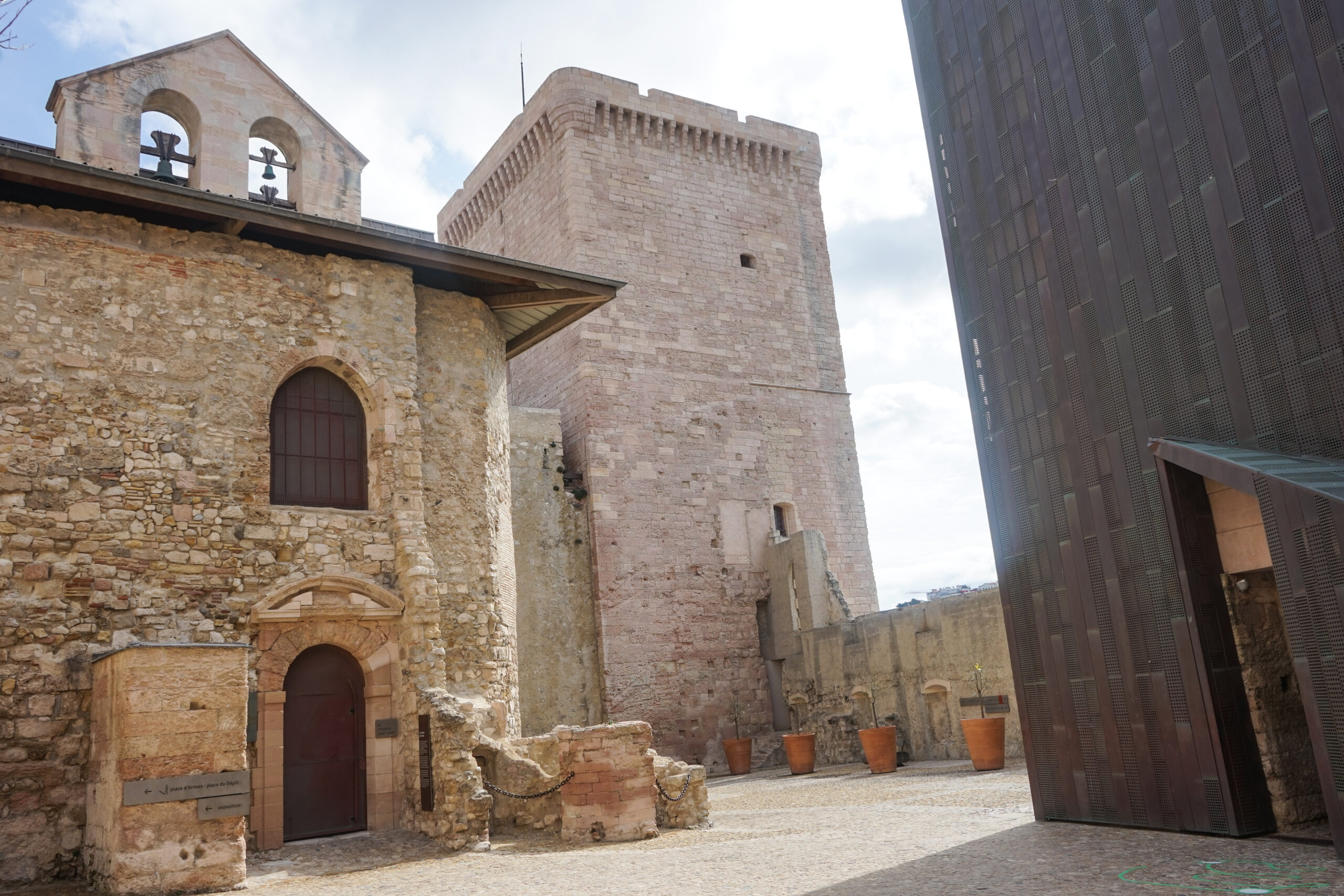
Mucem, Fort Saint-Jean, Cours de la commande, Tour du roi René, Chapelle © Julie Cohen
Test

The J4, contemporary architecture in “super concrete
Since its opening in 2013, the building designed by Rudy Ricciotti (in association with Roland Carta) has won worldwide acclaim for its architectural blend of technical prowess and aesthetic power.
Take a free tour of the Mucem, on the fishnet side!
- Exterior railings
- Meet us on the first floor, in the lobby of the J4 building. From here, two outdoor ramps lead to the roof terrace, inviting visitors to experience a fascinating ascent with panoramic views of Fort Saint-Jean and the horizon. Switch from one ramp to the other using the outside stairs!
- Tree poles
- As you walk through the building, you’ll notice huge pillars in the shape of “chicken bones”: the J4 is in fact held up by 309 tree-like posts that surround the exhibition halls, freeing the center of the building from any load-bearing function. The posts are made of BFUHP (Béton Fibré à Ultra-Hautes Performances), a state-of-the-art material that is as flexible as it is resistant.