Techniques, pratiques et récits du corps
Other themes
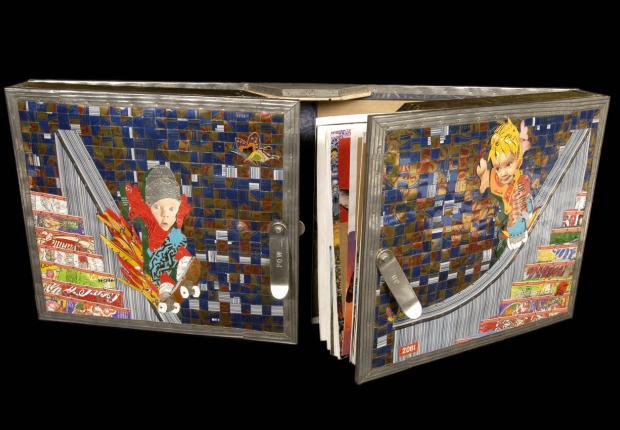
Skaters’ masterpiece
Inventory number: 2006.27.1
2003
France, Rhône-Alpes Auvergne, Allier
This box is a unique piece created in 2003 in Montmarault, in the Allier region of France, by five young boys aged 14 to 16, brought together by their passion for skateboarding. It’s a wooden box whose exterior is decorated by weaving together pieces of aluminum from soda cans. Inside (the box can be opened and unrolled over 11 meters), these young boys, with the help of their parents, have assembled administrative documents – a handwritten letter, a feasibility study, insurance, estimates, a survey of local residents – as well as information and educational documents relating to skateboarding, to explain to the municipal team their practice and lifestyle, and their expectations in terms of equipment.
Skateboarding was born in the USA in the 1950s, and spread to Europe in the 1960s, particularly to France. By the 1990s, skateboarding had become a mass practice, appealing to all social classes, although it was mainly young men from middle-class and affluent backgrounds who took up the sport. Skateboarding takes place in the city, in public spaces that are appropriated and chosen for practical and technical reasons (type of street furniture, flooring, materials, architectural requirements) as much as for symbolic reasons (town hall or church forecourt). Skateboarding is also a way of learning about otherness: noise or damage to street furniture brings skaters face to face with prevailing social norms, sometimes through the intermediary of social agents (guards, security guards, policemen). The skatepark offers an alternative means of progressing, training and meeting in a suitable facility, while respecting the norms of the city. This is what prompted these young people to create this boxed set: to continue practicing their sport-passion, these five teenagers wanted to convince their town council to build a skatepark in their town.
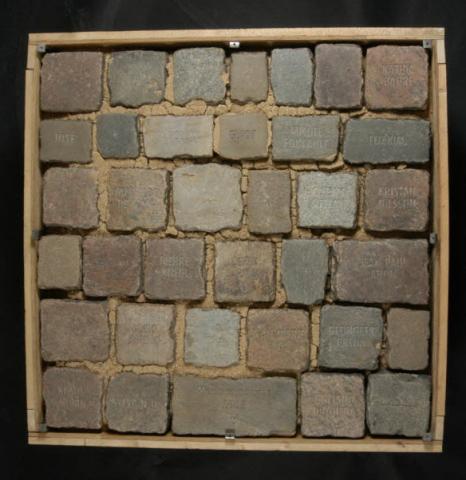
Memorial
Inventory number: 2003.10.1
2003
Tom Fecht (Frankenberg 1952 – )
Sculpture, granite.
The AIDS pandemic has revealed many inequalities that call into question the notion of citizenship. Patients and their associations have highlighted these inequalities, insisting on the defense of human rights that are not respected in many countries.
The first of these rights is the recognition of a person’s identity. Patient associations fought against the silence and shame surrounding the epidemic at the outset, and to a large extent even now. This is expressed in the work by German artist Tom Fecht. It is part of an ensemble entitled “Mémoire Nomade, Namen und Steine” (Names and Stones). Forty other installations, both permanent and ephemeral, are located mainly in northern European countries. The aim here is to highlight and remind us of the anonymity in which many AIDS victims have remained. That’s why, alongside paving stones engraved with the names of known or unknown victims of the epidemic, there are first names only, “+” signs indicating that the disease is still with us, and paving stones without names. Some of the names are those of personalities from the humanities or the arts (Mikaël Pollak, Michel Foucault, Jean-Paul Aron, Derek Jarman, Klaus Nomi), or association activists (Cleews Velay, president of Act Up-Paris, Pierre Kneip, founder of Sida-Info-Service).
The artist created this work for the Mucem as part of an ethnographic collection of objects and documents relating to the memories and history of AIDS, which brought together some 12,000 objects from most European and Mediterranean countries.

Parody wedding dress
Inventory number: 2004.211.24
2004
Paris, France
Textile materials
Association Act Up-Paris
This “wedding dress” was made to be worn by one of the members of the homosexual couple marching at the head of the Act Up-Paris association’s procession during the 27th edition of the Lesbian, Gay, Bi-sexual and Transsexual Pride march in Paris in 2004. This wedding costume is part of a carnival tradition of subverting dress codes and gender inversion. Its colors, which are also those of the association, break with the norm of bridal white: the black of mourning is chosen in memory of the victims of the AIDS epidemic, and the pink triangle inverts the stigmatization of homosexuality in the Nazi extermination camps. In addition to the dress and headdress, the costume is completed by a T-shirt bearing one of the association’s founding slogans: action = life.
Founded in 1989, Act Up-Paris defines itself as “a militant and political association from the homosexual community, defending all populations affected by AIDS”. It is known for its activism, its sense of provocation, and its conspicuous presence at street demonstrations. This object was collected as part of Mucem’s research into the history and memories of the struggle against AIDS, at a time when debates on homosexual unions and homoparentality were emerging in the public arena.
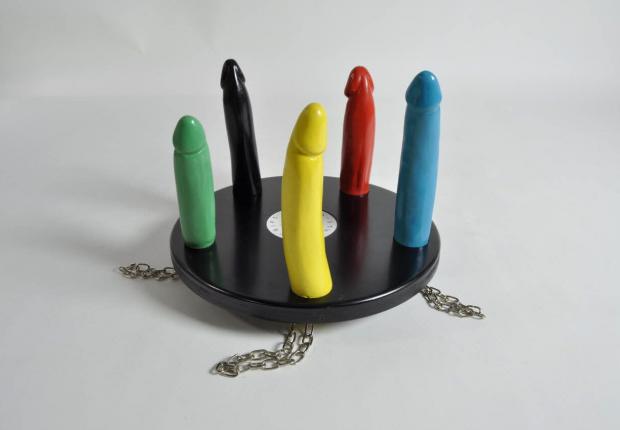
Prevention material: The enchanted merry-go-round (Els Gegants Encantats)
Inventory number: 2002.93.21.3
2002
Paris, Barcelona
Wood, resin
These five erect penises, made of colored resin, are a teaching aid dedicated to learning the correct use of condoms, used in health programs. They can be used for sex education in family planning centers, or for demonstrations to raise awareness among teenagers or young people, as part of prevention operations or campaigns. This type of material makes it easier to learn how to have safe sex, in order to avoid sexually transmitted infections such as AIDS.
The object’s name derives from the circular horizontal rotating platform on which five yellow, blue, red, black and green penises are inserted, held in place by chains. The varied size and shape of these penises is also intended to reassure young people. This creation by the Centre régional d’information et de prévention du sida (CRIPS) d’Île-de-France is distributed in Spain by the Catalan association Sida-Studi, based in Barcelona.
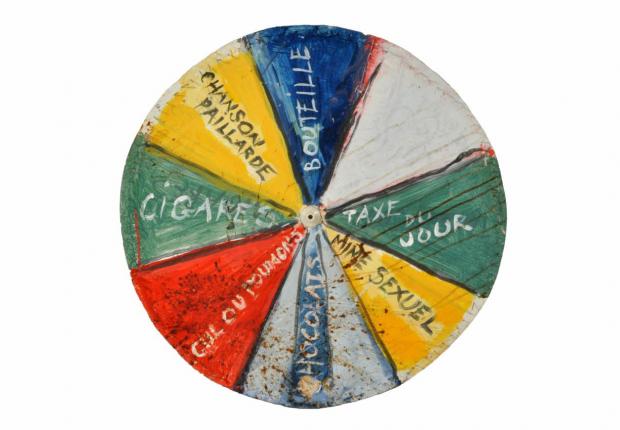
“Wheel of Fortune” for the Laennec Hospital on-call room
Inventory number: 2000.65.47.1-2
4th quarter 20th century
Wood, iron, metal. D: 74 cm, D: 4 cm
At the dawn of the year 2000, three Parisian pavilion hospitals (Boucicault, Broussais and Laennec) were about to close their doors, when they were transferred to the Georges-Pompidou European Hospital (HEGP). The Musée National des Arts et Traditions Populaires (MNATP) and Assistance-Publique-Hôpitaux de Paris (AP-HP) joined forces to investigate the identity and memory of these three sites, with a view to preserving their tangible and intangible heritage. The result is a collection of several thousand objects, including the “wheel of fortune” that once hung on the walls of the on-call room at Laennec Hospital.
On-call rooms are “private” areas within public hospitals. Reserved for medical interns, these rooms, where they come to share their meals, are decorated with frescoes depicting sexual or even obscene scenes. This tradition dates back to 1859, when a group of painters, including Gustave Doré, decorated the Charité’s on-call room. For the residents, these frescoes are a means of asserting themselves and proclaiming their identity. When they eat there, they are subject to a complex set of rules, governed by the bursar (an elected resident, or one appointed by his peers, who presides over a guardroom for at least a semester) and the elders, which aim to organize social life within the resident community, such as the custom of greeting each guest by tapping his right shoulder with his right hand. The Wheel of Fortune is there to punish boarders who break any of these laws. In this case, the bursar spins the wheel, which stops on evocative words, suggesting the pledges to be made by those who break one of the on-call room rules (“ass or lung”, “sexual mime”, “cigar”, “tax of the day”, “bawdy song”, “bottle”, “chocolate”).
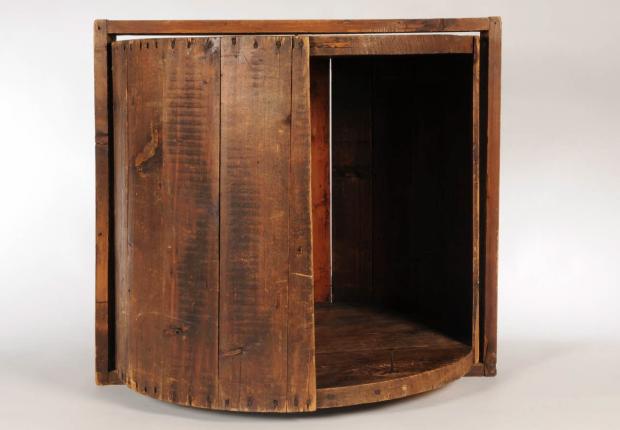
Child abandonment tower
Inventory number: 1907.3.27
France
Wood, metal
66 x 64.5 x 71.5
This empty cylindrical tower, made of nailed wooden panels and open on one side, was installed in the wall of a hospice around the end of the 19th and beginning of the 20th centuries. Although the existence of such towers has been attested since at least the 12th century, they only became widespread in France and Paris from the 17th century onwards, thanks to the action of the Church and St. Vincent de Paul, who founded the hospital for foundlings in 1638. In 1670, this institution was transferred to the responsibility of the Paris General Hospital, and the presence of the towers was legalized under the Third Republic, by the imperial decree of January 19, 1811.
At that time, mothers who were unable to raise their babies, either for financial reasons or because they had conceived them outside marriage in a patriarchal society, were able to anonymously deposit them in the tower installed in the wall of the hospices, instead of abandoning them in the street. The hospices that took in the child then provided assistance and protection, and the child became a ward of the state, thus giving substance to the republican desire to protect and improve the lot of these children.
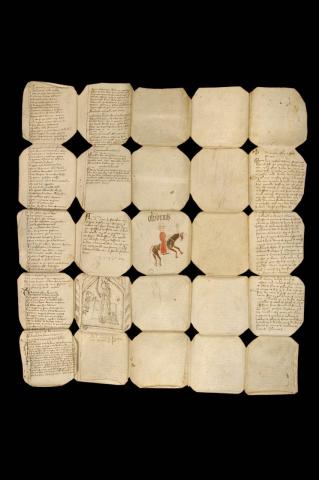
Delivery bag
Inventory number: 1977.2.1
15th century.
France
Parchment. H: 60.5 cm, W: 56.2 cm.
Until the end of the 19th century, it was common practice for mothers-to-be to wear a birthing bag or belt at the moment of birth. The high mortality rate associated with childhood explains why these magico-religious practices were so widespread in popular medicine. Numerous objects played this protective role: pious images or statuettes of patron saints, silk belts available in shrines dedicated to the Virgin, protective medals, etc., were used alongside other practical precautions, such as infusions of mugwort or sitz baths with emollient herbs.
Such objects are hard to come by, as people would rather burn them when they were too worn or unused than throw them away, for fear of attracting bad luck. However, they were carefully preserved in families, where they were passed down from mother to daughter or daughter-in-law. As their contents had to remain secret, they were not opened: they could lose their power.
In addition to the practice of secrecy, so common in folk medicine, there’s the matricial symbolism of a tightly sealed envelope with sacred contents. This explains the perfect state of preservation of the inside of the sachet on display: already opened when it entered the museum, the sachet contains a parchment recounting the life of Saint Marguerite – one of the patron saints of women in childbirth – and several prayers. It reads: “And if a woman in childbirth has this writing with her, as soon as she delivers herself from the child, neither the child will perish, nor the woman will die at this moment”.
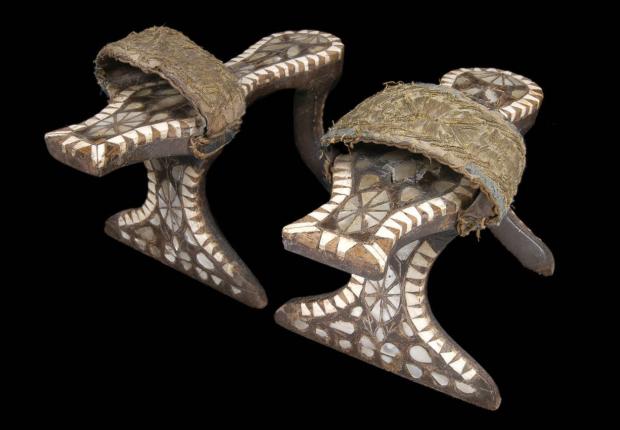
Pair of hammam sandals
Inventory number: 2002.76.1.1-2
19th century
Turkey, Algeria
Wood, mother-of-pearl, leather, gold thread
The discovery of Greek and Roman baths by the Arabs led them to adopt steam baths. The practice of ritual ablutions and the Koran’s recommendation of meticulous hygiene led to the spread of the practice as Islam spread around the Mediterranean. The Prophet Muhammad himself is said to have praised the practice. The traditional hammam is most often heated by hypocaust (underground fireplace), but natural hot springs can also be used.
Beyond the religious dimension, the hammam is also a place of relaxation, pleasure and conversation, a social place where people meet, where the barber operates and gives massages. It’s also a place where appearances are made and women have the opportunity to show off. That’s why some sandals are adorned with mother-of-pearl or gold thread, like this pair from the 19th century, whose shape corresponds to a Turkish model used in Algeria and in all countries that were under Ottoman domination.
Over the past century, hammams have been frequented only by the most privileged members of society, and in many regions of the Maghreb and the Near East, they are deteriorating and in danger of disappearing, as they are costly to maintain. It is only very recently that these places and this practice are being reintegrated into the cultural heritage of this region. At the same time, in the West, the hammam has become fashionable, joining other water-based health practices – thalassotherapy, the thermal bath – or steam treatments – the sauna – that respond to the quest for both physical and mental well-being.
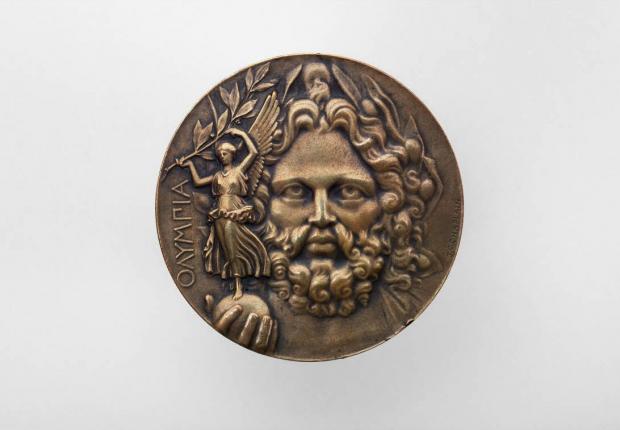
Bronze medal at the Athens Olympic Games
Inventory number: 2014.6.4
1906
Jules-Clément Chaplain (1839-1909), engraver
Bronze. D. 0,05
The modern Olympic Games were revamped at the end of the 19th century, following the archaeological discovery of the site of Olympia in the Peloponnese, and as part of a movement to reform the education of European youth through the promotion of sport and physical exercise. Thanks in particular to the efforts of Pierre de Coubertin (1863-1927), the first revamped games were held in Greece in 1896. Ten years later, in 1906, the King of Greece once again organized the Olympic Games, against the wishes of Pierre de Coubertin and the International Olympic Committee. This is why, unlike the 1900 and 1904 Games, the 1906 Intercalated Olympic Games were not accompanied by a World’s Fair.
Although unofficial, these Games are important in the Olympic genesis, as they mark the beginning of ceremonial traditions, including the athletes’ parade and medal presentations. This bronze medal was awarded to the Greek team for third place. The iconography on both sides of the medal – the Acropolis of Athens on one side and the Zeus of Olympia carrying Victory in his right hand on the other – refers to the ancient games and establishes a filiation between modern Greece and ancient Greece, in a context of consolidation of national consciousness in the face of Ottoman rule.
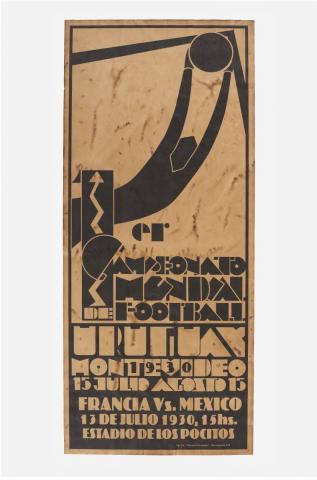
Poster for the opening match of the first soccer World Cup
Inventory number: 2015.14.1
1930
Guillermo Laborde (Montevideo 1886 – Montevideo 1940)
Lithograph. H. 0.88; L. 0.38
The opening match of the first Football World Cup, between France and Mexico on July 13, 1930, marked the start of what was to become the world’s most popular sporting event. Although the first international soccer competitions were organized at the Olympic Games in 1908 (London) and 1912 (Stockholm), the fact that footballers were away from home for several weeks prompted the young Fédération Internationale de Football Association (FIFA, founded in 1904 in Paris) to introduce professionalism in the 1920s, thus consummating the break with the International Olympic Committee (IOC), promoter of amateurism.
FIFA decided to organize the first World Cup in 1930, assigning responsibility for the operation to the Uruguayan federation in view of the development of soccer in South America and Uruguay, thanks to the country’s excellent results at the recent Olympics, and to celebrate the centenary of the country’s independence. Guillermo Laborde (1886-1940), a Uruguayan painter, sculptor and draughtsman who was part of the planista art movement, was responsible for giving this first competition a modern image.
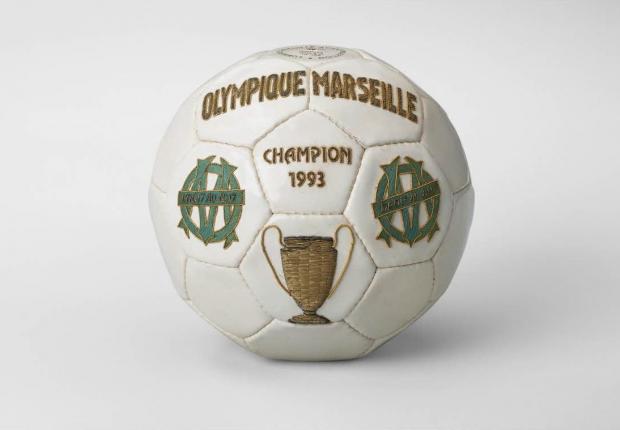
Ball commemorating Olympique de Marseille’s victory in the Champions League
Inventory number: 2014.6.8
1993
Leather. D. 0,15
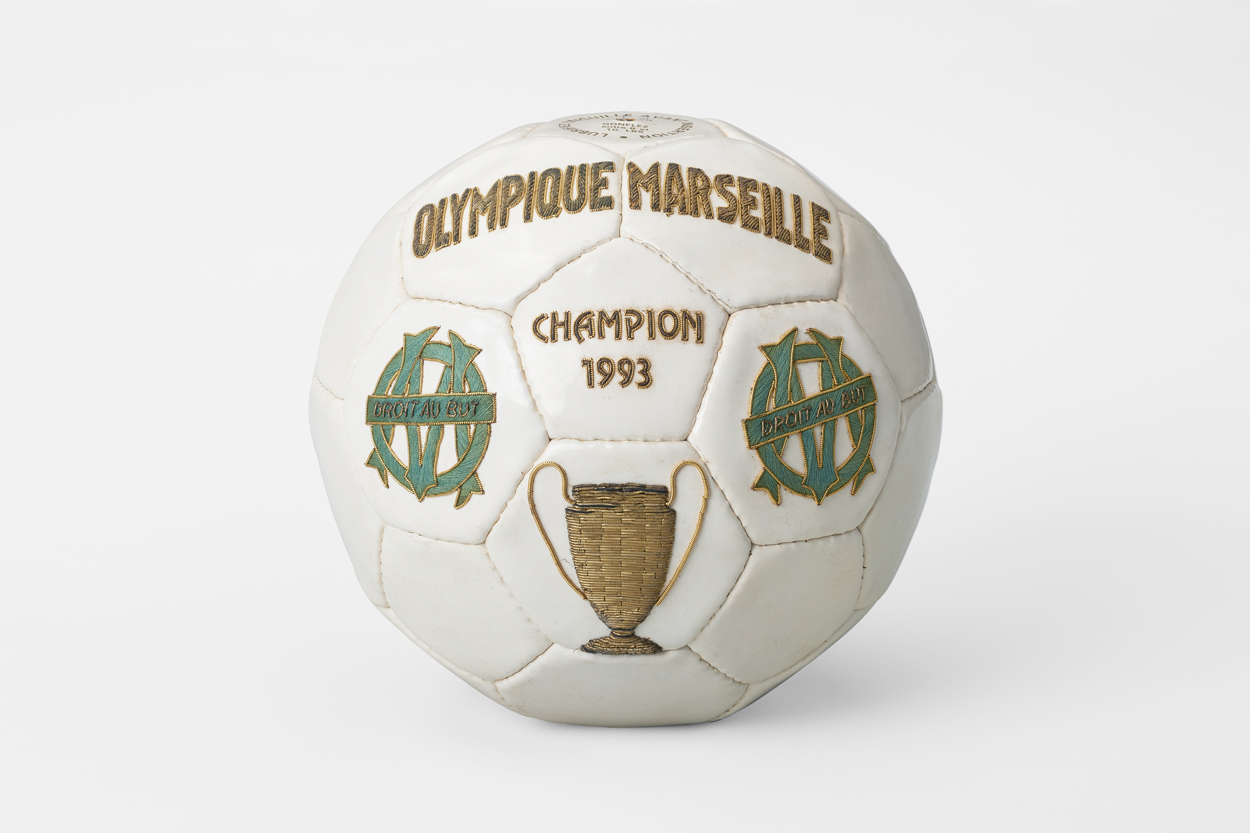
“Allez les Marseillais! It was May 26th! Allez les Marseillais! Together we won! Allez les Marseillais! Forever first!” In their songs, Marseille fans still remember with passion the club’s victory in the Champions League final on May 26, 1993. This ball also commemorates that date and Olympique de Marseille’s victory over AC Milan at the Olympic Stadium in Munich, Germany. It bears the inscription “Olympique de Marseille, Champion 1993”, accompanied by a representation of the “cup with the big ears”, the Champions League cup (crater with two side handles), stitched in gold thread, as well as two representations of the Olympique de Marseille soccer club emblem, an M surrounded by an O, crossed by the club slogan “Droit au But”.
The ball bears witness to the only victory by a French club in the history of this annual soccer competition organized by the Union of European Football Associations (UEFA). It celebrates a milestone in the club’s history, as well as in the identity of the city of Marseille.
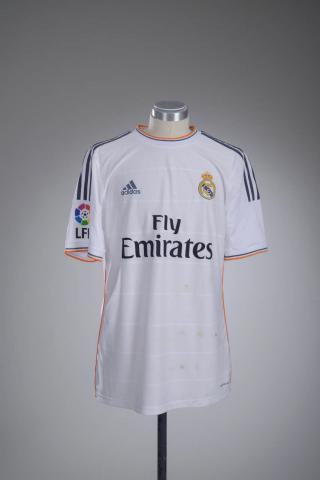
Cristiano Ronaldo’s Real Madrid jersey
Inventory number: 2015.2.2
2013/2014
Textile
Cristiano Ronaldo is a Portuguese footballer born in 1985 in Funchal, on the island of Madeira. He can be described as a “folk hero”, in the sense that he embodies certain values (perseverance, performance, success) that drive our contemporary societies.
This player has already won three Ballon d’Or awards, following in the footsteps of Michel Platini, Johan Cruyff and Marco van Basten. He won the Euro in 2016, the Champions League on three occasions, as well as numerous trophies in England with Manchester United and in Spain with his current club, Real Madrid. In the 2013-2014 season, Real Madrid won the King’s Cup and its tenth Champions League title, the decima. The club also finished third in the league table, behind Atletico Madrid and FC Barcelona. Cristiano Ronaldo played a major role in his team’s success.
Born into a modest family, in 2016 he is one of the most talked-about sportsmen and the highest-paid player in the world. After transferring from Manchester United to Real Madrid in 2009 for €94 million, he earned almost €24 million in the 2016/2017 season.
As well as being a talented footballer, Cristiano Ronaldo is the object of a veritable “popular cult”. Every time he appears in public, fans gather to take a selfie with their idol, or to get a jersey worn by him, like this one worn by “CR7” during the 2013-2014 season. In Madeira, an entire museum is dedicated to him, in which all his individual and collective trophies surround a wax mannequin in his likeness.
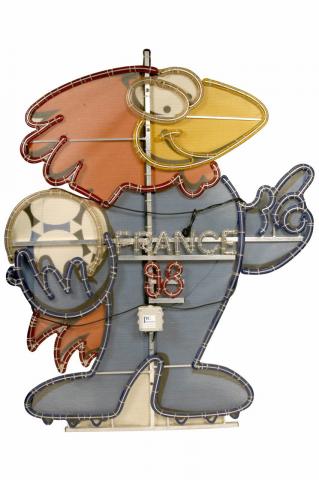
Footix” illuminated sign
Inventory number: 1998.83.1
1998
Metal, plastic. H: 185 cm, W: 140 cm.
The Football World Cup is the most popular sporting event in the world. Every four years since 1930, the world’s best teams have competed for the trophy that will crown the supremacy of one of them. In addition to the sporting competition, the event is also staged as part of a global communications strategy. For the 1998 World Cup, the French organizing committee chose “Footix” to represent France, the host country. The smiling, blue-clad rooster in studs, designed by graphic artist Fabrice Pialot, was featured on a host of graphic, clothing, artistic and commercial creations, acquired by the Mucem in 1998 to bear material witness to the memory of the event. On this illuminated sign of imposing dimensions, Footix holds a ball in his right wing and raises the “index finger” of his left wing, as an invitation to play.
As the world’s most popular sport, soccer is one of the best reflections of the societies in which it evolves. The plurality and profusion of objects produced on this occasion testify to the importance of the economic and commercial relationships generated by soccer, over and above strictly sporting issues.
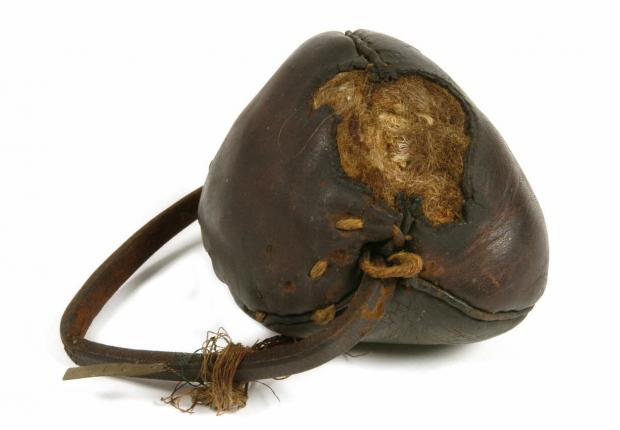
Honorary Soule Ball
Inventory number: 1964.46.5
1964.
France – Oise
Leather, straw, string. L: 14.1 cm, W: 15.6 cm, D: 9.8
The soule ball presented here was collected in the Oise region in the mid-1960s. At the time, men competed with this small leather ball in the game of soule, the basic principle of which is to carry the ball, called soule or pelote, over a line, or to carry it from one camp to another, or even from one village to the next. It’s a ball game with a massive scrum. The confrontation between the two rival camps reflects the opposition between two territories. By fighting over the ball, you’re defending the identity of the village or group to which you belong.
Soule is typical of games played under the Ancien Régime: there are no clearly established rules, many variations exist and, for example, the ball has no fixed shape. The ball, for example, has no fixed shape: it can be a leather skin, a ball stuffed with cloth, or a piece of wood… Soule is thus often considered to be one of the ancestors of rugby. The game was played as early as the 12th century in Normandy, Brittany and northern France. It survived in this region until the 20th century, when it fell into decline, although it is now coming back into fashion as part of a reinvention of tradition.
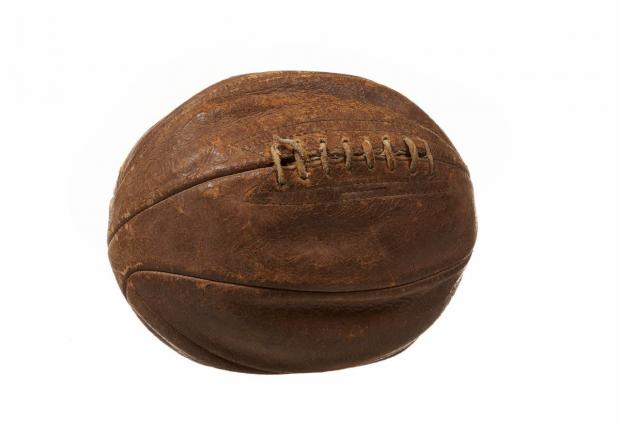
Rugby ball
Inventory number: 2014.6.5
First quarter of the 20th century
Leather. D. 0,20
The first rugby clubs were formed in France in the 1890s. The Stade Olympien des Étudiants Toulousains (SOET) was founded in 1896, as was the Sport Athlétique Toulousain (SAT). In 1899, the USEV (Union Sportive de l’École Vétérinaire) was founded. Under the impetus of Ernest Wallon (1851-1921), a law professor, rugby was institutionalized with the purchase of the Ponts-Jumeaux site, which led to the merger of the various rugby forces in Toulouse into a single team: Stade Toulousain, created in 1907. The structuring of this team, of which Ernest Wallon was the first president and shareholder, contributed to the sport’s national success. This rugby ball, used by the Stade Toulousain on the Prairie des Filtres around 1910, bears witness to the beginnings of rugby in Toulouse and France.
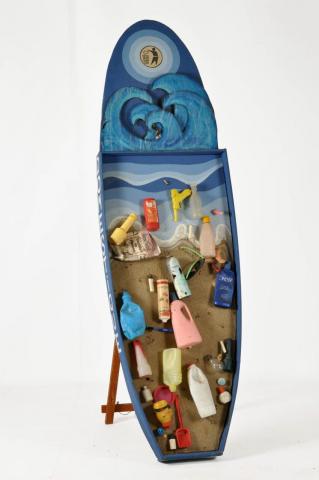
Awareness facility
Inventory number: 2006.55.32
This object, in the shape of a surfboard, is made up of a variety of garbage collected on a beach. At the top, the logo is painted in blue and white, showing a character throwing an object into a garbage can. Underneath, the sea is symbolized by cardboard waves in which a surfer moves.
The lower part represents the sea bed made up of sand, on which float all kinds of garbage (household product bottles, beach toys, aerosol cans, tampons, lighters, cigarette butts, light bulbs, table wine bricks, etc.) all collected by the surfer.) all collected by the Surfrider Foundation – whose sticker is affixed to one side of the board – during one of its first beach clean-up campaigns. The object was designed to raise holidaymakers’ awareness of coastal preservation. The Surfrider Foundation is an association dedicated to the protection and enhancement of lakes, rivers, oceans and coastlines. Founded in 1990 by a group of surfers, it now has over 9,000 members in Europe and is active in 14 countries.