Religions et croyances
Other themes
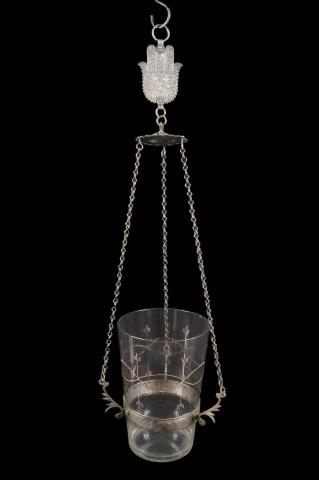
Synagogue lamp
Inventory number: 2002.78.2.1-2
Hanging in strict alignment in the side of synagogues, lamps of this type, sometimes called “memorial lamps”, were given by the family of a deceased person and lit in their memory. The name of the deceased could be written on the lamp’s glass vessel. Two lighting methods were possible: either the container was filled with oil in which lit wicks were immersed, or it contained water on the surface of which pilot lights were floated.
The upper part of the suspension chain is adorned with a khamsa hand, which means “five” in Arabic. This number is a symbol of protection, shared by both Muslim and Jewish communities in North Africa. Here, the hand is decorated with a six-pointed star known as the “Star of David” or “Seal of Solomon”, a symbol of Judaism.
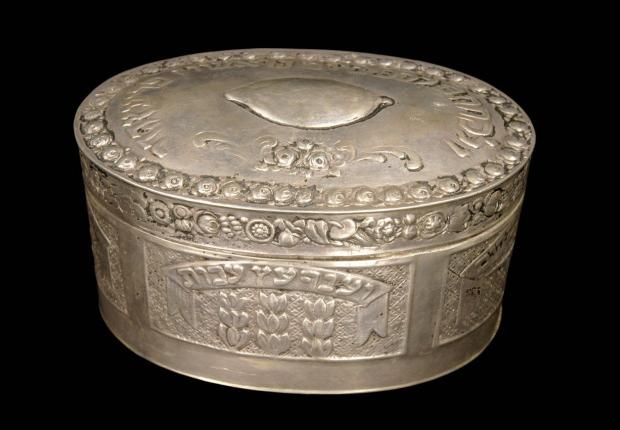
Citron box
Inventory number: 2004.84.1
The citron, also known as etrog, is a citrus fruit that plays a role in the Jewish festival of Sukkot, the Festival of Cabins. This name refers directly to the small, ephemeral structures built into houses in memory of the tents in which the Jewish people sheltered after leaving Egypt. During the reading of the psalms, the citron is held in the left hand, while a branch made up of date palm, myrtle and willow branches – 4 spices that symbolize Torah study – is held in the right. While the branch is brought to the synagogue wrapped in a cloth, the citron is transported in a box made of cardboard, wood or decorated metal, as shown here. The inside of the boxes can be padded to preserve the fruit’s rind and stalk, which give it its symbolic value. The etrog is sometimes considered the forbidden fruit of the Bible, and may also be called “Adam’s apple” or “Paradise apple”. A widely-held popular belief is that biting into a citron will ensure that a pregnant woman will have a male child.
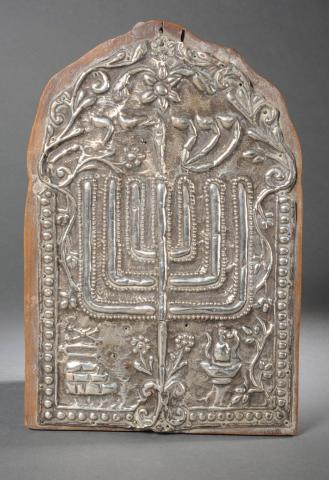
Mezuzah case
Inventory number: 2011.2.5
Mezuzot are among the most important devotional objects in everyday Jewish life. Mezuzah cases, made of wood or metal and generally measuring between 5 and 15 cm in height, enclose a small parchment scroll inscribed with two passages from Deuteronomy (VI 4-9 and XI 13-21). These must be written to strict standards: 22 lines, inscribed from memory and not copied. Fixing the case to the doorframe must also follow precise rules: it must be positioned at an angle, with the top facing inwards and the bottom facing outwards. The mezuzah is touched each time it passes through the door. This gesture of protection is accompanied by the recitation of a short prayer. This example is particularly ornate: it features the candlestick and crockery from the Temple of Jerusalem, built by King David’s son Solomon and the most important holy place in Judaism.
Circumcision kit
Inventory number: 1987.9.3
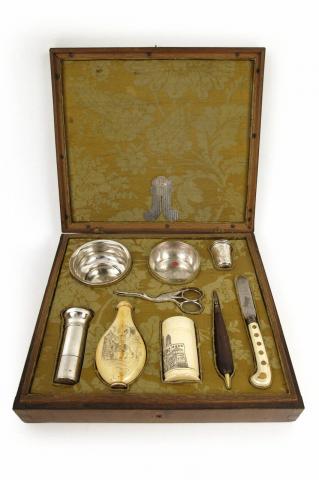
Circumcision in Judaism, known in Hebrew as brit milah (the two words meaning “covenant” and “cut”), originates in the biblical texts of Genesis and symbolizes the covenant promised by God to Abraham and the people of Israel. To constitute a sign of belonging to the Jewish religion, it must be performed at home or in the synagogue by a mohel, a voluntary officiant, today generally a member of the medical world, on the eighth day after the birth of the boy. The procedure involves removing the foreskin, exposing the glans, drawing a minimal amount of blood and reciting a blessing. This rite of passage, which marks the child’s entry into the community, must take place in the presence of ten adult men and possibly a rabbi. This box contains all the instruments needed by the mohel to perform a circumcision, including a scalpel, scissors, cups and bowls, a box and a pourer for talcum powder.
Icon of the Nativity
Inventory number: 2011.4.1
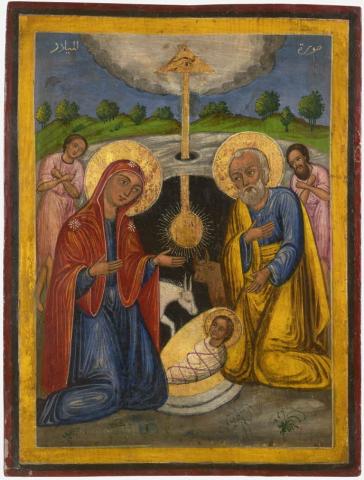
The art of the icon spans the entire Orthodox Christian world, made up of a wide variety of churches. This icon is a production of the Melkite Church, headed by the “Melkite Patriarch of Antioch and All the East, Alexandria and Jerusalem”, in residence in Damascus. This is not a national church, but is spread throughout the Arab Near East. Its patriarch, episcopate, clergy and faithful are predominantly Arab, as evidenced by the inscriptions on the icon. The term Melkite refers to the Monophysite crisis at the Council of Chalcedon in 451, when the two natures of Christ (human and divine) were officially recognized by imperial doctrine and the Patriarch. The Melkites were then considered the “true believers”, those who followed the orthodoxy of the king (melek in Syrian).
In this classic representation of the Nativity, we recognize the characteristics of the Ecole de Jérusalem (19th century): a pastel palette, a naïve style, a taste for the decorative, and a border of colored bands.
Holy Sepulchre tile
Inventory number: 2013.16.1
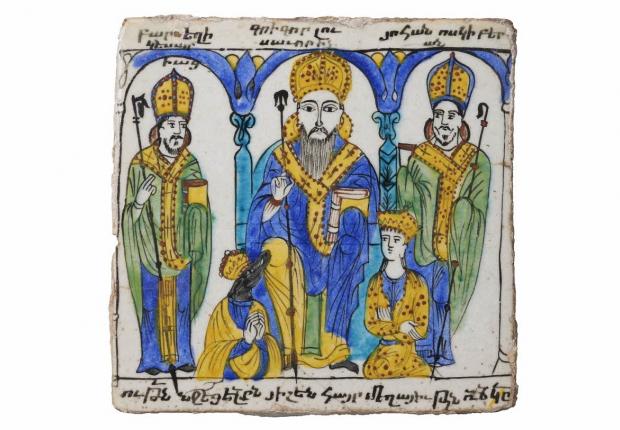
The tile shows Saint Gregory the Illuminator on a throne, holding the Armenian crozier with two snakes, surrounded by Saints Basil of Caesarea and John Chrysostom. At his feet kneel King Tiridate III, in the guise of a boar, and Saint Hripsime. The scene condenses the story of Gregory’s conversion of the Armenians: King Tiridate has Gregory, a Christian, tortured for refusing to sacrifice to idols, and condemns him to thirteen years in a pit filled with mud and snakes. Meanwhile, Tiridate falls in love with Hripsimé, a young woman who has fled to Armenia to escape the advances of Emperor Diocletian. When Hripsimé refused him, Tiridate had her tortured. Three days later, he is punished by Heaven and transformed into a boar. Tiridate’s sister has a dream and announces that only Gregory can restore her brother’s human appearance. Saved by the saint’s prayer, Tiridate is baptized by Gregory, who subsequently organizes the Armenian clergy. This tile belongs to a series commissioned by an Armenian dignitary to decorate the Church of the Holy Sepulchre in Jerusalem, where it was never installed.
Karamanli prayer book
Inventory number: 2015.11.1
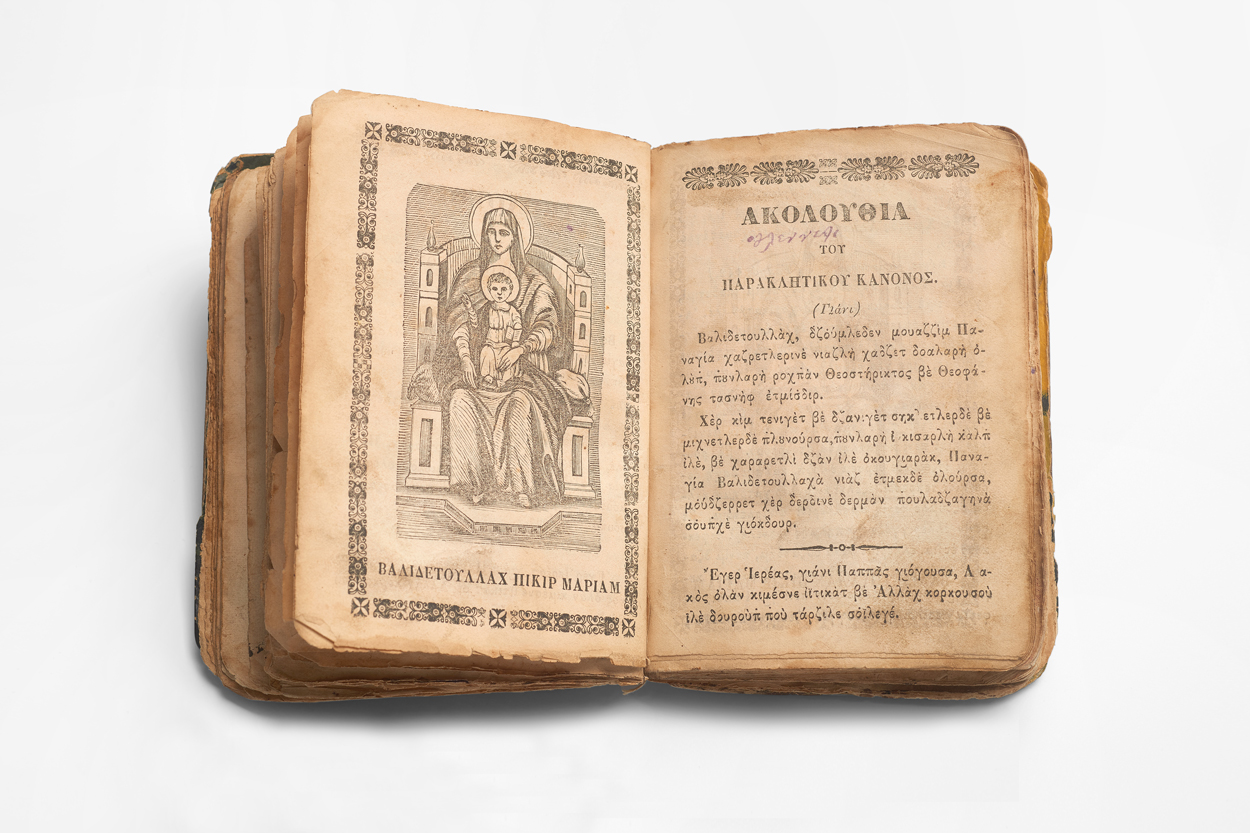
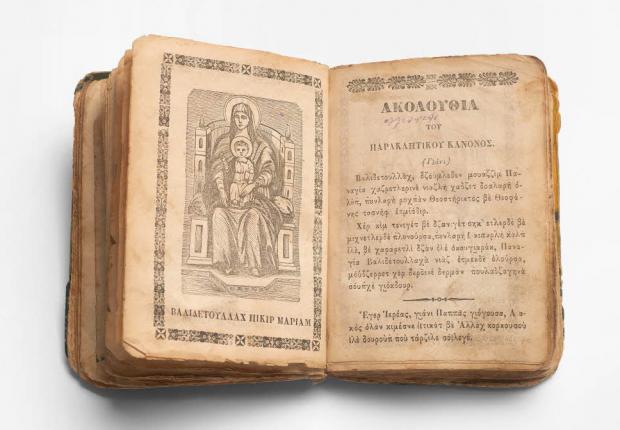
This illustrated prayer book is a relatively rare example of karamanlidika, works written in the karamanli language (Turkish written in Greek characters). These works constituted the mainly religious literature of the Greeks of Asia Minor. 752 titles published between 1718 and 1935 have been referenced. At the time, this production was a direct result of a concern to preserve the religious identity of Orthodox communities settled in Turkey, by helping believers who had become Turkish-speaking to understand dogma and liturgy. In the second half of the 19th century, editions multiplied to counter the development of Lutheranism, whose missionaries distributed liturgical books and catechisms on a large scale and free of charge. Their disappearance coincided with the departure of the Greek community from Turkey and the population exchanges at the end of the war. This copy was brought to France by a Greek Orthodox woman who left Turkey in 1922, first to settle in Athens and then to the south of France.
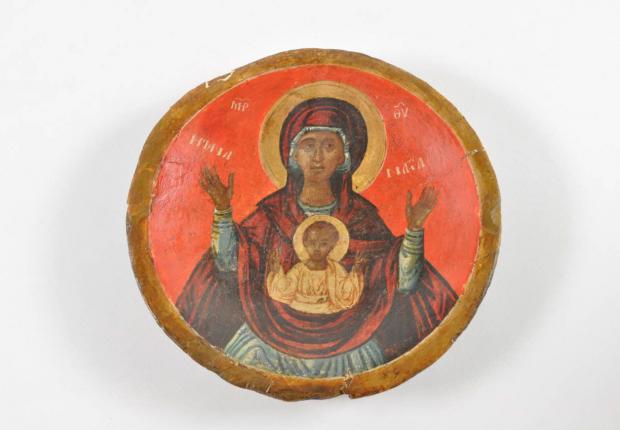
Panagiar, liturgical dish
Inventory number: 2009.1.4
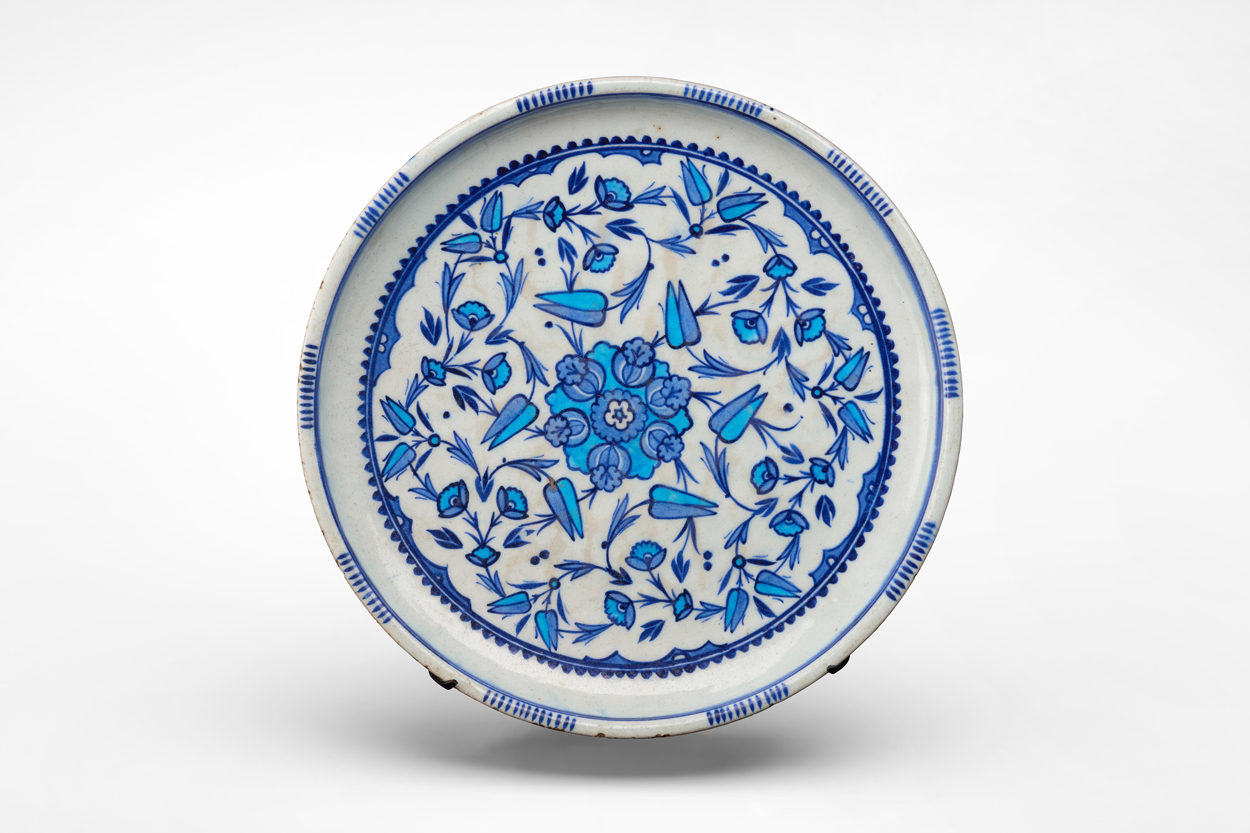
The depiction of the Virgin Mary on this dish is reminiscent of the iconography of the Virgin Mary of the Blachernes, or Blachernitissa, named after the Constantinople church where an icon of the Virgin Mary praying (hands facing heaven) with the Child on her breast is preserved in a medallion. She wears a blue dress (the color of humanity) under a red cloak (the color of divinity), thus echoing the chromatic codes widespread in iconic art.
The Virgin occupies a special place in Orthodox liturgy, in which, immediately following the offering, the priest celebrates the assembly of saints touched by Pentecost, foremost among whom is “She who is Blessed among all women”. In addition to the liturgy, the cult of the Virgin Mary may include food offerings. Believers may use a dish called panagiar to place the bread offered to the Virgin. The practice of making food offerings to the Virgin Mary has continued to this day, in both the Orthodox and Roman Churches. In the Puglia region of Foggia, for example, there are 13 rural chapels dedicated to the Virgin, offering flowers, fruit and, more rarely, bread. In Gela, Sicily, the Virgin of Manna is often the recipient of offerings of wheat grains cooked in milk and decorated bread. In Trentino and Germany, gifts of fruit (usually apples) are placed at the feet of certain statues of the Virgin.
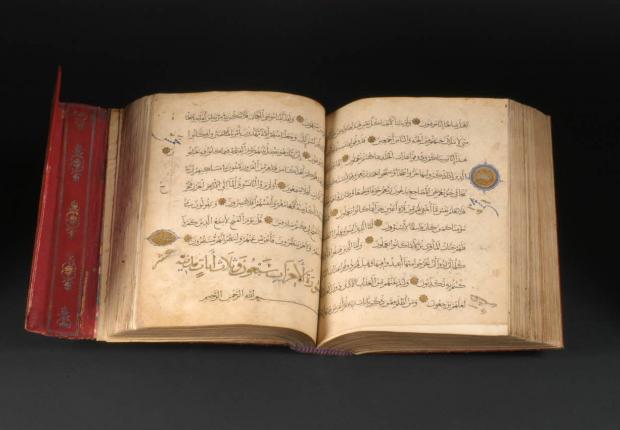
Koran
Inventory number: 2003.39.1.1-2
The Koran (from the Arabic for “recitation”) is the sacred founding text of the Muslim religion. It is made up of 6236 verses and 114 suras or chapters, and gathers together the words that God addressed to the prophet Muhammad through the angel Jibril (Gabriel), Revelation. This revelation was transmitted by the angel to Muhammad over a period of twenty-three years. For Muslim believers, the text of the Koran, written in the language of the Prophet, Arabic, has undergone no change since Revelation. It therefore reproduces exactly the words that the angel Jibril transmitted to the Prophet, hence its sacred nature. The sanctity of the Book requires a certain amount of care and attention. Koran holders can be used to keep the book open while it is being read, and to prevent it from being placed on the ground. The importance of the divine word is also reflected in the care taken in decorating the Koran. Since figurative representation is generally not permitted in Sunni Islam, the decoration, as in this case, uses abstract motifs and the art of writing, calligraphy, as a means of magnifying the divine word.
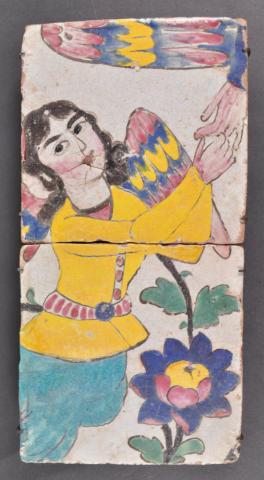
Facing tiles with angel
Inventory number: 2007.7.1
A sura in the Koran mentions the importance of angels in Islam: “The good man is he who believes in God, the Last Day, the angels, the Book and the prophets” (S. II, 177). The text cites several angels, foremost among them Gabriel (Jibril), who plays an important role: he transmits the Revelation to the prophet Idriss, announces the miraculous birth of Yahya to Zechariah, the birth of Jesus (Isa) to Mary, and appears to Muhammad in the Hira cave to reveal that he is the new Envoy of Allah. Asrael is the angel of death: sent by God, he comes to take away the soul of the dying person. Sidjil is responsible for recording all human deeds on a scroll throughout their lives. Israfil is responsible for attaching the soul of the unborn child to its body.
These tiles were produced under the Iranian Safavid Empire (1501-1736), when the cities of Meched, Yedz and Kirman were the main centers of ceramic production.
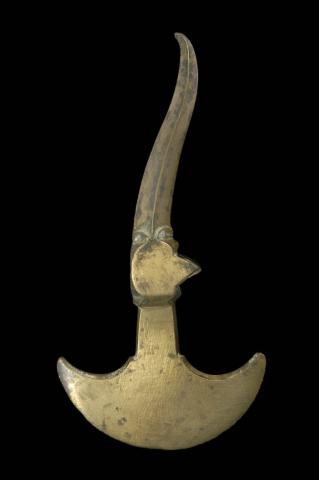
Dervish hatchet
Inventory number: DMH1955.59.938
The word “dervish”, of Persian origin, meaning “poor” or “beggar”, is used to designate members of certain Sufi brotherhoods, Muslim brotherhoods whose precepts are the inner, ascetic search for Enlightenment and the love of God. The dervish is initiated by a master and takes part in the brotherhood’s rituals, which often consist of repeated invocations of God’s name (invocations called dhikr), or other practices such as dancing or singing, leading to mystical ecstasy.
The axe is an attribute of Abu Muslim (d. 755), the general who overthrew the Umayyad dynasty, and who became a hero in Iran from the Safavid period (16th – first third of the 18th century) and a model for certain Sufi brotherhoods. It is said to have been forged from a piece of Imam Ali’s sword. Although the axe was originally a means of defense for dervishes traveling on foot, this ceremonial hatchet is above all part of the dervish’s symbolic paraphernalia, reflecting his desire to cut himself off from reality, to detach himself from the world and see only God.
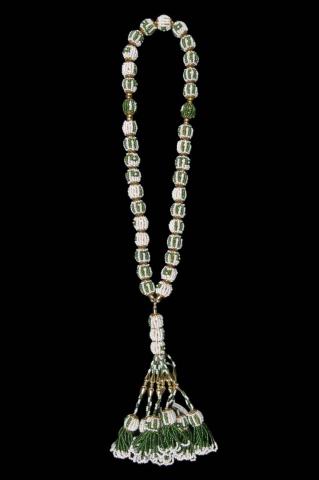
Misbaha, Muslim rosary
Inventory number: 2001.54.1
In many religions and denominations, such as Catholicism, Orthodoxy and Buddhism, rosaries are used to help believers pray, with the beads used to count the number of prayers or invocations recited. In Islam, the rosary, known in Arabic as misbaha or sabha, supports the recitation of the 99 names of God. Indeed, in addition to the name Allah, other names quoted in the Koran or in the Hadiths are used by Muslims to qualify the divinity (The Clairvoyant, The Just, The Gentle, The Living, The Patient…). Generally composed of 99 or 33 grains, they can be made from a variety of materials, from the poorest, such as olive stones, to the most ornate, as in this case. This Syrian example, made by a prisoner in the early 2000s, has the name of Allah engraved on each of the grains.
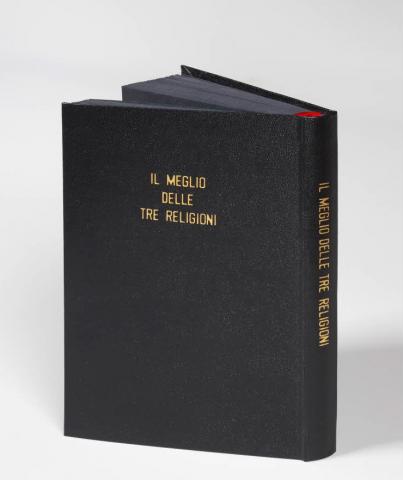
Adel Abdessemed, Il meglio delle tre religioni (The best of three religions)
Inventory number: 2013.6.1
Reproducing the format of the Bibles found in hotel rooms in European countries such as Switzerland and Germany, the book opens from the left like a book written in Arabic. The artist’s aim was to create a hybrid object, a synthesis of the three monotheistic religious faiths of Judaism, Christianity and Islam.
All 365 pages of the book, like so many days in the year, are black, evoking the idea that superimposing the three sacred scriptures would result in an illegible accumulation. The color also reflects the quarrels between the three religions. But the work also opens up a reflection on agnosticism, a school of thought which holds that no one can prove the existence of God, and on forms of spirituality other than those embodied by the three so-called “book” religions.
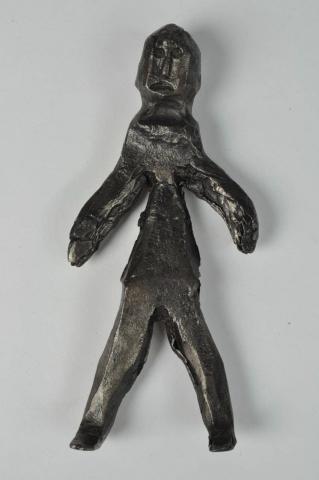
Ex voto
Inventory number: 1957.8.2
An ex-voto is an object offered in request or thanks for a grace granted by God or a holy intercessor. While ex-votos thanking for a miraculous rescue may take the form of small paintings depicting the accident, we also come across three-dimensional objects illustrating the wish expressed, as in this case. To ask for the healing of a diseased organ or limb, one might offer a representation of the organ or limb, in metal, clay or wax, for example. This is known as a morphological or therapeutic ex-voto. Sometimes it’s a representation of the whole body, as shown here, which is made and offered to place a person under protection or to thank for healing. But beyond people, ex-votos can also be used to protect livestock, or even the material possessions dear to their owners.
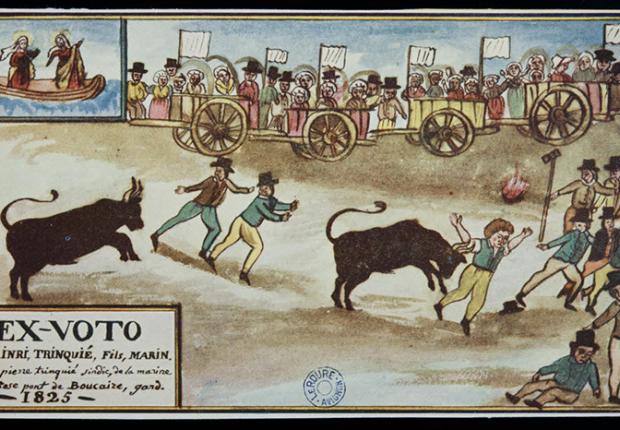
Ex voto
Inventory number: 1956.55.1
An ex-voto is an object offered in request or thanks for a grace granted by God or a holy intercessor. Painted ex-votos appeared in the 17th century. They generally consist of two registers: the lower, earthly register depicting the accident and miraculous rescue of the believer, and the upper register depicting the divine or holy apparition that made the rescue possible. In the foreground, this ex-voto shows a bullfight in which one of the participants is gored before the eyes of the crowd of spectators and other participants. In the upper left-hand corner, two saints are shown in a boat. These are probably the disciples of Jesus, St. Mary Jacob and St. Mary Salome, who arrived by boat in the Rhone delta after being expelled from Palestine. Remaining in the region, they were buried at Saintes-Maries-de-la-Mer, in the Camargue region, not far from Beaucaire, from which the unfortunate accident victim pictured originates.