Vie publique
Other themes
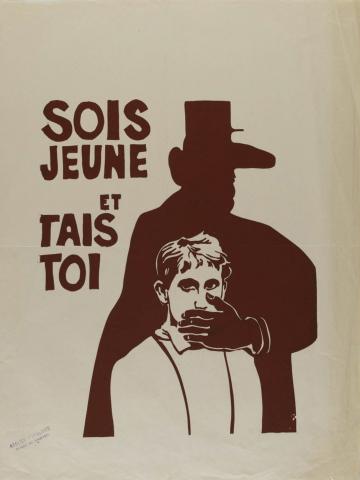
May 68 poster
Inventory number: 1968.48.34
This poster depicts the red silhouette of a tall figure wearing a kepi, immediately identifiable as General de Gaulle. His left hand is placed over the mouth of a student, to prevent him from expressing himself. On the one hand, this gesture symbolizes all forms of political censorship and possible dissent; on the other, it marks a moment in French history when young people no longer recognize themselves in the post-war governments and in a society that has since been politically marked by the almost omnipresence of General de Gaulle. To this logic of generational confrontation is added that of an opposition of political methods and practices, where military force and authority challenge the dynamics of civil society embodied by its youth. This image was created and circulated from the Atelier Populaire, where students at the Ecole des Beaux-Arts in Paris held daily general assemblies, in the manner of union action at the Boulogne-Billancourt factory, for example. An adaptation of this image was produced in spring 2016 with the phrase “Sois jeune et bats toi”, where the character wearing kepi is bitten on the left hand by the youngest; it was used during demonstrations, notably in Marseille, to protest against the el-Khomri labor bill and the government’s use of Article 49-3 of the Constitution to pass this text.
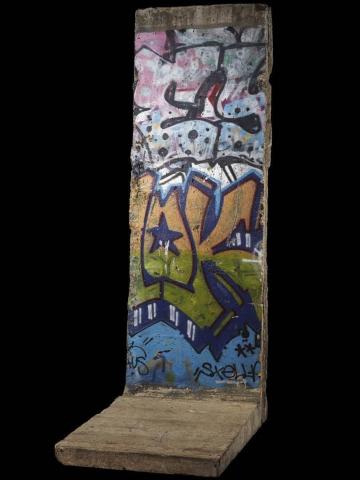
Berlin Wall section
Inventory number: 2008.77.1
The fragment of the Berlin Wall, donated to the Mucem by the city of Berlin, stands as an emblematic object; an object of memory for the heritage of the 20th century, an object of division for a city conceived at the time of the Cold War to create a border between two political entities, but above all dividing German and Berlin families overnight. An “iron curtain” had been drawn between the Baltic port of Lübeck and Czechoslovakia as early as 1947 by the West and the Soviets, and the Berlin Wall was erected on the night of August 12-13, 1961 as an “anti-fascist protection wall”; it forms a physical boundary over one hundred and fifty-five kilometers enclosing West Berlin. Three meters and fifty centimeters high, the wall is just one element in a no-man’s-land lined with anti-personnel mines. Contested by Berliners, and because they had to live with it and express how heavy its presence was, they used it as a medium for graffiti. The fall of the Wall on November 9, 1989, as a result of peaceful protest and favorable geopolitical conditions, underlines the extent to which public opinion must also be taken into account by state power. Since its destruction, other border walls have been erected, such as the seven-hundred-kilometre-long wall on the West Bank, which was declared illegal by the International Court of Justice in 2004.
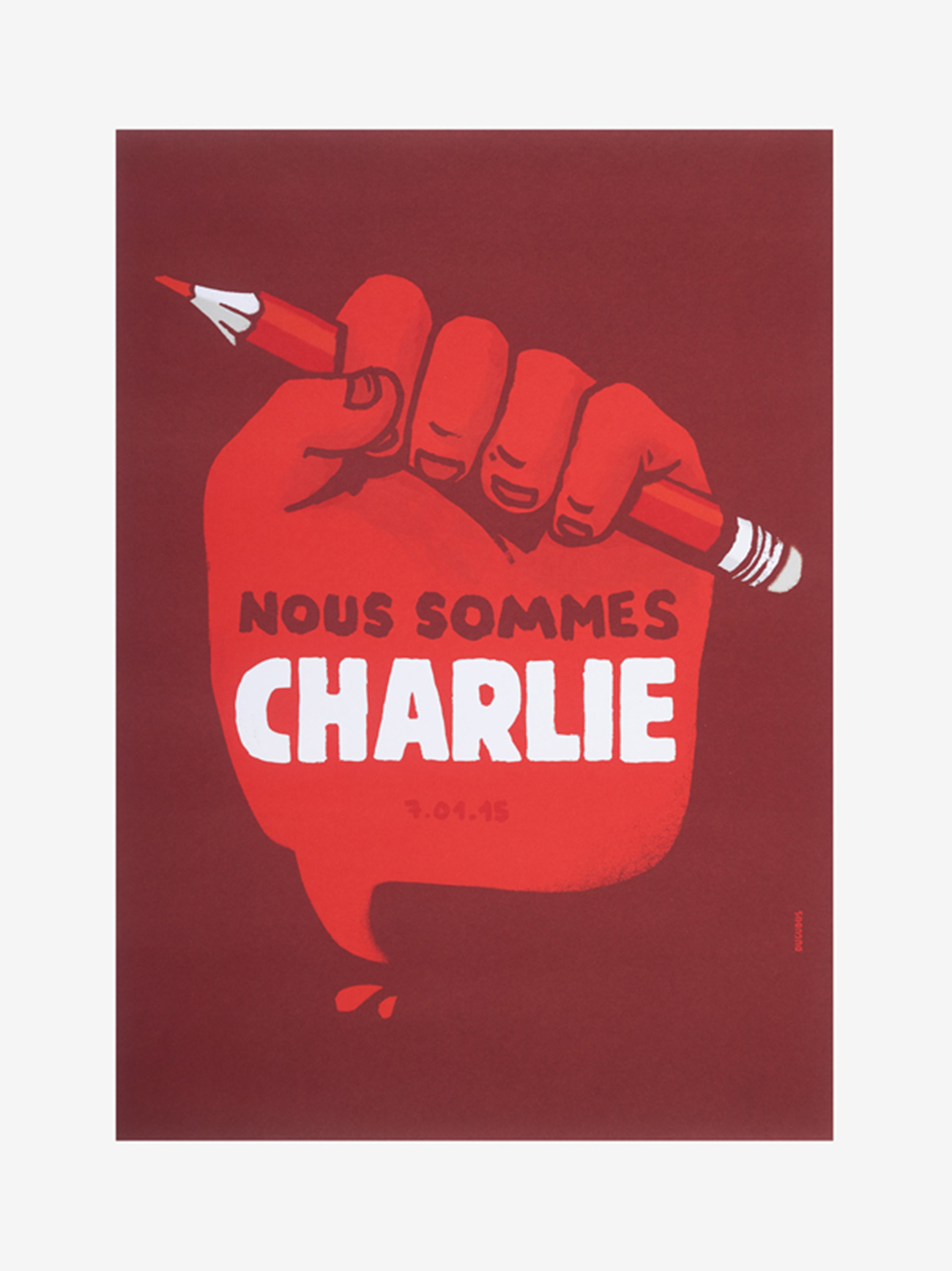
Event poster
Inventory number: 2015.9.7.1-2
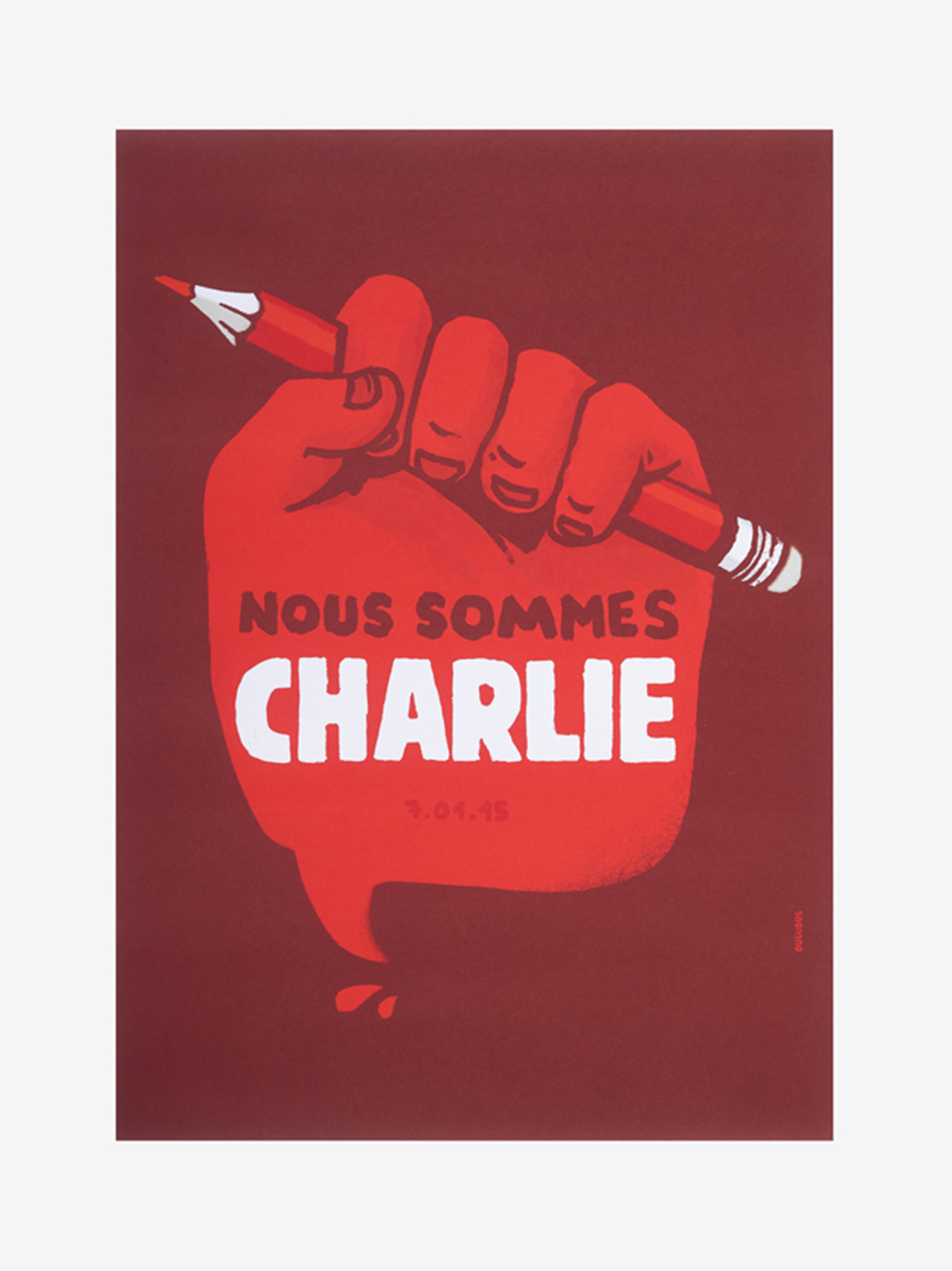
This poster is part of a set of signs, placards, stickers… designed in a hurry by the demonstrators who took part in the January 7, 8, 9 and 11, 2015 demonstrations in Paris, in reaction to the terrorist attacks perpetrated from January 7 to 9 in the capital against the editorial team of Charlie Hebdo, then against the Hyper Cacher in Vincennes, but also representatives of the forces of law and order. The first spontaneous demonstrations, on the evening of January 7 in tribute to the victims at the offices of the satirical newspaper Charlie Hebdo, were an opportunity for demonstrators to create panels featuring montages of old Charlie Hebdo front pages, as well as reproductions of Delacroix’s La Liberté guidant le peuple. Dugudus, a young Parisian poster artist, designed this poster for the occasion, which was produced by hand in half a day. It features the closed-dot motif, illustrating both the struggle that the cartoonist Charb, assassinated by the January 7 commando, used to incorporate into his drawings, and, more importantly, the idea of freedom of expression, associated here with the pencil. The limited color palette and the strength of the drawing give this poster great expressive power.
Poster for an event
Inventory number: 2015.9.1
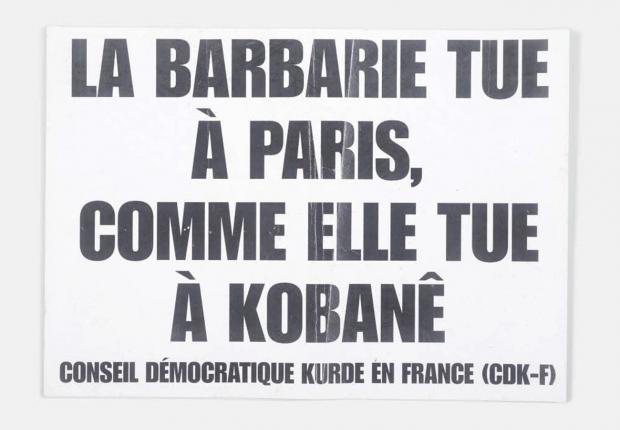
This sign is one of the documents preserved after the Paris demonstration of January 7, 2015 by the collective “Les Balayeuses archivistiques”, who, as their name suggests, have set themselves the mission of safeguarding modest documents to build a memory of the ephemeral events that make up the most spontaneous demonstrations. The battle of Kobane (Syria) – September 2014 to June 2015 – saw jihadists and Kurds clash. In this month of January 2015, the forces involved are beginning to be supported by foreign powers, and since early November 2014, the Kurdish Democratic Council in France has already organized support demonstrations in Paris and France to publicize the city’s siege, to French civil society. The January 2015 attacks on Charlie Hebdo’s editorial team, but also on the Hyper Cacher in Vincennes and targeting police officers, allow the Kurdish Democratic Council to recall the parallelism at play in France and Syria, where jihadists constitute a real and clearly identified threat.
Mayor’s scarf
Inventory number: 1938.101.18
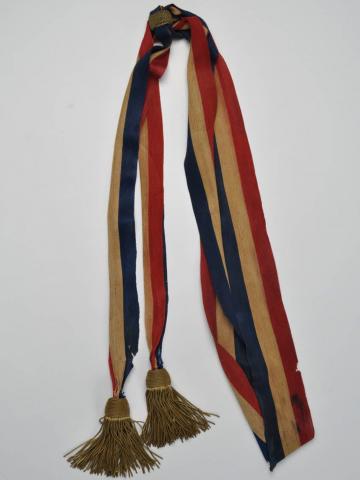
This mayor’s scarf was worn by Pierre-Louis Duchartre (1894-1983), mayor of Jonquières-sur-Saint-Vincent during the Third Republic (1870-1940), author of numerous works on folk arts and traditions and former inspector of the Musées de France. It is finished with golden bangs and tassels, signifying that it was worn by an elected municipal official. In fact, since the National Constituent Assembly of 1848, the gold color of the bangs and braid distinguishes mayors from members of parliament and officers of the court, for whom the trimmings are silver. This element of costume obeys a very specific protocol, as it marks the distinctive sign of the public authority or elected representative. Mayors wear it slung from the right shoulder to the left or around the waist, but the blue color must always be worn as close to the face as possible. Members of parliament, on the other hand, wear the red color closest to the collar. Today, tricolored scarves are made to a standard size of 2m in length and 8cm in width, and woven from a fabric composed alternately of blue, then white, then red threads.
Marianne
Inventory number: 1976.67.1
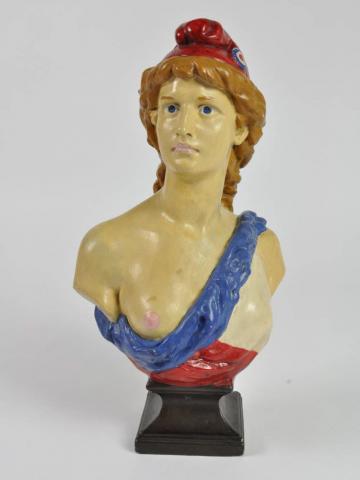
For historian Maurice Agulhon, the name Marianne began to be associated in the 1850s with the abstract idea of the French Republic, always represented by a female allegory. From the Third Republic in 1870 onwards, engravings and small busts were circulated under the name Marianne. In demonstrations, a young woman wearing a red bonnet and carrying the tricolor flag often headed the procession as the embodiment of the Republic, on the model of Eugène Delacroix’s Liberty Guiding the People (1830). Often, when a live model is not available, a bust is paraded like a shrine, following the model of Catholic ostensions.
The official image of the Republic had to be established in the public arena. The Paris Commune (1871) had associated the Phrygian bonnet with a socialist-inspired revolution; indeed, the bonnet has been the traditional emblem of Liberty since Roman antiquity. This representation, more popular and embodying the progressive, socialist political morality of the 1880s, is the one used as the model for the large statue of the Place de la République commissioned by the then far-left city of Paris in 1883. Here, this bust of Marianne shows her with her right breast uncovered, quite spontaneous, wearing the tricolor tunic, as well as the Phrygian bonnet and cockade, in a political tradition rather marked by left-wing socialist and workers’ currents, to serve in the circles or town halls of the interwar period.
Battle of Tlemcen
Inventory number: 1965.75.54
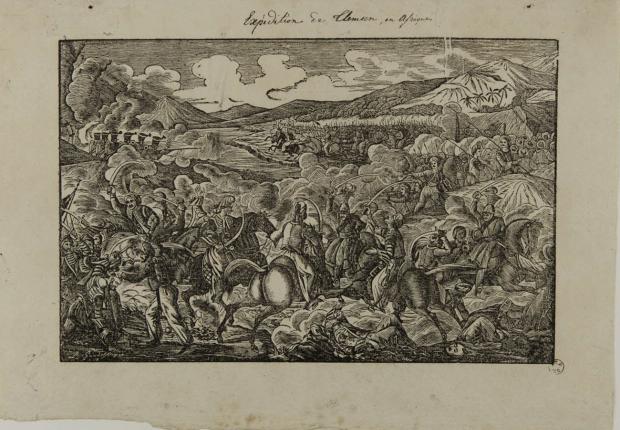
The Tlemcen expedition, in January 1836, was a military episode that saw Marshal Clausel’s troops clash with those of Emir Abd el-Kader in the early years of France’s military conquest of Algeria. While Emir Abd el-Kader was said to have left the town of Tlemcen on January 11 or 12, Marshal Clausel seized it on January 13; on January 15, a small expeditionary army led by Generals Pénégaux and d’Arlanges moved towards the Emir’s troops, who had remained in the vicinity of Tlemcen; but this military operation ended in defeat for both sides, and the two French generals were disavowed. On May 30, 1837, the Treaty of Tafna signed by General Bugeaud and Emir Abd el-Kader clarified the territorial situation: by recognizing France’s sovereignty over a third of the territory, Abd el-Kader saw his sovereignty over two-thirds of the territory of the former Ottoman regency of Algiers strengthened. This treaty organizes relations between the two powers, which mutually recognize each other’s sovereignty over this territory. This print dates back to the work of the chronicler Charles-Louis Lesur, who published articles on military events in Algeria from 1837 onwards, bringing the country’s recent history into popular memory.
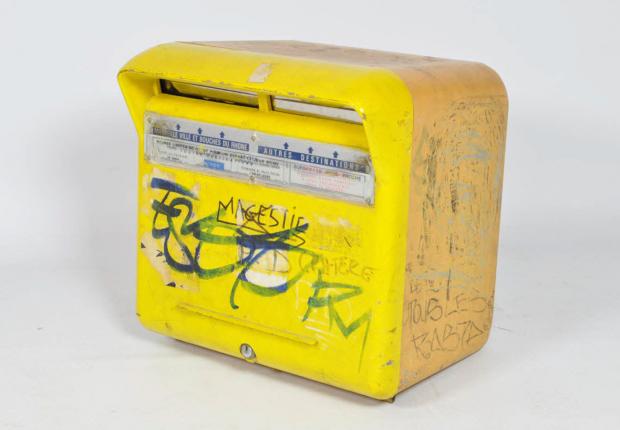
Tagged mailbox
Inventory number: 2003.140.1
This letterbox was part of the street furniture. It was, of course, originally the property of La Poste, which agreed to donate it to the Mucem as part of the Graff campaign in the early 2000s. Through targeted acquisitions, this survey-collection was intended to reflect the dynamics of the artists who emerged from the hip-hop movement of the 1980s, and the appearance in urban space of graffiti and aerosol drawings, sometimes signed by young artists influenced by New York graffiti. Tagged by a graffiti artist in 2002, it can now be seen as an urban art medium that has gone from being graffiti to an artist’s signature.
On this letterbox in Marseille, the tagger has written “TOUS DES RASTA”, “MAJESTIC”, “CRATERE”, “JOHANA+CHRISTOPHE”, “C’EST UN ENFANT DE PUTE”, “FATCATUR”, “AMS”, “GAP”, “NORO”, “NORONDE FREVALON EST UNE BALANCE NOTOIRE”; the inscription in the urban space fixes the discourse and makes it known to passers-by, who don’t necessarily manage to read it because they don’t take the time to understand the graphic logic of the text. The meaning thus escapes the majority, and reminds us that graffiti artists, even if they work in gangs, fiercely insist on their independence.
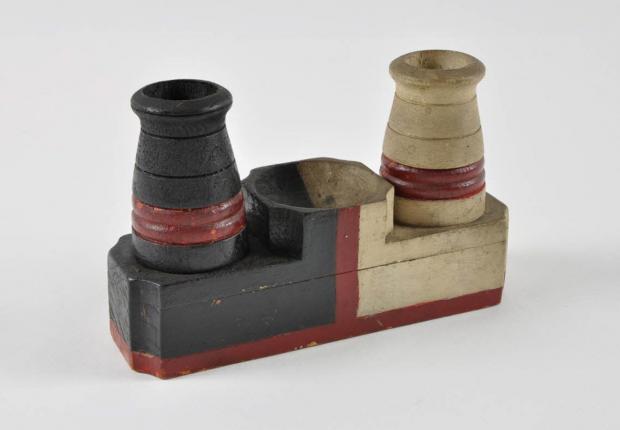
Ballot box
The ballot boxes used in the old learned societies, Masonic lodges or town councils were equipped with two cavities of opposite color; here white on one side and black on the other, to receive the voting tokens, which are themselves indistinguishable as the vote is cast by the necessarily limited number of participants. Voting is thus anonymous, and allows both majority and minority votes to be cast. Abstention is impossible with this system, which allows you to answer a question with a yes or no vote.