Arts du spectacle
Other themes
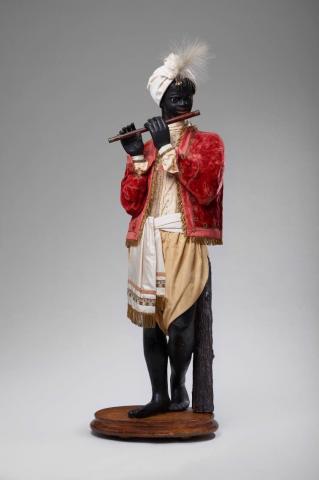
Automaton flutist
Inventory number: 2015.15.1
In the century of the Industrial Revolution, automaton technology was mastered mainly by French craftsmen. Alexandre-Nicolas Théroude, the creator of this piece for which he registered a patent in 1866, is known as the first to have enclosed the mechanism in the body of the automaton. Inspired by the marble model of the Faune jouant de la flûte exhibited in the Louvre (former Borghese collection, MR 187), the decorative envelope of this automaton, to satisfy the exotic tastes of the clientele of the time, takes on the appearance and color of the subjects of the colonial empire, then at its height. He has a mechanical cylinder organ in his chest; his fingers move up and down the instrument in sync with the music, he bows with his head, his eyes consider the audience, he blinks and his mouth seems to control his breath. The creation dates of the operetta arias he performs indicate that this model was probably made immediately after 1878, the date of the Paris Universal Exhibition. The exceptional state of preservation of this piece means that the mechanical organ still functions today with all its original parts, i.e. without any of them (apart from the bellows skins) having had to be replaced.
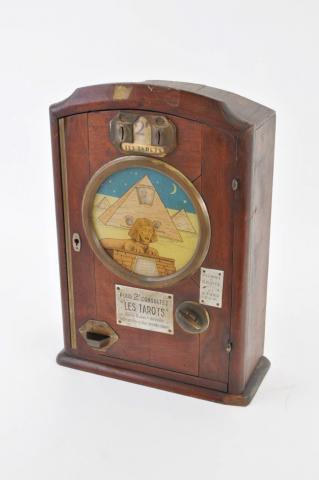
Automatic clairvoyant
Inventory number: 1987.15.1.1
This automaton, which tells your fortune by tarot cards for 2 Frs, is one of the automatons and roulettes found at the beginning of the 20th century in just about every fair and funfair, as well as in a few local cafés. Its mechanism is probably that of a mechanical slot machine converted from a lottery to a fortune-telling machine. The Bussoz company, which made this automaton, specialized in automatic games, and was also known for its table soccer, pinball machines, jukeboxes and other mechanical games installed in popular cafés.
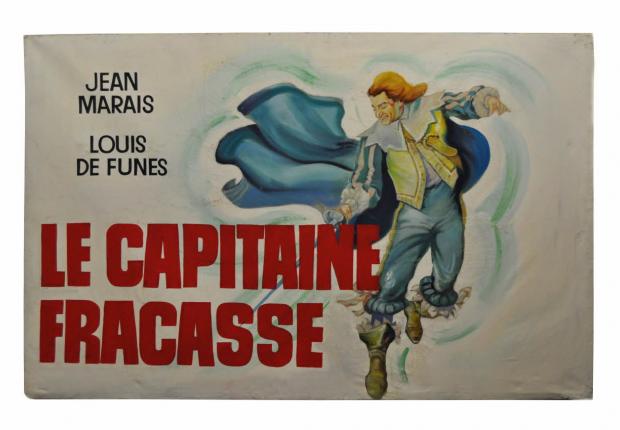
Painted cinema canvas
Inventory number: 1999.60.2
Painted advertising canvas for a cinema window for the film Le capitaine Fracasse, starring Jean Marais, Philippe Noiret, Louis de Funès and Sacha Pitoëff and directed by Pierre Gaspard-Huit in 1961. The figurative composition of this canvas is divided between the title in red and the character of Captain Fracasse dressed in blue. This asymmetry is reversed in the graphic design: the dry geometry of the title is matched by the realism and movement of the character, illustrating his novelistic character. The stripped-down yet baroque style of this poster makes it an outstanding example of Publidécor’s large-scale production. It’s interesting to note that this canvas is a reuse: underneath the surface work, you can still make out part of the painted canvas from the film The Hunchback (whose title role is also played by Jean Marais), which has been re-sewn here. Paint retouching has been used to modify the Hunchback’s appearance (the hump on his left shoulder is masked by the new paint), giving him the physical features of Captain Fracasse.
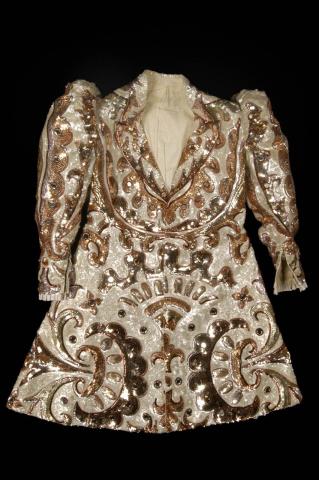
Clown coat
Inventory number: 2001.29.1.1
From 1929 to 1993, the Paris-based Maison Vicaire was world-renowned for its production of all kinds of costumes and stage sets. Within the company founded by his parents, Gérard Vicaire (1927-1993) devoted his life to making remarkable light suits that have dressed white clowns the world over. This coat was custom-made for Bruno Stutz, the white clown from Swiss duo The Chicky’s. Vicaire costumes were expensive, and it was not uncommon for them to be resold after being designed and made to measure, to be reused by other artists. Bruno Stutz, having signed ten-year contracts, was contractually obliged not to wear the same outfit every year, and therefore had to renew his wardrobe. After working with this coat for one season, he announced that he wished to sell it. Gilles Février, who was thinking of leaving the ventriloquist profession for that of a white clown, was looking for a coat, and this one fit. He wore it for a short time, performing a musical glass act, before returning to ventriloquism.
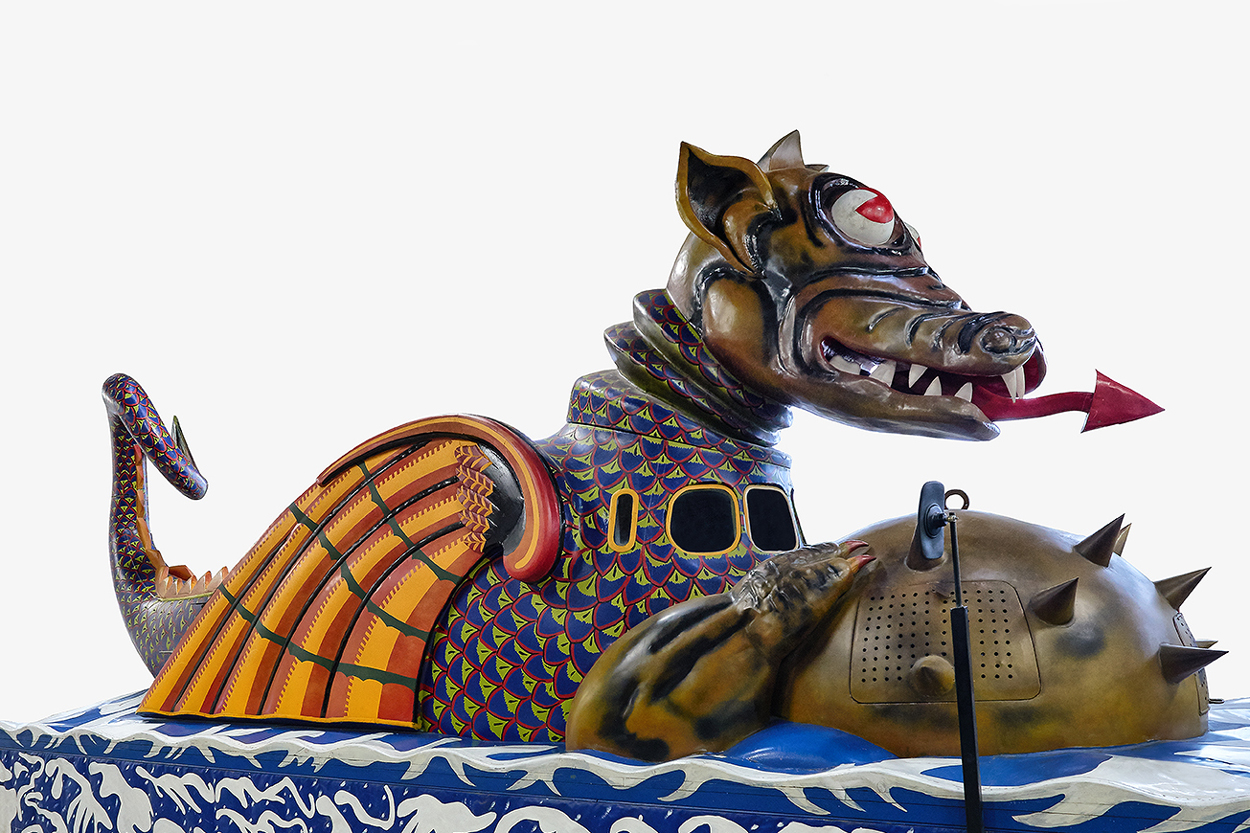
Circus parade float
Inventory number: 1996.52.2
Designed by André Chéreau, a renowned builder of merry-go-rounds and fairground floats, this float is one of the many one-offs he made to order for the tours of France’s leading circuses (Pinder, Bouglione, Amar, etc.) and fairgrounds. The float was used in street parades to announce the circus’ arrival in town and the program of the show. Based on a truck chassis, this float is a true masterpiece of bodywork, made of painted sheet metal nailed to a wooden frame in the shape of a dragon. A grandstand is installed at the rear of the float to accommodate a ten-piece orchestra, while the driver is concealed in the dragon’s head.
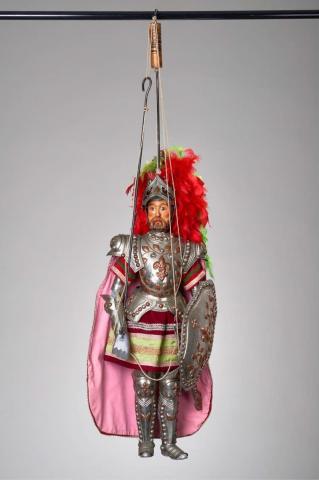
Charlemagne puppet
Inventory number: 2015.1.3
Puppet theater, or Opera dei Pupi in Italian, is a theatrical form whose main protagonists are medieval knights, represented by rod-and-wire puppets. Most of these puppets are dressed in armor, and carry a shield and a metal sword. They were, and still are, made by local sculptors, sometimes puppeteers themselves. They tell stories inspired mainly by the chivalric literature of the European Middle Ages, focusing on the paladins of France, Charlemagne’s heroes and their battles against the Moors. This theatrical form and its repertoire express and reflect the Sicilian sense of belonging and identity, as well as bearing witness to the earliest forms of European identity. UNESCO has inscribed Opera dei Pupi on the Representative List of the Intangible Cultural Heritage of Humanity. In 2015, Mucem acquired from Teatro Carlo Magno, directed by Palermo-based puppeteer Vincenzo Mancuso, the entire cast of La mort de Roland (end of the Carolingian cycle), i.e. forty-one puppets, as well as all the show’s sets and props.
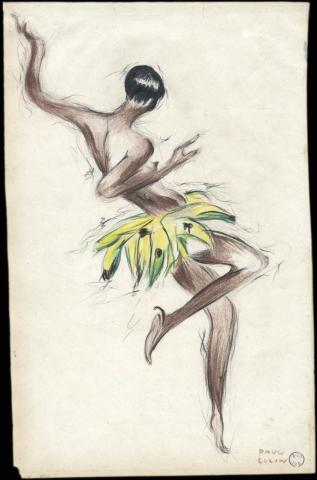
Drawing by Joséphine Baker
Inventory number: 2001.3.1
In the immediate aftermath of the First World War, the exoticism of the French colonial empire was particularly in vogue, at the same time as North American jazz was making a promising debut in Europe, and in Paris in particular. The Théâtre des Champs Élysées, which in 1923 had presented the ballet La Création du Monde based on Blaise Cendrars’ Anthologie Nègre, developed (based on an idea by the painter Fernand Léger) the project of a show performed entirely by blacks, following the example of what was already being done in the United States with some success. Born in Saint-Louis (Missouri) in 1906, Joséphine Baker began singing and dancing in Broadway music halls at an early age. In 1925, the Revue Nègre premiered at the Théâtre des Champs Élysées, with Joséphine Baker as the opening act. The whole of Paris flocked to the premiere. Joséphine Baker, whose fame would spread around the world, became a French citizen in 1937. A committed woman, she took part in the Resistance during the Second World War, and became involved in the struggle for Black civil rights.
The Revue Nègre poster was designed by painter and poster artist Paul Colin, who became a friend of Joséphine Baker. In 1929, Colin published a series of color lithographs under the title Le Tumulte noir, in homage to the “black madness” that had taken hold of Paris with the emergence of jazz and the Charleston, and above all because of Josephine Baker’s incredible personality. This is the design that graces the cover of Tumulte noir.
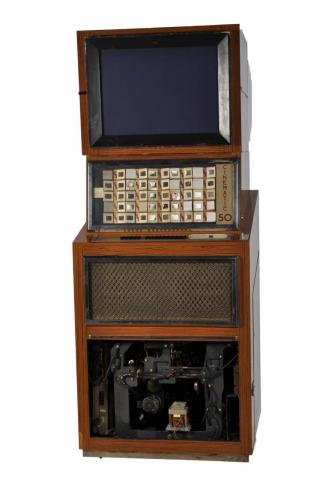
Cinematic 50
Inventory number: 1991.33.3
The Cinematic 50 were super 8 mm sound film projectors, with the special feature of being equipped with fifty reels of super 8 mm sound film. In the same spirit as the Scopitones, these were jukeboxes which, in addition to playing music, presented short films, the ancestors of today’s music videos. These machines, usually activated by coins, were installed in cafés from the late 1950s to the mid-1960s. Some, like this one, incorporated songs right up to the end of the 1970s. This scopitone contains the hits of artists who were all the rage in France in those years: Claude François, Village People, Dalida, Cerrone, Dick Rivers, Sheila, etc.
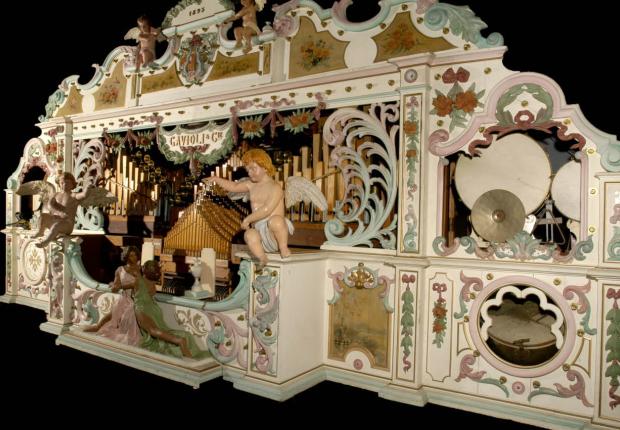
Fairground organ
Inventory number: 2002.69
Monumental one-hundred-and-fifteen/one-hundred-and-eighteen-key mechanical organ built in Italy in 1895. This organ was built by Charles Marenghi, former foreman and heir to the Gavioli firm. This firm, founded in 1806 in Modena (Italy) by Giacomo Gavioli, is world-renowned for having brought the production of fairground organs to the highest level. Around 1920, Gaudin, a former Marenghi foreman, transformed this organ. This instrument, capable of producing a particularly powerful sound, was then installed in fairgrounds at the foot of steam-powered roller coasters, to better attract passers-by. It has one thousand and forty pneumatically-operated pipes, one hundred and five keys, one hundred and eighty-three registers, thirty-two melody notes, twenty-five counter-notes, twelve accompaniment notes plus twelve bass notes. It is entirely chromatic and has a total range of around five octaves, allowing for all kinds of musical renditions, adaptations and creations. The effects produced are those of the double bass, acoustic bass, bombardon, trombone, English horn, slide trombone, saxophone, soprano saxophone, tenor saxophone, cello, cornet à pistons, 1st and 2nd violins, viola da gamba, alto violin, large flute, baritone, French horn, bassoon, clarinet, small clarinet, oboe, musette, flugelhorn, small flute, flageolet, panpipes, piccolo, snare drum, orchestral timpani, bass drum, cymbal and castanet.
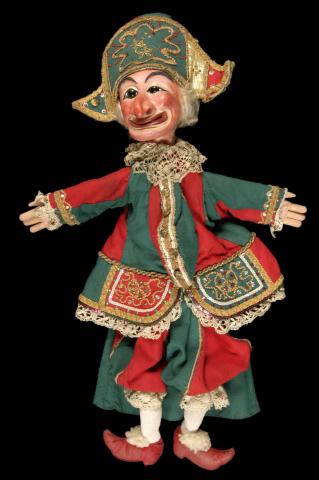
Polichinelle
Inventory number: 1989.27.1
Polichinelle is one of the central characters of commedia dell’arte, where the Pulcinella character took part in thwarted love intrigues by playing the role of valet, a jester authorized to express, even to excess, what everyone would like to hide from others. Hunchbacked and almost deformed, Pulcinella is a Neapolitan whose words are often difficult to understand. To distort the character’s voice, puppeteers would place a metal or wooden blade under their tongue: the “practice” (pivetta in Italian). Pulcinella’s very name means “little chick”, in reference to his beak-like nose and nasal voice. As Harlequin’s sidekick, he’s lazy and vulgar, yet cunning. Always armed with a stick, he is a feared character who never hesitates to respond violently to authority.
In the mid-16th century, commedia dell’arte arrived in France, where it met with success at courts and fairs. Over the centuries, these puppets mellowed, adapting to a more childlike audience from the 19th century onwards. The character of Polichinelle gradually became the presenter of puppet shows for children, notably the stories of Guignol. This puppet was created between 1981 and 1984 for the Théâtre de Chaillot, when Antoine Vitez was director and had taken over the puppet repertoire for his children’s theater.
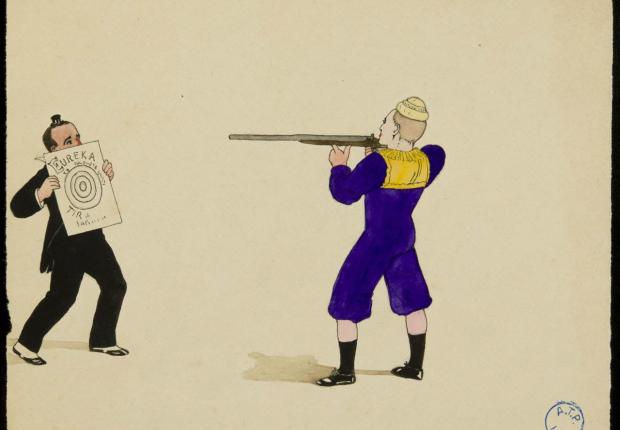
Drawing of a circus act
Inventory number: 1968.102.320
Marthe and Juliette Vesque devoted their lives to the circus. Their father, Julien Vesque, a botanist at the Muséum national d’Histoire naturelle, passed on his passion for drawing to his two daughters. Their fascination with the world of the circus led to the creation of an exceptionally rich collection. Their personal collection comprises almost sixteen thousand drawings of extreme precision and realism in the retranscription of movements and costumes. These watercolor drawings are accompanied by an extensive archive of research carried out by the Vesque sisters throughout their lives on all aspects of the performing arts and popular festivals, as well as on the world of sport and physical culture. These archives include handwritten notebooks in which Marthe and Juliette Vesque described in detail the circus acts they had attended and meticulously drawn.
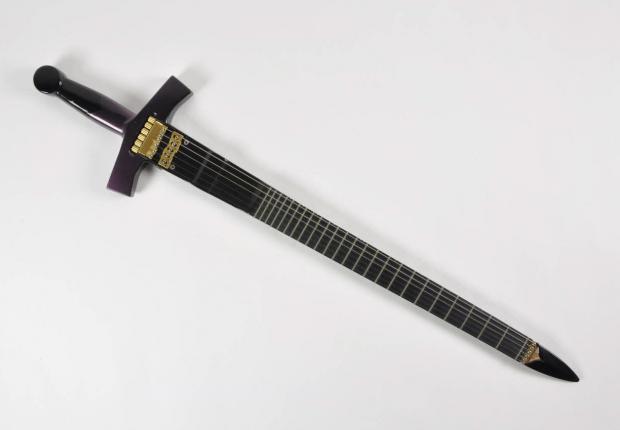
Electric guitar
Inventory number: 2002.80.1
Mucem’s collections include many musical instruments. The very first piece in its collections is a drum. Among the most recent instruments is this electric guitar made in the early 1980s by French luthier Vincent Berton. Extremely brilliant and a perfectionist, Vincent Berton was known for the eccentric shapes of his instruments, perfectly in tune with the aesthetics of certain bands and guitarists of the 1970-1980s. Jealous of the secrecy and sound of his pickups, he concealed them by integrating them into the body of the instrument itself. This sword guitar is emblematic of his creations, distributed under the VLine brand, and of the certain spirit of an era in rock.
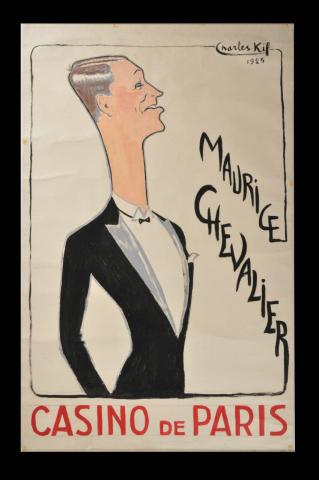
Casino poster
Inventory number: 1965.188.3
Maurice Chevalier (1888 – 1972) was one of the most famous singers and actors of the French music hall. His fame extended to the United States, where he enjoyed a career so brilliant that it earned him not only an honorary Oscar (1959), but also nominations for the Golden Globes and Grammy Awards. This painting, by Charles Kieffer (1902-1992), is a lithographed poster design for Maurice Chevalier’s show at the Casino de Paris in 1925.
The Casino de Paris is one of the capital’s most illustrious music halls. In 1914, Léon Volterra, an entertainment entrepreneur who ran the Luna Park amusement park on the outskirts of Paris, created a brand-new cinema-music hall in a building that had previously housed a skating rink as well as a theater, in order to present revues capable of competing with those of the Moulin Rouge. From then on, the Casino de Paris stage hosted the first jazz orchestras in France, and its revues were renowned throughout Europe. Immediately after the end of the First World War, Léon Volterra created a new revue, with Mistinguett as its star. Mistinguett was already famous, and performed successfully at the Moulin Rouge and the Folies Bergères. It was there, moreover, that she met Maurice Chevalier, with whom she had a long love affair that led her to enlist as a spy for France during the war.
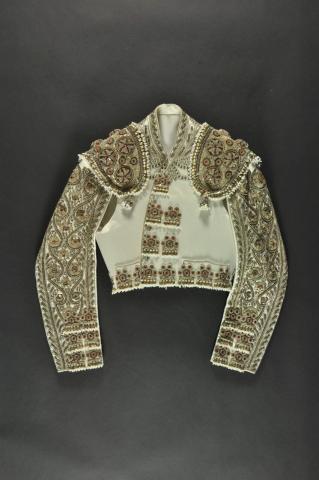
Chaquetilla, bullfighter’s jacket
Inventory number: 2004.81.1.4
In classic bullfighting, each team of bullfighters, or cuadrilla, comprises a matador, three banderilleros and two mounted picadors. Bullfighters wear “trajes de luces”, so called because they are richly embroidered with gold, silver or brass cannetille. Trajes de luces are both ceremonial costumes and the distinctive garments that participate in the ritualization of the practice. The three main pieces are made of silk adorned with cannetille: the jacket (chaquetilla), whose thickness and rigidity offer relative protection to the bullfighter’s body (without protecting it from blows from the horns), the vest and the breeches (taleguilla). The costume is completed by a white shirt, a tie (pañoleta), a wide silk belt and two pairs of superimposed stockings. Foot bullfighters also wear light shoes, usually black, a special headdress (montera), traditionally made of astrakhan, and a hairpiece (coleta) attached to the hair at the nape of the neck. Among bullfighters, only the matador wears a gold (or brass) embroidered suit, while the other members of the cuadrilla under his authority wear suits embroidered with silver cannetille, in black or white.
This chaquetilla was tailor-made for Christian Romero, a remarkable banderillero from Arles, who inaugurated it during the alternative (investiture bullfight) of the famous matador Jesulín de Ubrique, whose cuadrilla he was a member of at the time.
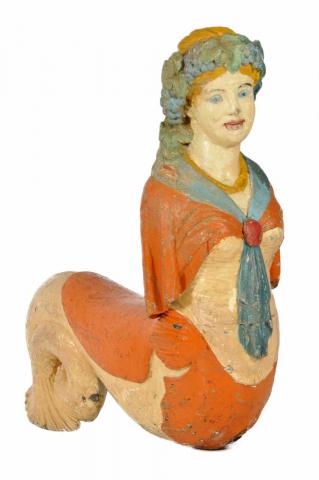
Carousel siren
Inventory number: 1991.2.1.1
Friedrich Heyn (1849-1928) is considered the founding sculptor of the German school of fairground art. He began by sculpting merry-go-rounds, particularly horses, on his own, but his talent was soon recognized. To produce complete rides, from the simplest to the most complex, he developed his workshops brilliantly, and at his peak, his factory in Neustadt sur Orla (Thuringia, Germany) employed up to a hundred people. His rides and subjects are known throughout Europe. Far beyond the world of fairground art, his talent as a sculptor is unanimously recognized, as much for the finesse of his creations as for the quality of his color schemes.
This mermaid is the subject of a jumping merry-go-round, i.e. a merry-go-round on which the subjects move up and down in a regular pattern. It is part of a series of six pieces of siren subjects by Friedrich Heyn in the Mucem collections, taken from merry-go-rounds in the Île-de-France region in the last century.