Vêtements, costumes, textile
Other themes
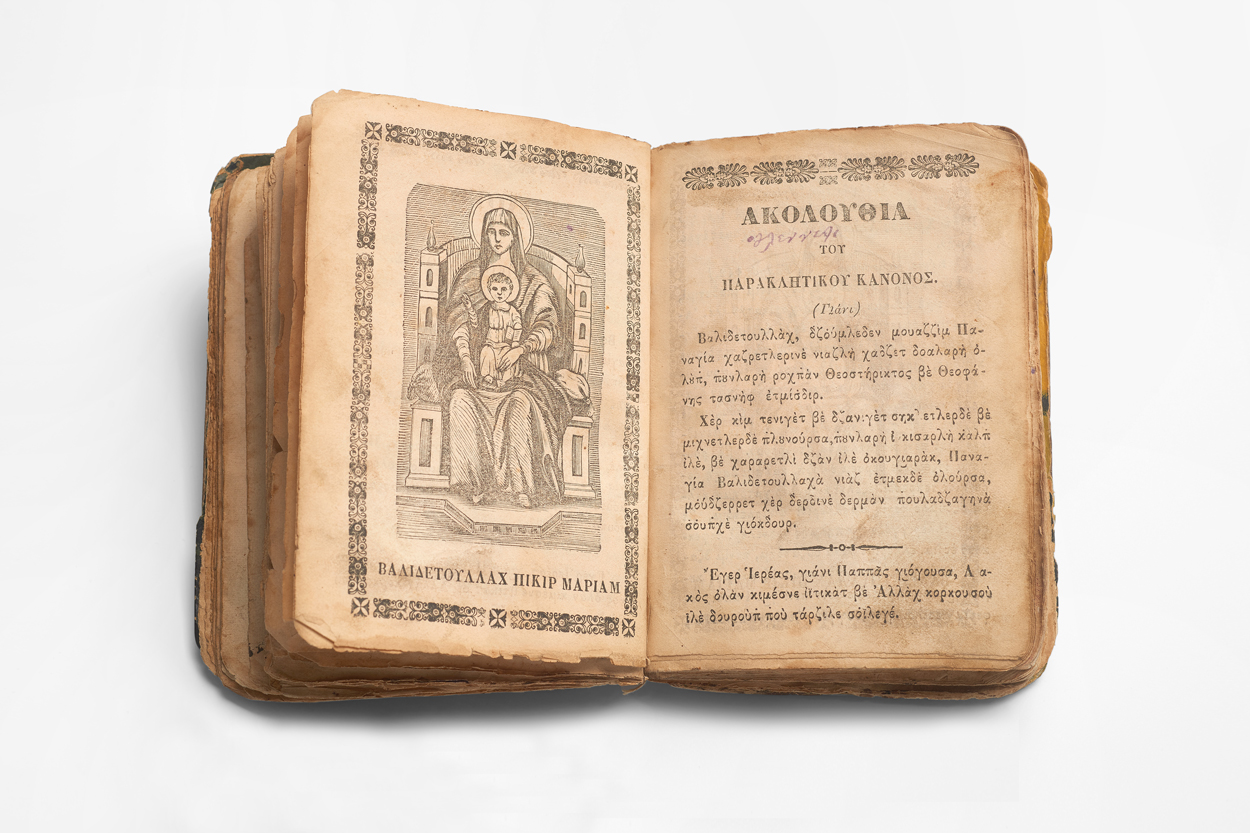
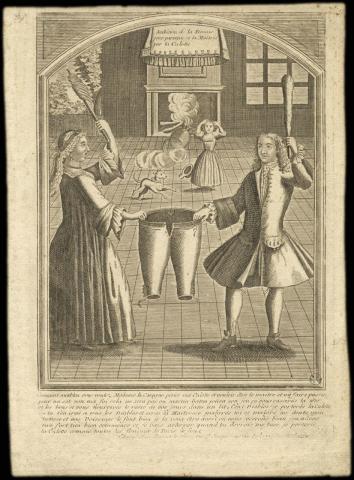
Engraving entitled “Ambition de la femme pour parvenir à la maîtrise par la culotte” (A woman’s ambition to achieve mastery through her panties)
Inventory number: 1943.16.124
This engraving, published by André Basset le Jeune in Paris in the third quarter of the 18th century, takes up a frequent theme in European folk art and imagery: the “panty dispute”. Husbands and wives quarrel over who has authority in the household, i.e. who wears the breeches. In the 18th century, this was the name given to a piece of men’s clothing, pants that came below the knee and were worn with stockings.
In this example, the quarrel is heated, as evidenced by the overturned cauldron and the little girl’s excitement. The wife is armed with her distaff, the husband with a club, and the dialogue is rather vigorous:
– How, morbleu, you want Madame la Carogne to wear my knickers and want to be the master and make me look like a fool […]
– A hundred devils, I’ll wear the knickers in spite of you […]. I wear my panties like all the women in Paris do.
Demands for equal rights are not new, and the concerns they arouse are as strong as ever.
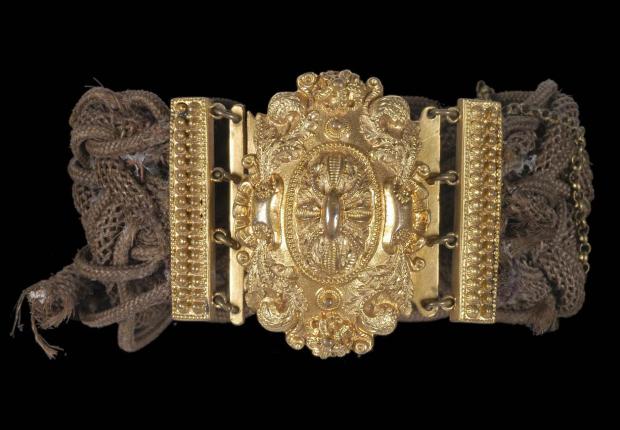
Hair bracelet
Inventory number: 1943.46.4
This bracelet with its beautiful gilded, stamped brass clasp, from Beaufort-en-Vallée in Maine-et-Loire, was made from hair. The hair was knotted and braided into solid or openwork cords, which were then intertwined. It is probably a sentimental piece of jewelry.
In popular ornamentation, and particularly in traditional jewelry, interlacing symbolizes love and union. The fashion for jewelry made from the hair of a loved one, living or dead, was very popular in the second half of the 19th century. At that time, hair was also used to make paintings and commemorative objects, of which the Mucem has a remarkable collection. They were intended to decorate domestic interiors or graves in cemeteries.
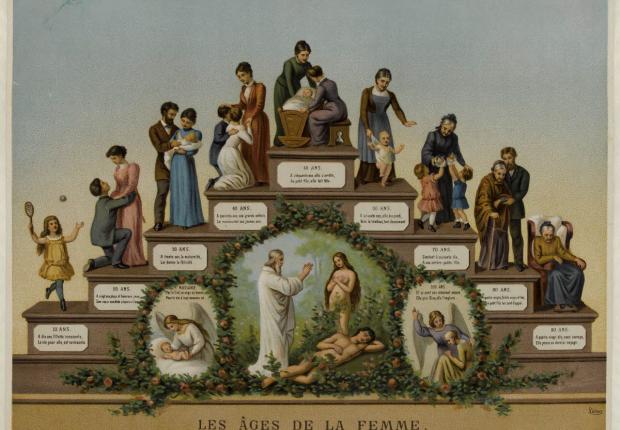
Lithography “The Ages of Women
Inventory number: 1944.10.8
This colored lithograph, designed by Fridolin Leiber and printed by E.G. May et fils in Frankfurt, was distributed until the late 1930s in Europe, North Africa and the Near East, but was created before 1912. As is traditional in popular imagery of the ages of life, each decade is symbolized by a step, ascending or descending on either side of the culmination of this female existence placed at 50 years of age.
The lithograph depicts the various stages in a woman’s life, with no other vocation or economic imperative than family life. Barely out of the carefree days of childhood, her entire existence is devoted to perpetuating the family line: marriage is followed by motherhood, then the joys of being a grandmother.
This very bourgeois conception of women’s roles ignores the hard-working reality of the majority of women in the first half of the 20th century, who had to toil in the fields and factories. The depiction of the creation of Adam and Eve at the base of the age pyramid lends religious justification to this distorted vision of role distribution.
Collection of tattoo designs
Inventory number: 1963.150.2.1-45
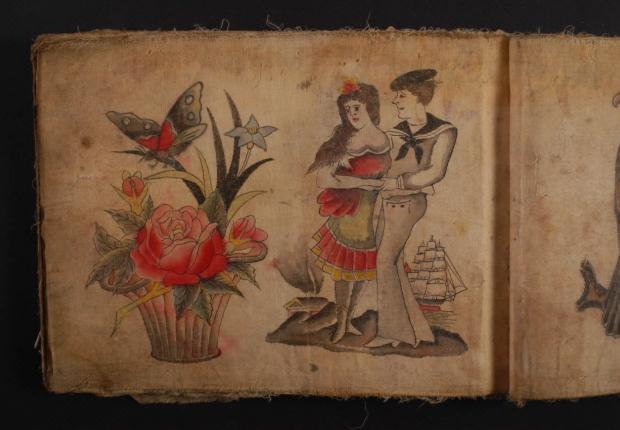
Dating from the late 19th or early 20th century, this collection of tattoo designs probably belonged to a professional tattooist, whose clientele was largely made up of seafarers, if the number of sailors pictured is anything to go by. In Europe, tattooing was initially the preserve of bad boys, the prison population and sailors. It was only at the end of the twentieth century that it was adopted as a form of adornment by a large part of the population.
The booklet consists of twenty-three pages, each made up of a double layer of unbleached percale or silk, on which the multicolored motifs offered to customers are drawn and colored in Indian ink. Several scenes depict a sailor and his lover tenderly embracing in front of a sailboat ready to set sail. Other, sometimes exotic, feminine representations, various fabulous animals (dragons, an eagle carrying a snake), plant motifs (bouquets, roses), religious scenes (crucifixion, devil) or various patriotic symbols were preferred.
Faith” ring
Inventory number: 1901.1.354
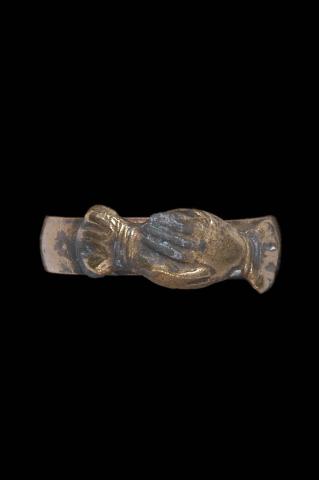
In Europe, the jewel that most strongly symbolizes love and matrimonial commitment is the ring. The so-called “faith” or “handshake” ring, used throughout France in the 19th century, was a promise ring in the West, and a wedding ring in the Dauphiné.
This one, in stamped and gilded brass, comes from Picardy. It was brought back from the Notre-Dame-de-Liesse pilgrimage in the Aisne region, probably by an anxious lover wishing to place his request under the Virgin’s intercession. It depicts two hands embracing. In other “faith” rings, the two hands support one or two hearts.
Fabric board “Rađaj!”
Inventory number: 2007.129.1
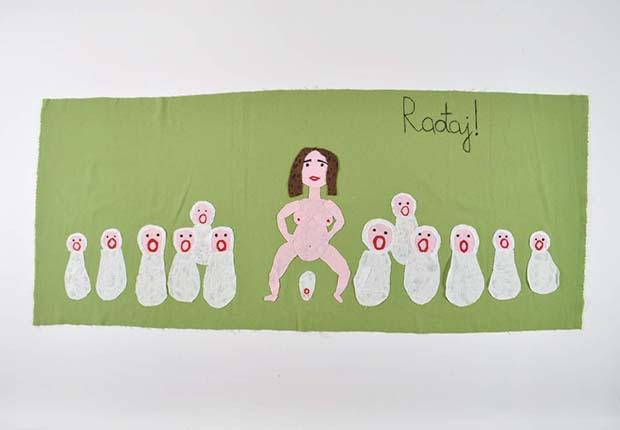
This artistic work, which questions the contemporary status of women in the Balkans, was created by Sandra Dukič, an artist from Bosnia-Herzegovina born in 1980. Inspired by the traditional embroideries (kuvarica) that once hung in the kitchens of her country and whose function was to remind women of their domestic obligations, in 2006 the author created a set of eight patchwork panels entitled “Les Conseils”, four of which were acquired by the Mucem.
The background is a rectangular panel of green felt, purchased for the occasion. The appliquéd figures were made from recycled fabrics, as was the case with traditional patchworks.
The work, which was exhibited at the Museum of Contemporary Art in Banja Luka (Bosnia-Herzegovina), depicts a naked woman, legs apart, belly round, who appears to have just given birth to a child. Lined up on either side are a dozen babies swaddled in white, their faces pink and their mouths wide open. At top right the painting bears the inscription “Rađaj!”, “Enfante”!
By hijacking traditional kuvarice motifs, Sandra Dukič denounces the tacit transmission of sexist commonplaces.
Grow a new wife” inflatable bridal figurine
Inventory number: 2007.140.1
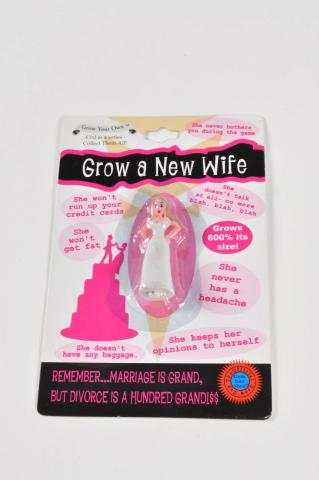
This humorous figurine of a bride is a misogynistic gift for the groom at bachelor parties.
The bride is supposed to swell in water to 600 times her original size. As the English words on the packaging indicate, she won’t gain weight after the wedding, but she has other qualities too: she won’t bore you during the match, won’t use your credit card, won’t chat incessantly, never gets a migraine, doesn’t carry luggage and keeps her opinions to herself.
Measuring some 15cm high, the polychrome acrylic resin figurine was made in China in 2007. It is preserved in its original packaging, consisting of a plastic bubble attached to printed cardboard. The reverse side features three containers of water, with the figurine increasing in size according to the length of immersion.
Despite their lack of aesthetic value and the conservation difficulties inherent in synthetic materials, Mucem also collects objects from globalized production, bearing witness to the changing mentalities of 21st-century societies.
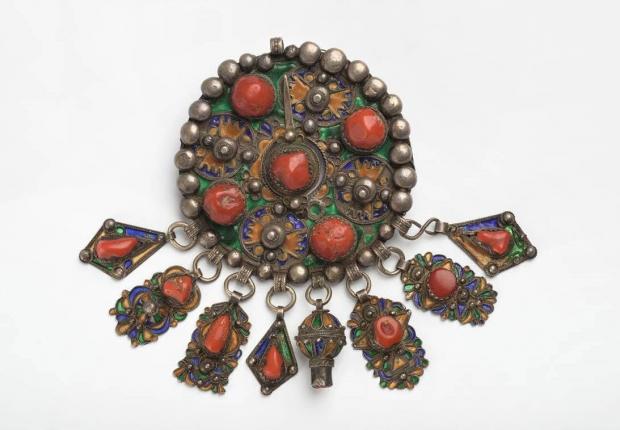
Fibule tabzimt
Inventory number: 2014.14.5
The tabzimt is a circular fibula with a central barb, decorated with cloisonné enamel and coral, typical of Kabylie (Algeria). In some tribes, the husband would give his wife a tabzimt for the birth of her first child. The size and beauty of the jewel depended on the family’s resources, but also on the sex of the newborn. The tabzimt was worn above the forehead, attached to the head veil, if it was a boy, and as a pendant on the chest if the child was a girl.
Remarkable for its size and the importance of the coral cabochons, this piece of jewelry, which may date from the early 20th century, was probably given by a well-to-do father, happy at the birth of a boy. It consists of a silver disc adorned with yellow, green and blue cloisonné enamels, silver beads and large irregularly shaped pieces of coral. Eight similarly adorned pendants are attached to the lower rim. At the opposite end is a ring for a cord or chain. The reverse also features a 10-pointed star motif in filigree and cloisonné enamel.
Both silver and coral were considered prophylactic materials, protecting mother and child.
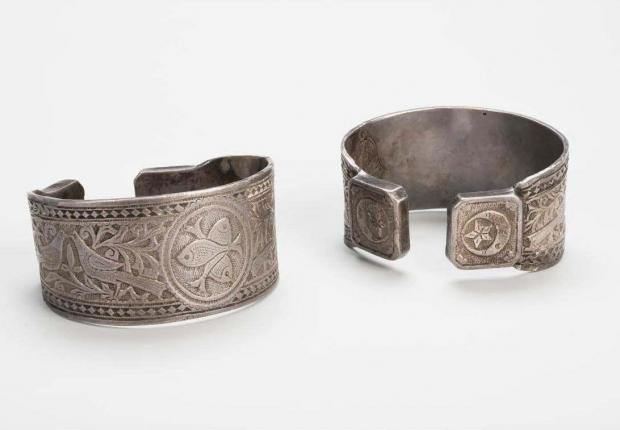
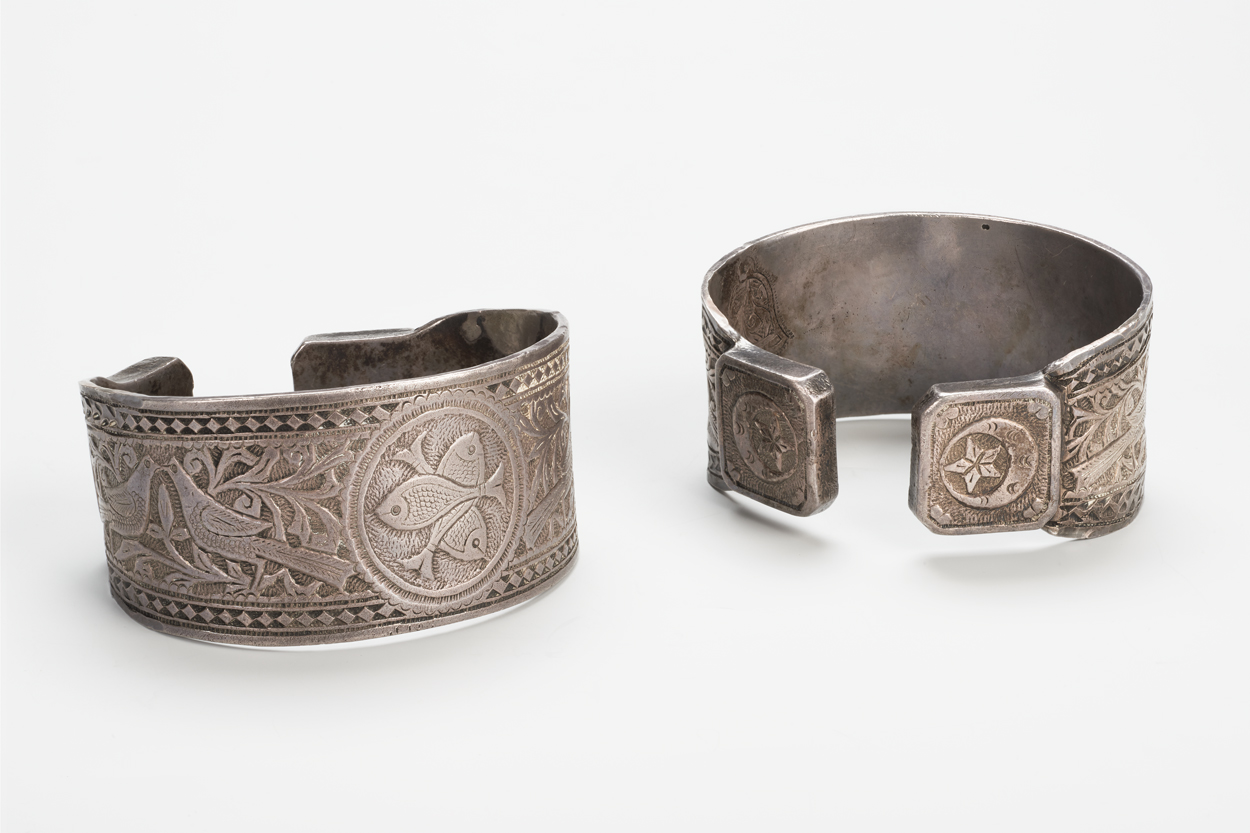
Pair of silver anklets known as khelkhal
Inventory number: 2014.14.21.1-2
In North Africa, women were given a pair of anklets at their wedding, which they would wear for the rest of their lives. A sign of their new social status, but also a sign of subjection to their husbands and their families, anklets came in a variety of shapes and weights, depending on the region.
These heavy, open silver rings, which probably date from the early 20th century, are typical of southern Tunisia. They were worn by nomadic women in the Médénine and Tataouine regions, but were probably made in Djerba by the island’s Jewish jewelers.
The decoration on these anklets is similar to that on the crescent-shaped fibulae worn by women from the same region: a pair of birds facing each other on a foliate background; a group of three fish entwined in a circle; a pomegranate. Rightly or wrongly, these jewels are attributed to a mythical jeweler, Moshé Nemni, an Italian Jew who first worked in Libya before settling in Tunis and Djerba in the 1st half of the 20th century.
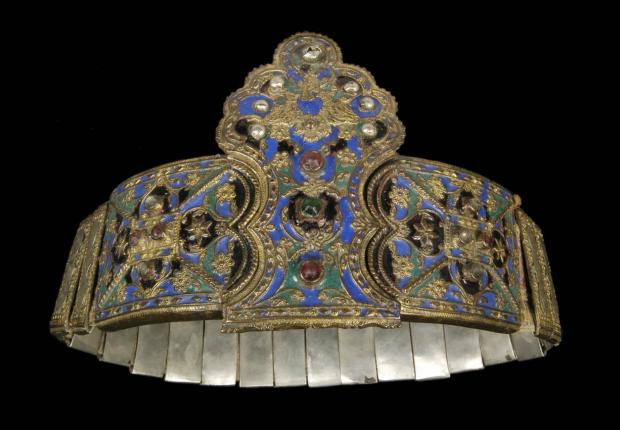
Bridal belt
Inventory number: DMH1957.51.16
Around the Mediterranean, the feminine belt, which evokes sexuality and fertility, was a highly symbolic and often highly ornate object. This was particularly true of the fastening system. While the belt was often made of fabric, the buckle could be made of metal and worked like a piece of goldsmith’s work.
Balkan wedding belts, of which the MuCEM holds an important collection, were particularly large and elaborate. Traditionally, it was the groom who gave his bride the belt that would signify her status as a married woman. He would sometimes have his name and the wedding date engraved on it.
This heavy enamelled copper bridal belt, adorned with pearls and coloured glass cabochons, comes from Soufili, Greece. It dates from the early 20th century and is the work of the famous Thracian silversmiths Kouyoumtzidès. The clasp is adorned with a gilded motif depicting a pair of birds facing each other, a symbol also common on jewelry from the southern shores of the Mediterranean.
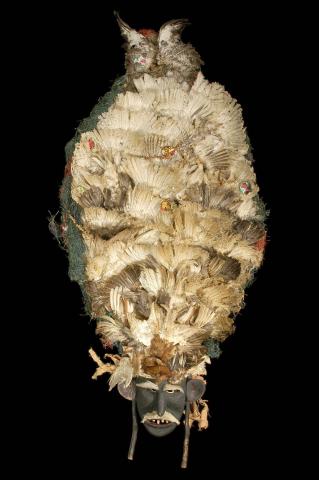
Survakar mask
Inventory number: DMH1968.23.378
In western Bulgaria, masquerades take place on the night of January 13th and the day of January 14th, the dates corresponding to the New Year in the Julian calendar, which remained in force in the country until 1916. On this occasion, the villages are criss-crossed by survakari, dressed in fur or shreds of cloth and wearing huge masks made of wood, fur or feathers.
This spectacular mask was worn in the middle of the 20th century in the village of Elovdol, near Pernik. The wooden face, painted black, is surmounted by a large, light wooden structure covered with poultry feathers. The whole is 2.72 m high. The wearer of the mask must keep it in balance by holding on to the two sticks placed on either side of the face.
The creation of the Pernik masquerade festival in 1966, with the aim of “preserving tradition”, has greatly contributed to the evolution of masks and costumes towards ever greater spectacularity and originality. Today, feather masks even larger than this one can be seen here, absolutely importable for ritual village quest tours.
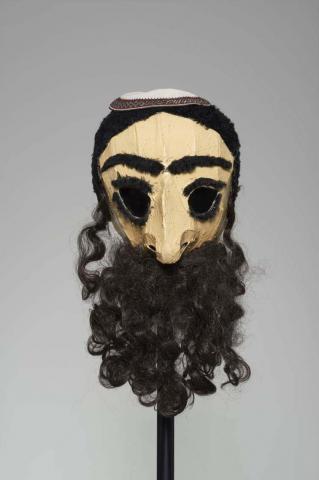
Jew” mask
Inventory number: 2012.3.3.3-4
In Central Europe, winter masquerades feature many characters, one of whom continues to amaze and even scandalize us: the “Jew”.
For centuries, Jewish communities have coexisted with Christian ones, and it’s not surprising that the character of the “Jew” has represented otherness in the upside-down games of carnival. It’s more surprising and disturbing to encounter him even today, when Jews have all but disappeared from Central Europe after the violent history of the 20th century.
Jester, ominous sorcerer or master of ceremonies, the “Jew” character fulfills ambivalent roles. This cardboard and fur “Jew” mask was made in 2011 by Boguslaw Ziolko, for use during Epiphany quest tours in Zelonki, near Krakow (Poland). In this region, the “Jew”, flanked by Death and the Devil, accompanies King Herod and his soldiers as they visit houses.
The carnivalesque character of the “Jew” can also be found in masquerades in the Maghreb, another region where Jewish communities were numerous and important.
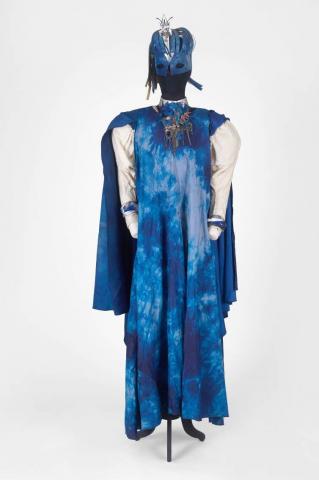
Neptune costume
Inventory number: 2015.3.2
Disappeared in the early 20th century, the Marseille Carnival was revived in 1989 by a group of artists and intellectuals living in the Rive Neuve district. Their project was to create a “Venetian” carnival on the Place d’Estienne-d’Orves, then disfigured by a parking lot, in order to contribute to its rehabilitation. This initiative was not isolated. In the 1980s, the revival of popular festivals was very often the work of local scholars or intellectuals.
Produced for the 1989 Marseilles Carnival, this Neptune costume was part of a group of three figures entitled the “Marriage of Marseilles and the Sea”, a Marseilles transposition of the Venetian rite of the “Marriage of Venice and the Sea”, during which the Doge threw a golden ring into the Adriatic Sea. The group also refers to Marseille’s founding myth, the marriage of Gyptis and Protis. The costumes were worn by Marseilles personalities: Jeanne Laffite for the allegory of Marseilles, and Jacques Mayol, the famous apneist, for Neptune.
The three costumes were designed by a famous theatrical costume designer, Geneviève Sevin-Doering, who applied her research into stage costumes designed to be seen from afar to the cutting and sewing. Her husband Reinhard Ubbelohde-Doering took care of the dyeing, and Jean-Pierre Ive, a visual artist and poet from Marseilles, was responsible for the accessories. Highly crafted, these costumes remain faithful to the spirit of carnival: Neptune’s trident, for example, is made from a straw broom. They also illustrate the strong link between the street arts and the performing arts.
The three costumes were donated to the MuCEM by Geneviève Sevin-Doering.
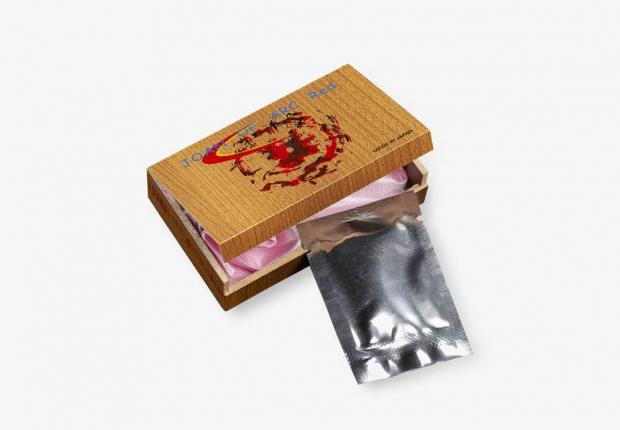
Artificial hymen kit
Inventory number: 2015.5.1
In Muslim societies on the southern shores of the Mediterranean, the obligation for young girls to marry as virgins, and to provide proof of this in the blood of defloration, is still unavoidable. For those who risk dishonor and repudiation, the prospect of marriage gives rise to anguished proceedings. The more affluent may resort to surgical hymenoplasty, others to expedients whose recipes are passed down from wife to wife.
Manufactured in Japan since the 2000s and distributed under the CIGIMO brand, this “artificial hymen” kit could be the solution. It consists of an albumin membrane containing a red liquid, and can be used to create the illusion of a wedding night. The sale of the “artificial hymen” kit is obviously forbidden in several countries, including Egypt, but it is available on the Internet.