Story(ies) of René L.
Contrasting heterotopias
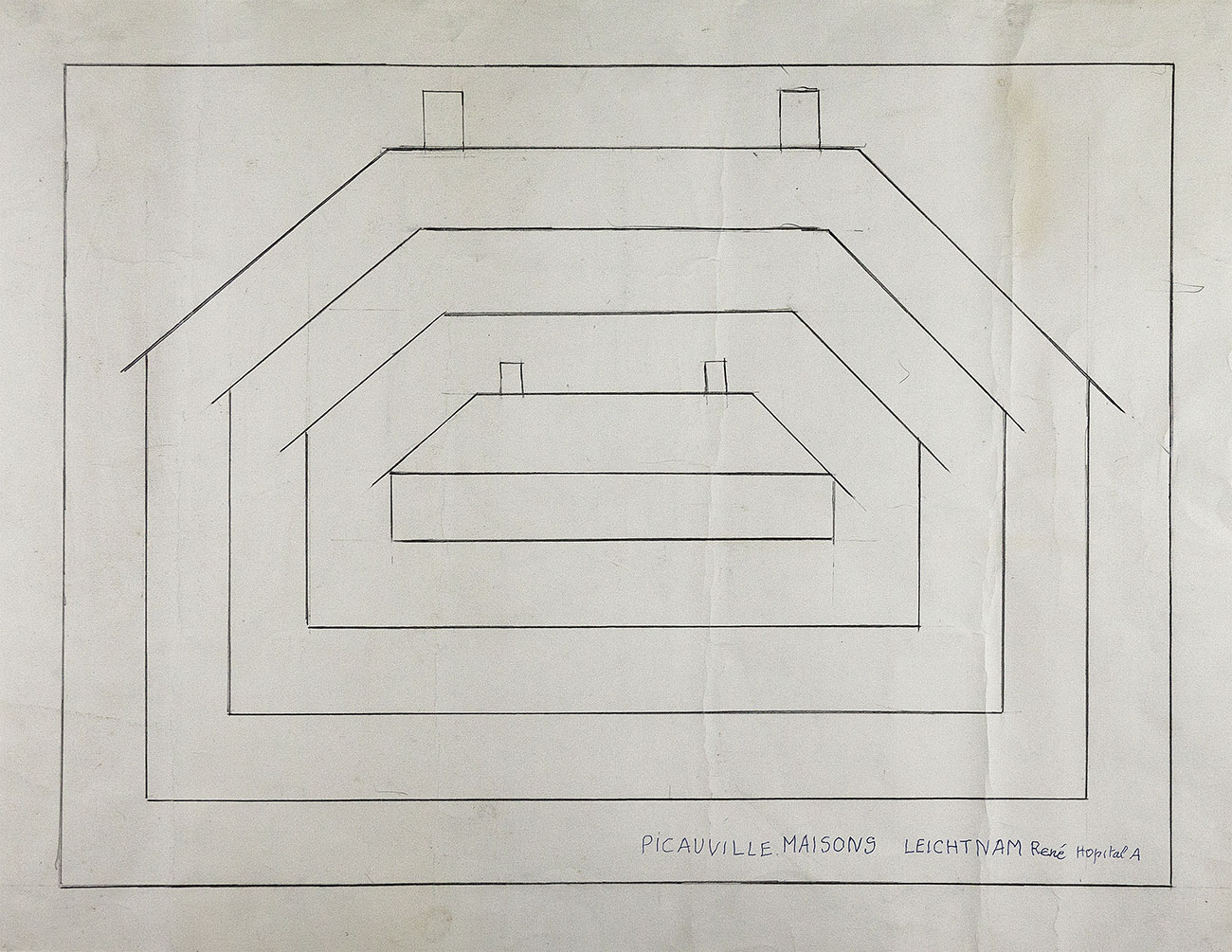
One day during a visit to asylums destined for destruction, our gaze stumbled upon these piles of papers, marked “to be thrown away”. The large room that was for a century a communal dormitory for the disturbed had become the storage area for a set of cardboard boxes. There, against a wall of this psychiatric hospital room, thick rolls of paper were found. Unfolding these sheets, dozens of drawings appeared, some drawn only with black pencil, others conscientiously coloured in.
What were these drawings? The product of a therapeutic workshop? Works of Art Brut? An archive? Enigmatic signs left by an individual called René, each of the drawings was signed.
René Louis L. was born in Perregaux (Oran) on 16 May 1920. His grandparents left Alsace in 1871 following the French defeat in the Franco-Prussian War and moved to the Oranais. René spent his entire childhood in this small colonial community. But after his twenties, he was hospitalised almost continuously in various institutions in Algeria, including the regional hospital in Orléansville and then the one in Blida, for mental disorders, falling into the category of schizophrenia. In 1963, just over a year after Independence, he was repatriated with over one hundred and fifty other patients, men and women who had been receiving psychiatric treatment in Algeria, to the Bon-Sauveur private psychiatric hospital in Picauville in the Manche département in northern France. The admission certificate stated: “Chronic delirium of imprecise structure with hypochondriac theme”. René L. remained in Picauville for the rest of his life.
All that remains of René are these forty or so drawings; what text do they make up?
An exhibition to solve the enigma: to go in search of René L., not in the archives of the Civil Registry or psychiatric institutions, but in History, the great one — the one that is the subject of treaties, the one that shapes cities, the one that determines our lives; inventing René from images, documents, archives, works; to be unafraid of making weak connections, of improbable associations; to risk history; to follow René L., and perhaps, from trace to trace, explore another memory of our present.
This exhibition offers a journey through our twentieth century and the heterotopias of which it was the scene. Taking up Michel Foucault’s concept to designate these “other spaces”, these spaces that bring together in a single place all the places, these worlds that are not fictitious such as utopias, but which are quite real, like so many autonomous islands in the archipelago that makes up our modernity, the exhibition gives us a glimpse of the heterotopias that René L. crossed and largely drew.
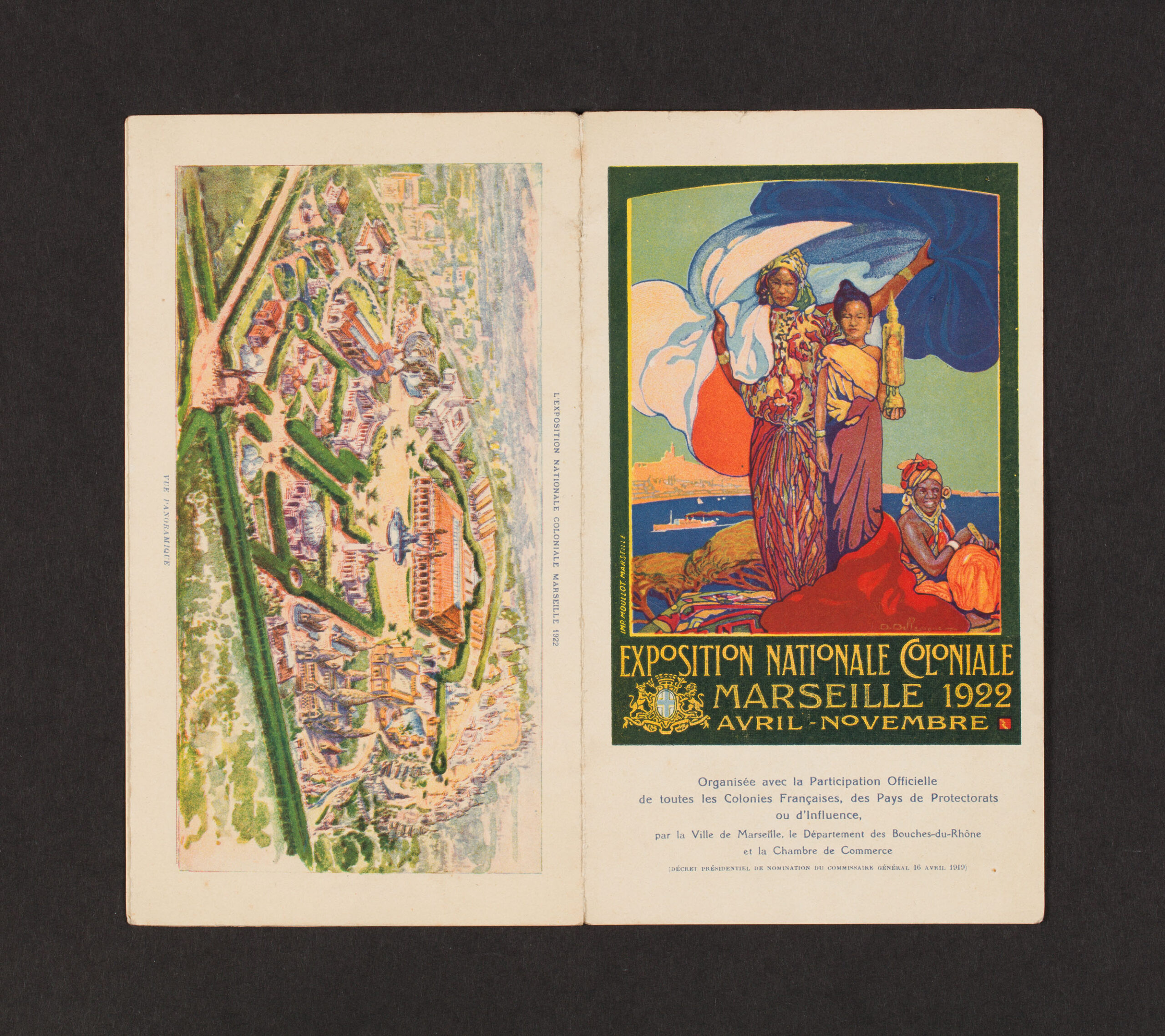
The heterotopia of the ship (which transports colonists to Algeria; which, like the cruise liner SS France from the 1960s onwards, is a floating universal exhibition; and, like the shipwrecked vessel represented on a marine ex-voto, speaks of chaos) opens the exhibition and then ventures into the colonial heterotopia. We arrive in the town of Perregaux, with its town hall, post office and courthouse, and visit the large-scale collective housing projects, those dreamed up by Le Corbusier for Nemours and Algiers, and those built by Fernand Pouillon. Through this colonial heterotopia, we will reach the asylum and the model psychiatric hospital of Joinville-Blida. We will discover the primitivist theses of the School of Algiers. As a mirror image, we will follow René L. to the Bon-Sauveur psychiatric hospital in the Manche, after his latter repatriation. There, through a series of his drawings, we will understand the importance of another heterotopia, that of the Olympic Games, those of Grenoble in 1968: we will dream in front of the speed ring and Vasarely’s frescos. We will cross Novarina’s Olympic village.
This progress through correspondences and echoes will be highlighted by four figures who meet in René L.’s stories. First, there will be Michel Foucault at the crossroads of heterotopology and psychiatry; then, Frantz Fanon between psychiatry and colonialism; followed by Le Corbusier at the junction of colonial projects and housing estates; and finally Georges Perec and his island, W, where the sporting heterotopia turns into a nightmare.
In this journey, works will act as beacons: a residence by Etienne-Martin, a cage by Sol LeWitt, a Nude by Fernand Léger, and an athletic figure by Germaine Richier.
Thus, with the biography of an individual who was a psychiatric patient as a story arc, the exhibition offers up another memory of our twentieth century – a fragmented, contradictory and complex memory where dreams collide and are broken, a discontinuous social and cultural memory.
– Curators: Philippe Artières, historian, research director at the CNRS (Iris, EHESS, Paris-Condorcet), et Béatrice Didier, co-director of the Point du Jour art centre, editor and teacher
– Scenography : FREAKS, architecture and scenography agency
Interview with Philippe Artières and Béatrice Didier, curators of the exhibition
One day during a visit to asylums destined for destruction, our gaze stumbled upon these piles of papers, marked “to be thrown away”. The large room that was for a century a communal dormitory for the disturbed had become the storage area for a set of cardboard boxes. There, against a wall of this psychiatric hospital room, thick rolls of paper were found. Unfolding these sheets, dozens of drawings appeared, some drawn only with black pencil, others conscientiously coloured in.
What were these drawings? The product of a therapeutic workshop? Works of Art Brut? An archive? Enigmatic signs left by an individual called René, each of the drawings was signed.
René Louis L. was born in Perregaux (Oran) on 16 May 1920. His grandparents left Alsace in 1871 following the French defeat in the Franco-Prussian War and moved to the Oranais. René spent his entire childhood in this small colonial community. But after his twenties, he was hospitalised almost continuously in various institutions in Algeria, including the regional hospital in Orléansville and then the one in Blida, for mental disorders, falling into the category of schizophrenia. In 1963, just over a year after Independence, he was repatriated with over one hundred and fifty other patients, men and women who had been receiving psychiatric treatment in Algeria, to the Bon-Sauveur private psychiatric hospital in Picauville in the Manche département in northern France. The admission certificate stated: “Chronic delirium of imprecise structure with hypochondriac theme”. René L. remained in Picauville for the rest of his life.
All that remains of René are these forty or so drawings; what text do they make up?
An exhibition to solve the enigma: to go in search of René L., not in the archives of the Civil Registry or psychiatric institutions, but in History, the great one — the one that is the subject of treaties, the one that shapes cities, the one that determines our lives; inventing René from images, documents, archives, works; to be unafraid of making weak connections, of improbable associations; to risk history; to follow René L., and perhaps, from trace to trace, explore another memory of our present.
This exhibition offers a journey through our twentieth century and the heterotopias of which it was the scene. Taking up Michel Foucault’s concept to designate these “other spaces”, these spaces that bring together in a single place all the places, these worlds that are not fictitious such as utopias, but which are quite real, like so many autonomous islands in the archipelago that makes up our modernity, the exhibition gives us a glimpse of the heterotopias that René L. crossed and largely drew.
The heterotopia of the ship (which transports colonists to Algeria; which, like the cruise liner SS France from the 1960s onwards, is a floating universal exhibition; and, like the shipwrecked vessel represented on a marine ex-voto, speaks of chaos) opens the exhibition and then ventures into the colonial heterotopia. We arrive in the town of Perregaux, with its town hall, post office and courthouse, and visit the large-scale collective housing projects, those dreamed up by Le Corbusier for Nemours and Algiers, and those built by Fernand Pouillon. Through this colonial heterotopia, we will reach the asylum and the model psychiatric hospital of Joinville-Blida. We will discover the primitivist theses of the School of Algiers. As a mirror image, we will follow René L. to the Bon-Sauveur psychiatric hospital in the Manche, after his latter repatriation. There, through a series of his drawings, we will understand the importance of another heterotopia, that of the Olympic Games, those of Grenoble in 1968: we will dream in front of the speed ring and Vasarely’s frescos. We will cross Novarina’s Olympic village.
This progress through correspondences and echoes will be highlighted by four figures who meet in René L.’s stories. First, there will be Michel Foucault at the crossroads of heterotopology and psychiatry; then, Frantz Fanon between psychiatry and colonialism; followed by Le Corbusier at the junction of colonial projects and housing estates; and finally Georges Perec and his island, W, where the sporting heterotopia turns into a nightmare.
In this journey, works will act as beacons: a residence by Etienne-Martin, a cage by Sol LeWitt, a Nude by Fernand Léger, and an athletic figure by Germaine Richier.
Thus, with the biography of an individual who was a psychiatric patient as a story arc, the exhibition offers up another memory of our twentieth century – a fragmented, contradictory and complex memory where dreams collide and are broken, a discontinuous social and cultural memory.
– Curators: Philippe Artières, historian, research director at the CNRS (Iris, EHESS, Paris-Condorcet), et Béatrice Didier, co-director of the Point du Jour art centre, editor and teacher
– Scenography : FREAKS, architecture and scenography agency
Interview with Philippe Artières and Béatrice Didier, curators of the exhibition