Picasso, « a genius without a pedestal »
Picasso and popular arts and traditions
“Art obliges the artist not to keep himself apart; it subjects him to the most humble and the most universal truth. That is why true artists scorn nothing…”
Albert Camus. From his acceptance speech for the Nobel Prize in Literature, delivered in Oslo, Sweden on 10 December 1957.
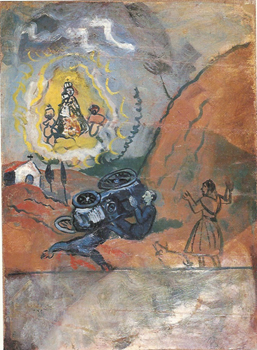
From 27 April to 29 August 2016, the Mucem presents a major exhibition of 270 works demonstrating how Picasso, both established in his era and attached to his roots, nurtured his influences stemming from the popular arts and traditions. The exhibition itinerary, divided into four parts, mirrors the artist’s masterpieces with reference-objects from the rich collections of the Mucem. Benefiting from exceptional loans and support from public and private collections, both French and international, including a rich partnership with the Musée National Picasso-Paris, the exhibition brings together essential and iconic works, placed in perspective with surprising discoveries.
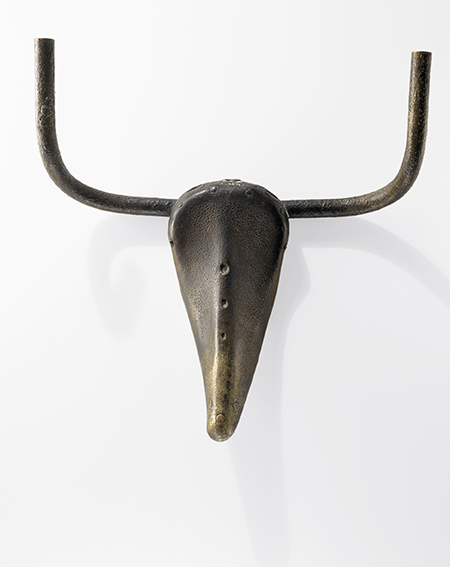
After evoking the sacred aspects of these primarily Spanish sources, the exhibition highlights how the artist drew inspiration from his memories. The themes and motifs, reoccurring memories in Picasso’s work, are thus illustrated by examples that represent his particular fascinations with the worlds of adornment (Jacqueline with Mantilla), music, the circus (Blue Acrobat), bullfighting (Bull’s Head), and toys.
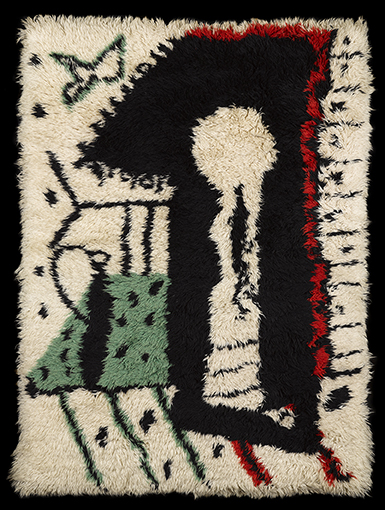
The exhibition is built around Picasso’s encounters with various artisans, whose established expertise nourished his own experience and research. Thus the artist made successive incursions into the domains of woodworking (Paco Durrio), ceramics (Suzanne and Georges Ramié at the studio Madoura), silversmithing (François Hugo), linocutting (Hidalgo Arnera), filmmaking (Robert Picault), textiles (Marie Cuttoli), and sheet-metal (Lionel Prejger).
His utilisation of the everyday in its most prosaic (discarded items), but also most personal dimensions is expressed by a very beautiful group of constructions or assembled sculptures (Baboon and Young) where the gleaned objects and recycled materials are easily recognised.
Twentieth century art often toyed with its origins to construct a new relationship with the world. Picasso’s roots were multiple. Among these foundations, the environment of his childhood was very fertile ground. The everyday objects that Georges Henri Rivière honoured in the Musée des Arts et Traditions Populaires, which he founded in 1937, infinitely influenced the affective and aesthetic background of the artist. The collections of the Mucem that punctuate this exhibition itinerary were chosen from those acquired by Georges Henri Rivière, like so many echoes of the work of Picasso. With this knowledge at once intimate and universal, Picasso asserted himself as the true signal of a new popular culture.
General Curators:
Joséphine Matamoros, Chief Curator of Heritage, former Director of the Musée d’Art Moderne de Céret, Director of the Musée d’Art Moderne de Collioure
Bruno Gaudichon, Chief Curator of Heritage, Curator of La Piscine- Musée d’Art et d’Industrie André Diligent in Roubaix
Emilie Girard, Curator of Heritage, Director of the Centre for Conservation and Resources of the Mucem
Scenography: Jacques Sbriglio, Architect, Scenographer
With the generous support of the Musée National Picasso-Paris
With support from the La Fondation PwC France et Afrique Francophone pour la Culture et la Solidarité, founding sponsor of the Mucem.
Interview with the curators of the exhibition Joséphine Matamoros and Bruno Gaudichon
What popular arts and traditions are echoed in the work of Picasso?
Picasso was very marked by his roots. The perennial nature of these popular sources intervenes in two ways: through the reoccurring themes in his work, related to popular and cultural practices (the mantilla worn by Spanish women, musical instruments, the circus, bullfighting, pigeon keeping, etc.), but also by this preoccupation that animated him at the end of the war, of developing his work through forays into new domains like arts and crafts (ceramics, silversmithing, linocutting, etc.). Lastly, it seemed important to us to demonstrate his approach to sculpture, particularly after the war, in a period for ripe for research: thus he created constructions using found objects, simple popular objects. One of the most famous is the Bull’s Head (1942), created with a handlebar and a bicycle seat. What is interesting is that he does not set out to make the work; it is the found object that becomes the stimulus. The point is not for him to make something, but to translate the evocative power of the object.
“The point is not for him to make something, but to translate the evocative power of the object.”
In the exhibition, how will the mirroring of works by Picasso with objects from the collections of the Mucem operate?
Showing the objects that directly inspired Picasso is obviously impossible because they were swallowed into the works themselves. But we have been able to find in the collections of the Mucem objects that can fully illustrate his preoccupations. So, in each exhibition hall, a few objects will be presented first, echoing the theme to be addressed. Finally, recall that Picasso has ties to the Mucem: he knew Georges Henri Rivière, the founder of the Musée des Arts et Traditions Populaires (whose collections are now at the Mucem), at a time when the popular object was rightly being reconsidered: “museum-ified” by Rivière and rendered sacred by Picasso through its integration into his work.
This exhibition proposes a new way of interpreting the work of Picasso…
Clearly, retrospective for artists like Picasso, no longer really makes sense. Thus we propose a new way of interpreting his work that has never been explored. This question of the importance of popular arts and traditions in the artist’s work allows us to create a new approach to the exploration of Picasso.
The exhibition blends masterpieces with pieces that have never been seen. A few examples?
We indeed have important and famous works, particularly in the hall of assembled sculptures, constructions like Baboon and Young, whose head is made from two small cars that Picasso pilfered from his son: it is an icon. Not to mention the painting The Acrobat, a magnificent work, deeply anchored in his passion for the circus. As for the previously unseen or little known pieces, they are numerous: for example the set of tiles created by Picasso with Derain, presented in France for the first time; or the three silver dishes, compotiers, made with François Hugo, which should surprise many. Without forgetting the series of linocut posters created for the annual exhibition of Vallauris ceramics. We have them all, and this is a first. And then these large bullfighting paintings, absolutely extraordinary, and very rarely seen… We have benefited from a large number of loans from private collections, allowing us to feature very rare pieces.
What has struck you the most during your research for this exhibition?
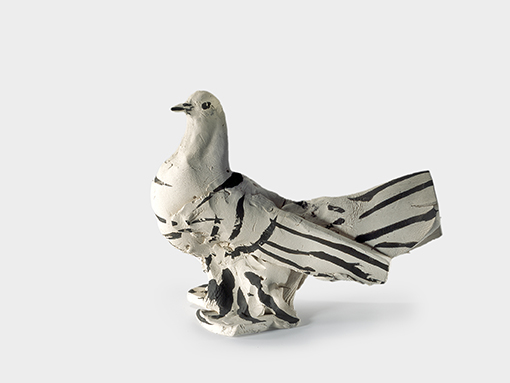
The fact that this new manner of interpretation became a reality. We have confirmed that this question of the impact of popular arts and traditions on Picasso’s work bears weight. Throughout our research, while gradually unwinding the thread, certain things took on new meaning. We reread Sabartès’ texts in which he evokes a particular painting by Picasso’s father, Le Pigeonnier (The Dovecote), as a key element for the artist; and his passion for pigeon keeping would be reflected later in a magnificent set of works. The matrix of his childhood had a huge and clear impact on his themes and his techniques. Picasso never saw the Pigeonnier again after childhood (he vowed never to return to Spain while Franco was in power). But we have found it, and it is presented in the exhibition.
Between the circus, music and bullfighting, and from arts and crafts to sculpture, this exhibition explores the work of Picasso in all its richness. And has its share of surprises!
This ability to bounce all over; to make, from everything, the pieces of a puzzle full of surprises, that’s the genius of Picasso. We hope to offer a dynamic and jubilatory exhibition…while remaining serious in our approach! The scenography proposed by Jacques Sbriglio and his team should further this sense of wonder that we are seeking. Because this part of the game was very important in the construction of Picasso’s work, he knew how to combine distance and depth with disconcerting ease.
“Art obliges the artist not to keep himself apart; it subjects him to the most humble and the most universal truth. That is why true artists scorn nothing…”
Albert Camus. From his acceptance speech for the Nobel Prize in Literature, delivered in Oslo, Sweden on 10 December 1957.
From 27 April to 29 August 2016, the Mucem presents a major exhibition of 270 works demonstrating how Picasso, both established in his era and attached to his roots, nurtured his influences stemming from the popular arts and traditions. The exhibition itinerary, divided into four parts, mirrors the artist’s masterpieces with reference-objects from the rich collections of the Mucem. Benefiting from exceptional loans and support from public and private collections, both French and international, including a rich partnership with the Musée National Picasso-Paris, the exhibition brings together essential and iconic works, placed in perspective with surprising discoveries.
After evoking the sacred aspects of these primarily Spanish sources, the exhibition highlights how the artist drew inspiration from his memories. The themes and motifs, reoccurring memories in Picasso’s work, are thus illustrated by examples that represent his particular fascinations with the worlds of adornment (Jacqueline with Mantilla), music, the circus (Blue Acrobat), bullfighting (Bull’s Head), and toys.
The exhibition is built around Picasso’s encounters with various artisans, whose established expertise nourished his own experience and research. Thus the artist made successive incursions into the domains of woodworking (Paco Durrio), ceramics (Suzanne and Georges Ramié at the studio Madoura), silversmithing (François Hugo), linocutting (Hidalgo Arnera), filmmaking (Robert Picault), textiles (Marie Cuttoli), and sheet-metal (Lionel Prejger).
His utilisation of the everyday in its most prosaic (discarded items), but also most personal dimensions is expressed by a very beautiful group of constructions or assembled sculptures (Baboon and Young) where the gleaned objects and recycled materials are easily recognised.
Twentieth century art often toyed with its origins to construct a new relationship with the world. Picasso’s roots were multiple. Among these foundations, the environment of his childhood was very fertile ground. The everyday objects that Georges Henri Rivière honoured in the Musée des Arts et Traditions Populaires, which he founded in 1937, infinitely influenced the affective and aesthetic background of the artist. The collections of the Mucem that punctuate this exhibition itinerary were chosen from those acquired by Georges Henri Rivière, like so many echoes of the work of Picasso. With this knowledge at once intimate and universal, Picasso asserted himself as the true signal of a new popular culture.
General Curators:
Joséphine Matamoros, Chief Curator of Heritage, former Director of the Musée d’Art Moderne de Céret, Director of the Musée d’Art Moderne de Collioure
Bruno Gaudichon, Chief Curator of Heritage, Curator of La Piscine- Musée d’Art et d’Industrie André Diligent in Roubaix
Emilie Girard, Curator of Heritage, Director of the Centre for Conservation and Resources of the Mucem
Scenography: Jacques Sbriglio, Architect, Scenographer
With the generous support of the Musée National Picasso-Paris
With support from the La Fondation PwC France et Afrique Francophone pour la Culture et la Solidarité, founding sponsor of the Mucem.
Interview with the curators of the exhibition Joséphine Matamoros and Bruno Gaudichon
What popular arts and traditions are echoed in the work of Picasso?
Picasso was very marked by his roots. The perennial nature of these popular sources intervenes in two ways: through the reoccurring themes in his work, related to popular and cultural practices (the mantilla worn by Spanish women, musical instruments, the circus, bullfighting, pigeon keeping, etc.), but also by this preoccupation that animated him at the end of the war, of developing his work through forays into new domains like arts and crafts (ceramics, silversmithing, linocutting, etc.). Lastly, it seemed important to us to demonstrate his approach to sculpture, particularly after the war, in a period for ripe for research: thus he created constructions using found objects, simple popular objects. One of the most famous is the Bull’s Head (1942), created with a handlebar and a bicycle seat. What is interesting is that he does not set out to make the work; it is the found object that becomes the stimulus. The point is not for him to make something, but to translate the evocative power of the object.
“The point is not for him to make something, but to translate the evocative power of the object.”
In the exhibition, how will the mirroring of works by Picasso with objects from the collections of the Mucem operate?
Showing the objects that directly inspired Picasso is obviously impossible because they were swallowed into the works themselves. But we have been able to find in the collections of the Mucem objects that can fully illustrate his preoccupations. So, in each exhibition hall, a few objects will be presented first, echoing the theme to be addressed. Finally, recall that Picasso has ties to the Mucem: he knew Georges Henri Rivière, the founder of the Musée des Arts et Traditions Populaires (whose collections are now at the Mucem), at a time when the popular object was rightly being reconsidered: “museum-ified” by Rivière and rendered sacred by Picasso through its integration into his work.
This exhibition proposes a new way of interpreting the work of Picasso…
Clearly, retrospective for artists like Picasso, no longer really makes sense. Thus we propose a new way of interpreting his work that has never been explored. This question of the importance of popular arts and traditions in the artist’s work allows us to create a new approach to the exploration of Picasso.
The exhibition blends masterpieces with pieces that have never been seen. A few examples?
We indeed have important and famous works, particularly in the hall of assembled sculptures, constructions like Baboon and Young, whose head is made from two small cars that Picasso pilfered from his son: it is an icon. Not to mention the painting The Acrobat, a magnificent work, deeply anchored in his passion for the circus. As for the previously unseen or little known pieces, they are numerous: for example the set of tiles created by Picasso with Derain, presented in France for the first time; or the three silver dishes, compotiers, made with François Hugo, which should surprise many. Without forgetting the series of linocut posters created for the annual exhibition of Vallauris ceramics. We have them all, and this is a first. And then these large bullfighting paintings, absolutely extraordinary, and very rarely seen… We have benefited from a large number of loans from private collections, allowing us to feature very rare pieces.
What has struck you the most during your research for this exhibition?
The fact that this new manner of interpretation became a reality. We have confirmed that this question of the impact of popular arts and traditions on Picasso’s work bears weight. Throughout our research, while gradually unwinding the thread, certain things took on new meaning. We reread Sabartès’ texts in which he evokes a particular painting by Picasso’s father, Le Pigeonnier (The Dovecote), as a key element for the artist; and his passion for pigeon keeping would be reflected later in a magnificent set of works. The matrix of his childhood had a huge and clear impact on his themes and his techniques. Picasso never saw the Pigeonnier again after childhood (he vowed never to return to Spain while Franco was in power). But we have found it, and it is presented in the exhibition.
Between the circus, music and bullfighting, and from arts and crafts to sculpture, this exhibition explores the work of Picasso in all its richness. And has its share of surprises!
This ability to bounce all over; to make, from everything, the pieces of a puzzle full of surprises, that’s the genius of Picasso. We hope to offer a dynamic and jubilatory exhibition…while remaining serious in our approach! The scenography proposed by Jacques Sbriglio and his team should further this sense of wonder that we are seeking. Because this part of the game was very important in the construction of Picasso’s work, he knew how to combine distance and depth with disconcerting ease.