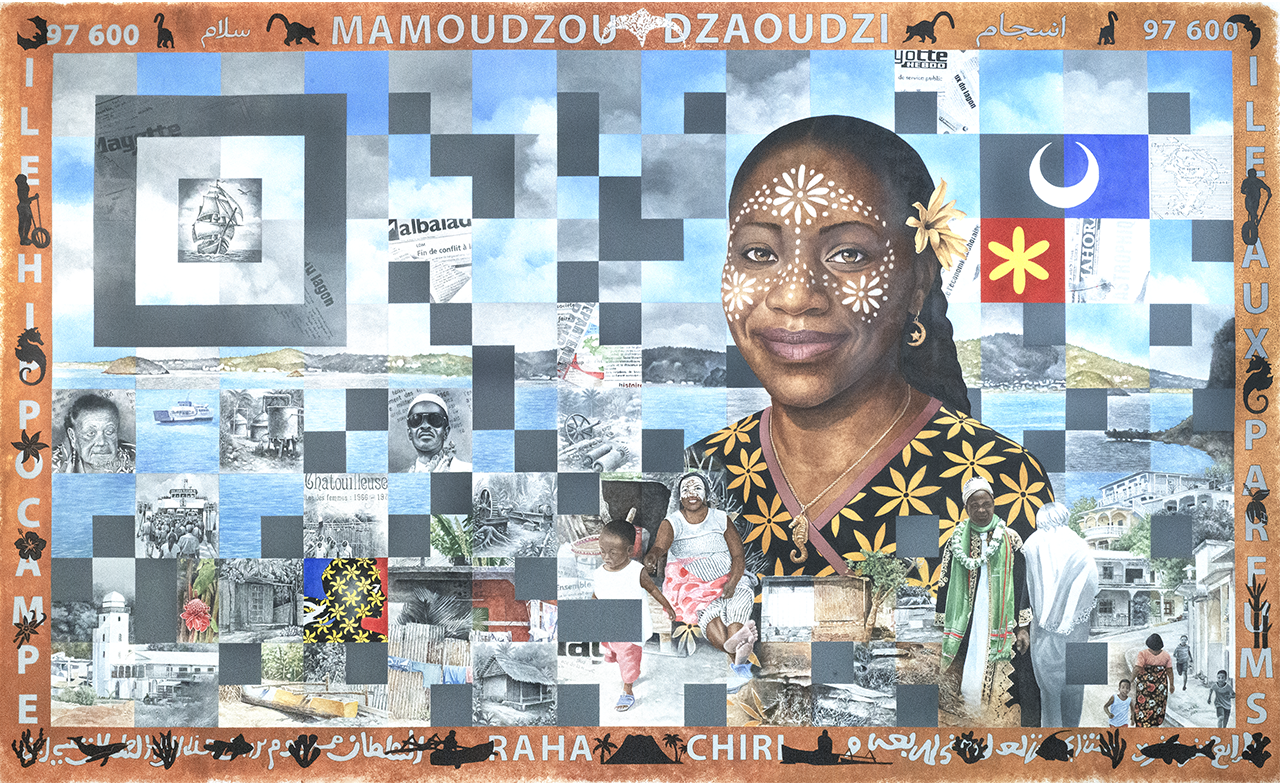
The Mucem unveils a singular exhibition devoted to Mayotte, that French island whose culture remains little known in mainland France, set more than 7,000 kilometres away in the heart of the Indo-Pacific. A land of contrasts and intermingling, Mayotte reveals itself as a true cultural crossroads, a meeting ground of many worlds, at times in conflict, more often fertile in exchange.
Volcanic in origin, the island forms a crucible of African, Malagasy, Arab-Muslim and Austronesian influences. These currents have shaped its languages, cuisines, ways of knowing, beliefs and crafts. The boutres, traditional sailing vessels, once roamed its waters, carrying spices, gold, captives, but also ideas, customs and tales.
Typologies
Over one hundred objects, witnesses of nature, archaeology, history, ethnology, living practices and artistic creation, give the exhibition its rare breadth and resonance. Among them are volcanic rocks from Fani Maoré, the youngest volcano on Earth, bearing vivid traces of the island’s shifting geology; archaeological ceramics; fragments of rock crystal once sculpted in the archipelago before becoming prized Fatimid artworks; the skeleton of a “sea monster” (a sperm whale); a carved monoxyle outrigger canoe; a vast dhow sail; the original decree abolishing slavery; a fitako (ceremonial carrying chair); a kwassa-kwassa boat; artistic tributes such as Didier Valhère’s painting La Mahoraise, and immaterial pieces as well, from oral storytelling to the poetry of Nassuf Djailani.
Today, these long-standing forms of social life that once anchored the Mahoran community are growing fragile. Globalisation, natural disasters, the erosion of direct human ties… The “elders” are passing, taking with them knowledge that cannot be replaced.
The Mucem unveils a singular exhibition devoted to Mayotte, that French island whose culture remains little known in mainland France, set more than 7,000 kilometres away in the heart of the Indo-Pacific. A land of contrasts and intermingling, Mayotte reveals itself as a true cultural crossroads, a meeting ground of many worlds, at times in conflict, more often fertile in exchange.
Volcanic in origin, the island forms a crucible of African, Malagasy, Arab-Muslim and Austronesian influences. These currents have shaped its languages, cuisines, ways of knowing, beliefs and crafts. The boutres, traditional sailing vessels, once roamed its waters, carrying spices, gold, captives, but also ideas, customs and tales.
Typologies
Over one hundred objects, witnesses of nature, archaeology, history, ethnology, living practices and artistic creation, give the exhibition its rare breadth and resonance. Among them are volcanic rocks from Fani Maoré, the youngest volcano on Earth, bearing vivid traces of the island’s shifting geology; archaeological ceramics; fragments of rock crystal once sculpted in the archipelago before becoming prized Fatimid artworks; the skeleton of a “sea monster” (a sperm whale); a carved monoxyle outrigger canoe; a vast dhow sail; the original decree abolishing slavery; a fitako (ceremonial carrying chair); a kwassa-kwassa boat; artistic tributes such as Didier Valhère’s painting La Mahoraise, and immaterial pieces as well, from oral storytelling to the poetry of Nassuf Djailani.
Today, these long-standing forms of social life that once anchored the Mahoran community are growing fragile. Globalisation, natural disasters, the erosion of direct human ties… The “elders” are passing, taking with them knowledge that cannot be replaced.