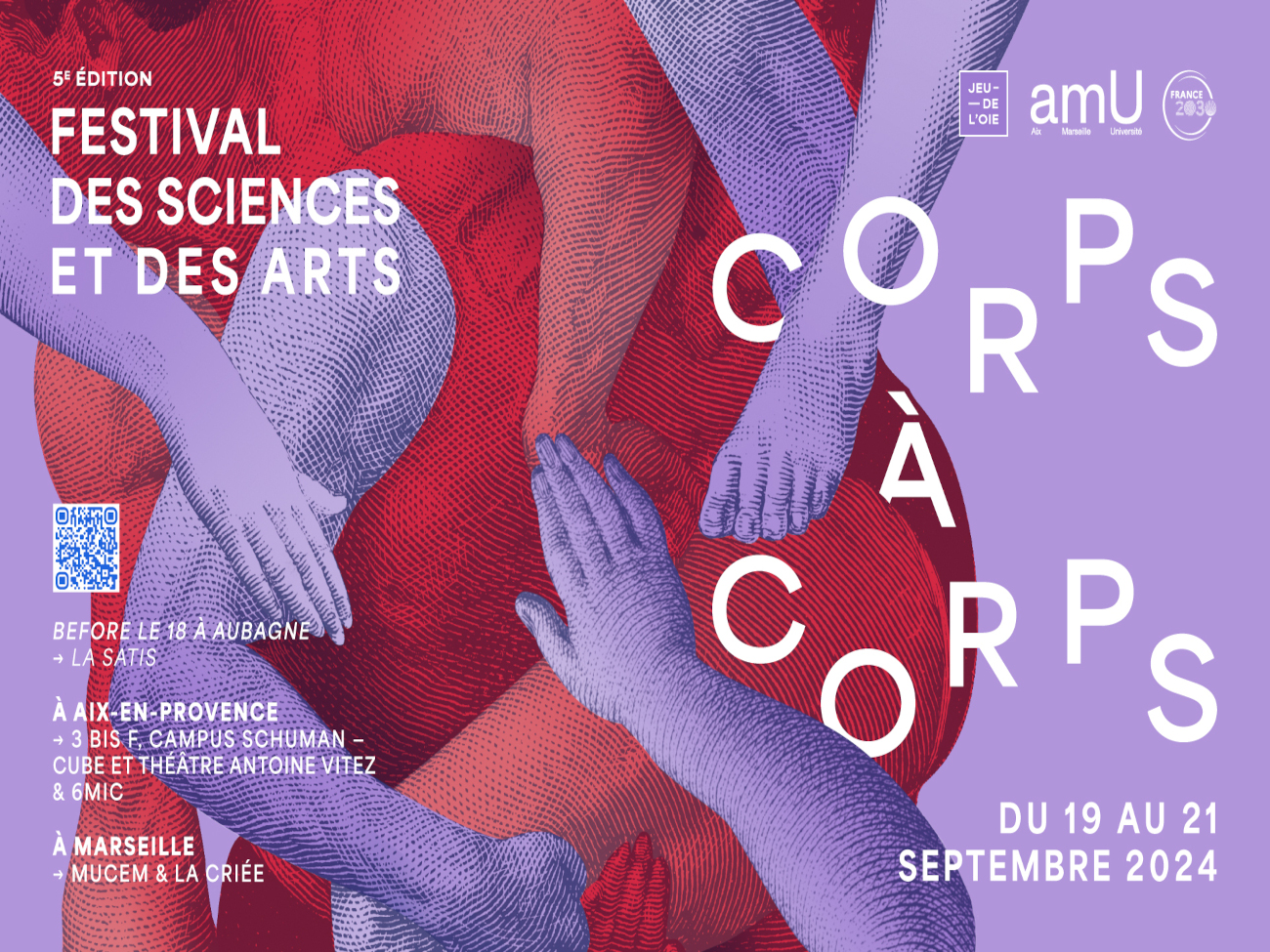
Science and Arts Festival
Body to body
Conceived as a “scientific performance” and a genuine back-to-school festival, playful and open to as many people as possible, the Festival des sciences et des arts seeks to circulate knowledge “differently”, by bringing together disciplines and players.
The 5th edition of this event at the Mucem is dedicated to questions of care, the body and identity. On the program: a major debate on education in hospitality and a discussion on end-of-life issues, as well as workshops and tours around the “Paradis naturistes” exhibition.
Aix-Marseille University and its partners (Mucem, La Criée, APHM, CNRS, IRD, Théâtre Antoine Vitez, 3 bis f center d’arts contemporains, Aix-en-Provence Biennale, Ville de Marseille, Espace Éthique Paca Corse and Espace Éthique IDF, ARTE Campus).
12pm-2pm, Mucem fort Saint-Jean (place d'Armes) Le grand pique-nique
The big picnic is back! The formula remains the same: a good meal to share for a convivial moment concocted by Les grandes Tables, around the theme of plants.
14h-15h30, Mucem J4 (auditorium) The gestures of hospitality
Hospitality may be a virtue, but it’s just as much a question of practices and gestures. Here’s an overview, with one question in mind: how can we be more hospitable?
3:30-6pm, Mucem J4 (forum) Stands, workshops, readings, exhibition
Registrations
The BU outside the walls
University libraries offer a selection of books on the festival theme.
Le 1 Hebdo newsstand
Presentation and distribution of the special issue produced in partnership with the festival, with free subscriptions to boot!
The Radio Grenouille set
Radio Grenouille sets up in the Mucem forum for a live broadcast, and a podcast listening session on the body.
Skin care with Les Maronneuses
Presentation and facial care. This natural cosmetics brand, made in Provence, was created by Cécile and Léa, both graduates of a master’s degree in dermocosmetics from Aix-Marseille University.
Rediscover your body with virtual reality
Change your face or go windsurfing in the calanques, it’s all possible thanks to advances in virtual reality. Demonstrations by the CRVM (Centre de réalité virtuelle de la Méditerranée) attached to Aix-Marseille University.
Use your senses to recognize plants
An in-depth exploration of the morphological characteristics of medicinal plants, both fresh and dried, using macro- and microscopic approaches. Participants will learn to identify and differentiate Mediterranean plants through a multisensory approach involving sight, smell, touch and taste. In addition to this sensory immersion, it will be possible to consult a Mediterranean herbarium. This workshop aims to enrich our botanical knowledge while raising awareness of the importance of medicinal plants in our daily lives. Proposed by Clémentine Baccati, PhD student in pharmacognosy at Aix-Marseille University.
From self-portrait to selfie
Registration required.
A photography workshop to learn the basics of taking pictures, draw inspiration from the work of painters and photographers who have explored the practice of self-portraiture in order to create their own, and question the invention of the self, from self-portrait to selfie. By Pierre Morales, photographer.
Compose and dance
Registration required.
A danced stroll through the corridors of the Mucem. By Muriel Piqué, program manager (PRISM) in association with Aix-Marseille Université’s scientific culture unit.
Drawing as body practice: discovering Mediterranean flora through our gestures
Registration required.
Drawing can transcribe a sensitive experience of the body. This workshop begins in the Mucem’s Jardin des Migrations, where we’ll learn to identify plants and then draw them, to preserve a trace of their existence through our gestures. By Dianela Rodrigues, anthropologist, Amidex Chair of Excellence.
The body in the mirror: writing workshop
Registration required.
Writing the body, drawing it, photographing it, filming it, choreographing it, theatricalizing it and setting it to music are all ways of holding up a mirror to the subject seeking to represent and recognize itself as an embodied being. Reflection and practice on intimacy and self-writing, with writer and performer Laure Becdelièvre.
Photographic exhibition “Eclipse. Making the invisible visible
An exhibition created by a group of 25 students from the Faculty of Law and Political Science to raise awareness of the need to combat discrimination against people with visible and invisible disabilities. With the Illuminate to Engage association.
La Maison des femmes
Stand presenting and raising awareness of the Maison des Femmes, a reception, listening, care, support and referral center for vulnerable women and victims of violence.
3:30 pm - 5 pm, Mucem J4 (auditorium) Mini-conferences
3:30-4 p.m.
Do babies communicate with their bodies?
Can a baby’s movements convey emotions and start a conversation with adults, whether parents or not? With Marianne Jover, professor of developmental psychology at Aix-Marseille University’s PsyCLE laboratory.
4:30 p.m. – 5 p.m.
The bodily fluids that govern us
What remains of Hippocrates’ “humoral” theory that blood and other bodily fluids determine our personality and temperament? A lecture on the real power of blood on our brain and mind. With Anne Kastner, professor at the Institut des neurosciences de la Timone (INT).
16h and 17h, Mucem J4 Visit the "Paradis naturistes" exhibition
Guided tour by Amélie Lavin, exhibition co-curator, head curator of the Bodies, Appearances and Sexualities department.
Registration
16h-17h45, Mucem J4 (auditorium) Screenings
16h-16h45, screening-debate
SWAP
Screening of the mini-series by L3 Satis students, option “Métiers de la production et de la réalisation”. Followed by a discussion.
In the near future, participants in a TV show can swap bodies with the charismatic presenter, but not without risk.
17h-17h45, screening-debate
Representations of disability in sport and art
How can we change the way we look at disability discrimination? Screening and discussion of Vestiaires with Adda Abdelli, author and scriptwriter of this humorous series featuring a dozen disabled performers who are members of an amateur swimming club.
6pm-7pm, Mucem J4 (auditorium) End of life. Assisted dying during Alzheimer's disease
Round-table discussion with Pascal Césaro, lecturer in film and audiovisual studies (Aix-Marseille University), Marie Gaille, director of INSHS at CNRS and philosopher, Fabrice Gzil, philosopher, specialist in Alzheimer’s disease.
Moderator: Pierre Le Coz, Professor of Philosophy at Aix-Marseille University and Director of the Espace Régional de Réflexion Ethique Région Sud et Corse.
Assuming that French legislators eventually authorize assisted dying, could we ourselves set the moment when we would like to be helped in the event of Alzheimer’s disease? Could a doctor help a patient who asks for nothing hic et nunc, but who had previously expressed this wish, before “sinking” into the disease? Is the self of the patient who says “yes to life” during the illness a true self? Should we take as our yardstick the self that existed before the onset of the illness?
This round table will be accompanied by an extract from Pascal Cesaro’s documentary film Une maison au bord du monde. Created twenty years ago in Gardanne, “La Maison” is a center specializing in end-of-life care.
In collaboration with the 2024 edition of the “Ethics and progressive neurological diseases” summer school.
8:30-9:30 pm, Mucem J4 (auditorium) - Free, reservation required Le 1 fait son numéro - Sommes-nous nos corps ?
To celebrate its tenth anniversary, and as part of its partnership with Aix-Marseille University, Le 1 is producing a life-size number on the Mucem stage. Éric Fottorino and the newspaper’s editorial team take up a simple question: “Are we our bodies?” From our color to our gender and our relationship to nudity, our bodies work on our identities. A polyphonic narrative at the crossroads of knowledge and the arts, blending anthropology with dance and drawing performance.
Illustrated live by Marion Fayolle. Directed by Julien Bisson.
Reservation
Conceived as a “scientific performance” and a genuine back-to-school festival, playful and open to as many people as possible, the Festival des sciences et des arts seeks to circulate knowledge “differently”, by bringing together disciplines and players.
The 5th edition of this event at the Mucem is dedicated to questions of care, the body and identity. On the program: a major debate on education in hospitality and a discussion on end-of-life issues, as well as workshops and tours around the “Paradis naturistes” exhibition.
Aix-Marseille University and its partners (Mucem, La Criée, APHM, CNRS, IRD, Théâtre Antoine Vitez, 3 bis f center d’arts contemporains, Aix-en-Provence Biennale, Ville de Marseille, Espace Éthique Paca Corse and Espace Éthique IDF, ARTE Campus).
12pm-2pm, Mucem fort Saint-Jean (place d'Armes) Le grand pique-nique
The big picnic is back! The formula remains the same: a good meal to share for a convivial moment concocted by Les grandes Tables, around the theme of plants.
14h-15h30, Mucem J4 (auditorium) The gestures of hospitality
Hospitality may be a virtue, but it’s just as much a question of practices and gestures. Here’s an overview, with one question in mind: how can we be more hospitable?
3:30-6pm, Mucem J4 (forum) Stands, workshops, readings, exhibition
Registrations
The BU outside the walls
University libraries offer a selection of books on the festival theme.
Le 1 Hebdo newsstand
Presentation and distribution of the special issue produced in partnership with the festival, with free subscriptions to boot!
The Radio Grenouille set
Radio Grenouille sets up in the Mucem forum for a live broadcast, and a podcast listening session on the body.
Skin care with Les Maronneuses
Presentation and facial care. This natural cosmetics brand, made in Provence, was created by Cécile and Léa, both graduates of a master’s degree in dermocosmetics from Aix-Marseille University.
Rediscover your body with virtual reality
Change your face or go windsurfing in the calanques, it’s all possible thanks to advances in virtual reality. Demonstrations by the CRVM (Centre de réalité virtuelle de la Méditerranée) attached to Aix-Marseille University.
Use your senses to recognize plants
An in-depth exploration of the morphological characteristics of medicinal plants, both fresh and dried, using macro- and microscopic approaches. Participants will learn to identify and differentiate Mediterranean plants through a multisensory approach involving sight, smell, touch and taste. In addition to this sensory immersion, it will be possible to consult a Mediterranean herbarium. This workshop aims to enrich our botanical knowledge while raising awareness of the importance of medicinal plants in our daily lives. Proposed by Clémentine Baccati, PhD student in pharmacognosy at Aix-Marseille University.
From self-portrait to selfie
Registration required.
A photography workshop to learn the basics of taking pictures, draw inspiration from the work of painters and photographers who have explored the practice of self-portraiture in order to create their own, and question the invention of the self, from self-portrait to selfie. By Pierre Morales, photographer.
Compose and dance
Registration required.
A danced stroll through the corridors of the Mucem. By Muriel Piqué, program manager (PRISM) in association with Aix-Marseille Université’s scientific culture unit.
Drawing as body practice: discovering Mediterranean flora through our gestures
Registration required.
Drawing can transcribe a sensitive experience of the body. This workshop begins in the Mucem’s Jardin des Migrations, where we’ll learn to identify plants and then draw them, to preserve a trace of their existence through our gestures. By Dianela Rodrigues, anthropologist, Amidex Chair of Excellence.
The body in the mirror: writing workshop
Registration required.
Writing the body, drawing it, photographing it, filming it, choreographing it, theatricalizing it and setting it to music are all ways of holding up a mirror to the subject seeking to represent and recognize itself as an embodied being. Reflection and practice on intimacy and self-writing, with writer and performer Laure Becdelièvre.
Photographic exhibition “Eclipse. Making the invisible visible
An exhibition created by a group of 25 students from the Faculty of Law and Political Science to raise awareness of the need to combat discrimination against people with visible and invisible disabilities. With the Illuminate to Engage association.
La Maison des femmes
Stand presenting and raising awareness of the Maison des Femmes, a reception, listening, care, support and referral center for vulnerable women and victims of violence.
3:30 pm - 5 pm, Mucem J4 (auditorium) Mini-conferences
3:30-4 p.m.
Do babies communicate with their bodies?
Can a baby’s movements convey emotions and start a conversation with adults, whether parents or not? With Marianne Jover, professor of developmental psychology at Aix-Marseille University’s PsyCLE laboratory.
4:30 p.m. – 5 p.m.
The bodily fluids that govern us
What remains of Hippocrates’ “humoral” theory that blood and other bodily fluids determine our personality and temperament? A lecture on the real power of blood on our brain and mind. With Anne Kastner, professor at the Institut des neurosciences de la Timone (INT).
16h and 17h, Mucem J4 Visit the "Paradis naturistes" exhibition
Guided tour by Amélie Lavin, exhibition co-curator, head curator of the Bodies, Appearances and Sexualities department.
Registration
16h-17h45, Mucem J4 (auditorium) Screenings
16h-16h45, screening-debate
SWAP
Screening of the mini-series by L3 Satis students, option “Métiers de la production et de la réalisation”. Followed by a discussion.
In the near future, participants in a TV show can swap bodies with the charismatic presenter, but not without risk.
17h-17h45, screening-debate
Representations of disability in sport and art
How can we change the way we look at disability discrimination? Screening and discussion of Vestiaires with Adda Abdelli, author and scriptwriter of this humorous series featuring a dozen disabled performers who are members of an amateur swimming club.
6pm-7pm, Mucem J4 (auditorium) End of life. Assisted dying during Alzheimer's disease
Round-table discussion with Pascal Césaro, lecturer in film and audiovisual studies (Aix-Marseille University), Marie Gaille, director of INSHS at CNRS and philosopher, Fabrice Gzil, philosopher, specialist in Alzheimer’s disease.
Moderator: Pierre Le Coz, Professor of Philosophy at Aix-Marseille University and Director of the Espace Régional de Réflexion Ethique Région Sud et Corse.
Assuming that French legislators eventually authorize assisted dying, could we ourselves set the moment when we would like to be helped in the event of Alzheimer’s disease? Could a doctor help a patient who asks for nothing hic et nunc, but who had previously expressed this wish, before “sinking” into the disease? Is the self of the patient who says “yes to life” during the illness a true self? Should we take as our yardstick the self that existed before the onset of the illness?
This round table will be accompanied by an extract from Pascal Cesaro’s documentary film Une maison au bord du monde. Created twenty years ago in Gardanne, “La Maison” is a center specializing in end-of-life care.
In collaboration with the 2024 edition of the “Ethics and progressive neurological diseases” summer school.
8:30-9:30 pm, Mucem J4 (auditorium) - Free, reservation required Le 1 fait son numéro - Sommes-nous nos corps ?
To celebrate its tenth anniversary, and as part of its partnership with Aix-Marseille University, Le 1 is producing a life-size number on the Mucem stage. Éric Fottorino and the newspaper’s editorial team take up a simple question: “Are we our bodies?” From our color to our gender and our relationship to nudity, our bodies work on our identities. A polyphonic narrative at the crossroads of knowledge and the arts, blending anthropology with dance and drawing performance.
Illustrated live by Marion Fayolle. Directed by Julien Bisson.
Reservation