Open the museum
Pop Philosophy Week
Lecture by Constance Rivière (Director of the Musée National de l’Histoire de l’Immigration, Palais de la Porte Dorée).
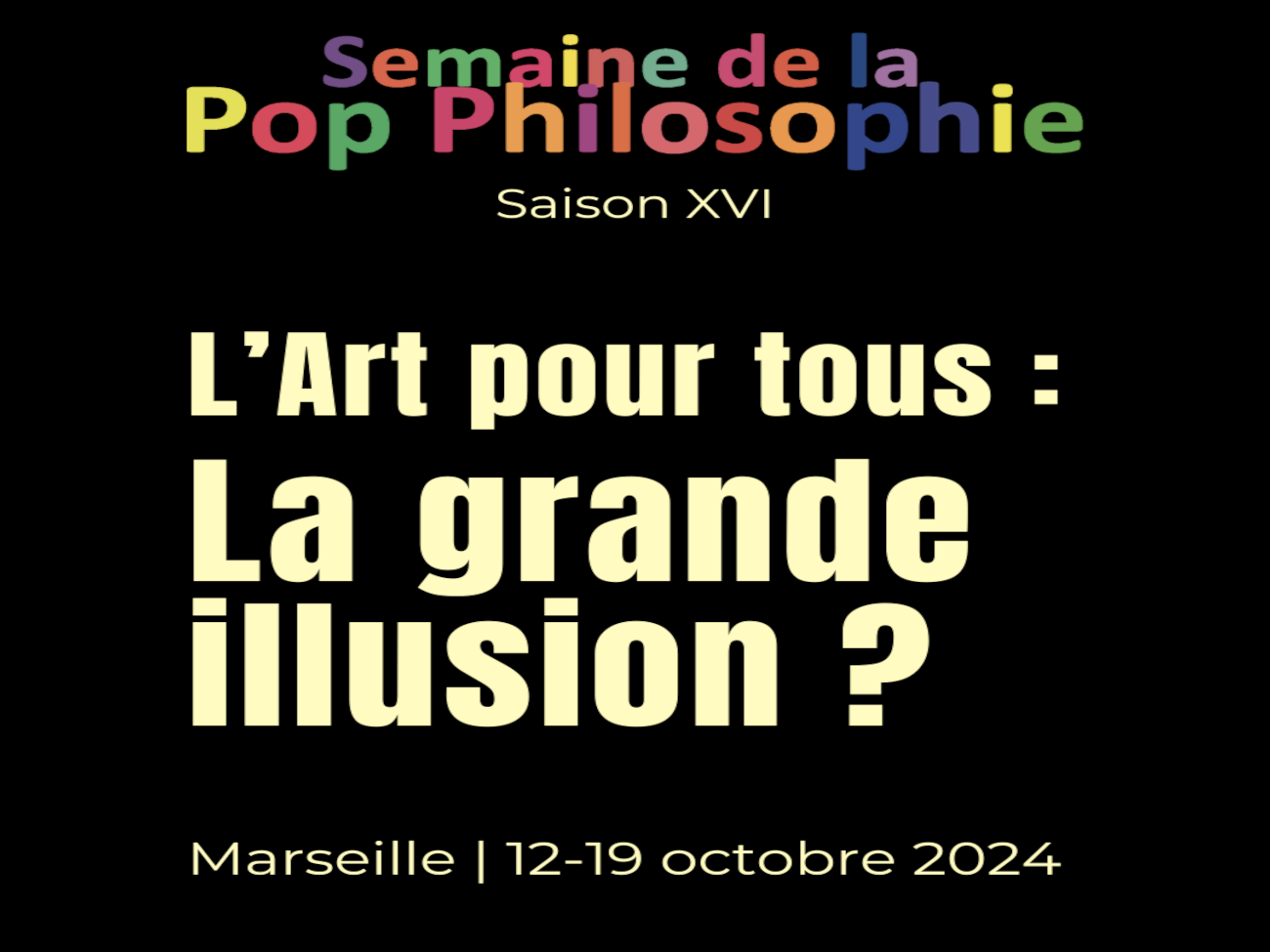
This year, Pop Philosophy Week, proposed by Jacques Serrano, explores the question of “art for all”.
Has “art for all” become an empty slogan, an assertion in which the people do not find themselves and which even unwittingly denotes a certain contempt for them?
At the Mucem, we’ll be taking a closer look at museums with Constance Rivière, Director General of the Palais de la Porte Dorée, formerly in charge of culture and citizenship under François Hollande, and author of Une fille sans histoire (2019), La Maison des solitudes (2021) and La Vie des ombres (2023).
The conference will be introduced by Pierre-Olivier Costa, President of the Mucem, and followed by a discussion with Constance Rivière, Marie-Charlotte Calafat, Scientific and Collections Director of the Mucem, and Fabrice Raffin, socio-anthropologist.
Opening museums
In recent years, history and society museums have made a strong comeback. The desire not only to understand, but also to take part in the major debates that are shaking the world, and to create a dynamic, shows that these museums, which are connected to the issues of the present day, are meeting the expectations of the public. The very good attendance figures at the Musée national de l’histoire de l’immigration since the reopening of its permanent tour confirm this trend, which is now taking on new demands, pushing museums to reinvent themselves.
From the presentation of collections to the writing of texts, from the choice of works for acquisitions to the programming of temporary exhibitions, via mediation and artistic and cultural programming, all these tools are available to institutions to move from the dream model of the universal museum to that of the shared, open museum, freed from certain codes and a form of overhang indifferent to changes in society. Museums are not neutral. This was forcefully underlined by the ICOM office in the United States at the time of George Floyd’s assassination: “Museums are not separate from their social context, from the power structures and struggles of their communities… Silence is not neutrality, it is a choice – the wrong choice”.
Our institutions therefore face common challenges in shaking up their traditional concepts, reconnecting them with the concerns of society, and opening up to new audiences, always with these essential questions as their compass: What impact? What social role? How can we make our museums places of cross-fertilization and friction, taking on the plurivocality of our societies without losing sight of the long term, scientificity and, above all, joy?
Constance Rivière
Lecture by Constance Rivière (Director of the Musée National de l’Histoire de l’Immigration, Palais de la Porte Dorée).
This year, Pop Philosophy Week, proposed by Jacques Serrano, explores the question of “art for all”.
Has “art for all” become an empty slogan, an assertion in which the people do not find themselves and which even unwittingly denotes a certain contempt for them?
At the Mucem, we’ll be taking a closer look at museums with Constance Rivière, Director General of the Palais de la Porte Dorée, formerly in charge of culture and citizenship under François Hollande, and author of Une fille sans histoire (2019), La Maison des solitudes (2021) and La Vie des ombres (2023).
The conference will be introduced by Pierre-Olivier Costa, President of the Mucem, and followed by a discussion with Constance Rivière, Marie-Charlotte Calafat, Scientific and Collections Director of the Mucem, and Fabrice Raffin, socio-anthropologist.
Opening museums
In recent years, history and society museums have made a strong comeback. The desire not only to understand, but also to take part in the major debates that are shaking the world, and to create a dynamic, shows that these museums, which are connected to the issues of the present day, are meeting the expectations of the public. The very good attendance figures at the Musée national de l’histoire de l’immigration since the reopening of its permanent tour confirm this trend, which is now taking on new demands, pushing museums to reinvent themselves.
From the presentation of collections to the writing of texts, from the choice of works for acquisitions to the programming of temporary exhibitions, via mediation and artistic and cultural programming, all these tools are available to institutions to move from the dream model of the universal museum to that of the shared, open museum, freed from certain codes and a form of overhang indifferent to changes in society. Museums are not neutral. This was forcefully underlined by the ICOM office in the United States at the time of George Floyd’s assassination: “Museums are not separate from their social context, from the power structures and struggles of their communities… Silence is not neutrality, it is a choice – the wrong choice”.
Our institutions therefore face common challenges in shaking up their traditional concepts, reconnecting them with the concerns of society, and opening up to new audiences, always with these essential questions as their compass: What impact? What social role? How can we make our museums places of cross-fertilization and friction, taking on the plurivocality of our societies without losing sight of the long term, scientificity and, above all, joy?
Constance Rivière