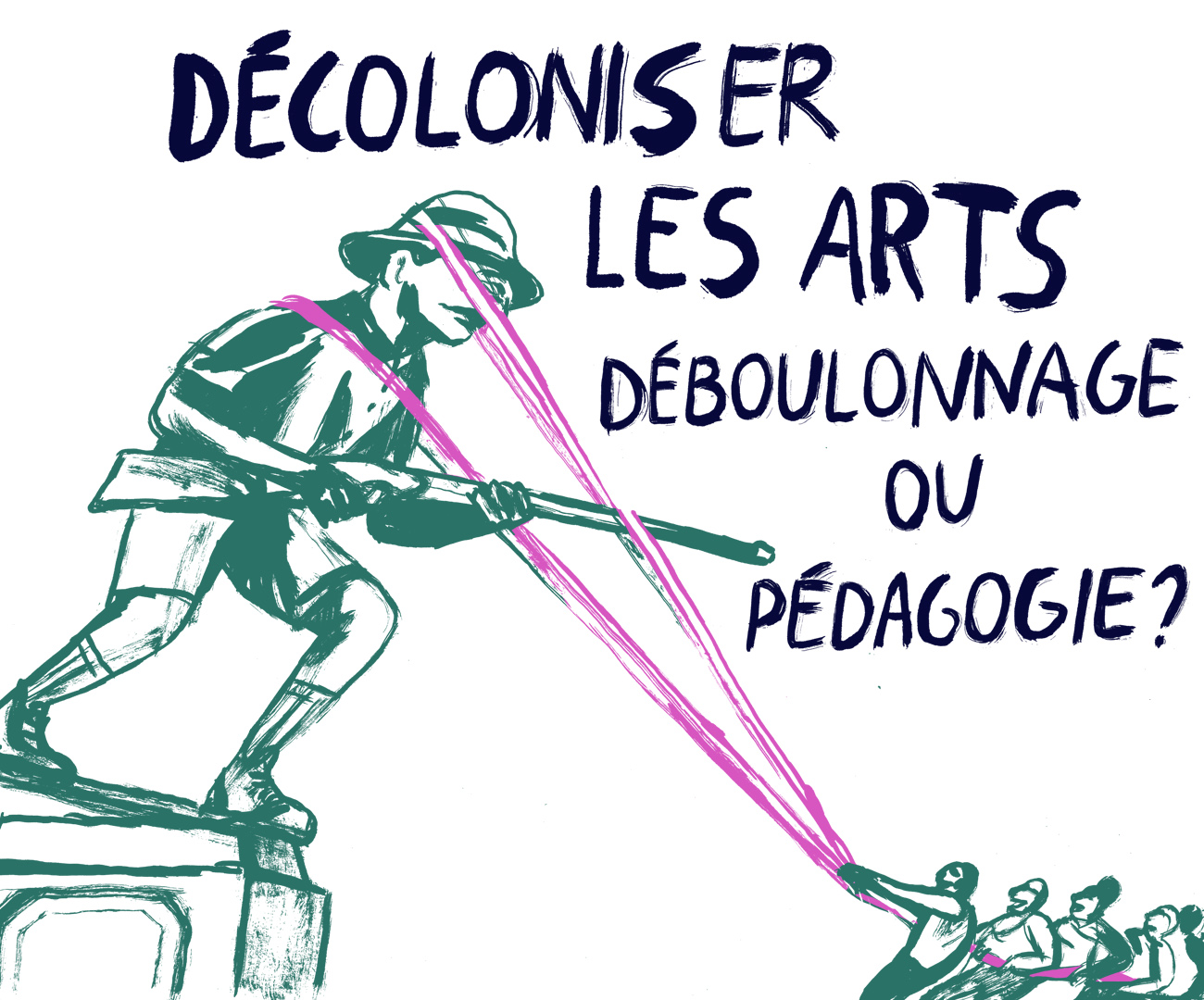
Decolonizing the arts: debunking or pedagogy?
Les Procès du siècle - Shared struggles
With Eva Doumbia (author, director, actress) and Nacira Guénif-Souilamas (sociologist, anthropologist).
Moderator: Rokhaya Diallo
With the participation of Julia Ferloni, heritage curator, head of the Crafts, Trade and Industry section at Mucem.
Between the restitution of works of art and the unbolting of statues, the “decolonization” of art and culture seems to be gaining new momentum. But how far should we go? Is it really necessary to wipe the slate clean? Erase everything? How can we rid ourselves of the centuries of slavery and colonization that have contaminated our knowledge, our imaginations and our museums?
The episode in newspaper and podcast
Eva Doumbia (author, director, actress)
Author, director and actress Eva Doumbia trained in theater at the University of Aix-en-Provence, then at the Unité nomade de mise en scène (CNSAD), where she studied alongside Jacques Lassalle, Krystian Lupa and André Engel. In 2000, she founded the La Part du Pauvre/Nana Triban company, and quickly developed an interest in authors such as Marie-Louise Mumbu, Léonora Miano, Maryse Condé, Dieudonné Niangouna and Aristide Tarnagda. Eva Doumbia is part of this generation that is closely observing the way in which racial relations, inherited from French colonial history, are still expressed in society today. In 2016, she founded the multidisciplinary festival Afropea, which promotes Afro-European creators, and since September 2019, her company has occupied the Théâtre des Bains Douches in Elbeuf, a working-class, multicultural town in Normandy. Since 2022, she has been an associate artist at Théâtre du Nord – Centre dramatique national Lille Tourcoing Hauts de France. She is patron of the Auteu.rices class at the Ecole du Nord in Lille. She is a founding member of the Décoloniser les Arts collective.
Rokhaya Diallo (journalist, author, director)
Rokhaya Diallo © George T
Rokhaya Diallo is an award-winning French journalist, author and film-maker. She is a columnist for the Washington Post and the Guardian, and a researcher at the Gender+Justice Initiative Research Center at Georgetown University (Washington). In France, she teaches cultural studies at Paris 1 – Sorbonne and is a columnist for television and radio. Rokhaya Diallo is the author of a dozen books and comic strips, and has made several documentaries. With Grace Ly, she also created “Kiffe Ta Race” (Binge Audio), the first French-language podcast dedicated to racial issues and ranked as one of the best podcasts by Apple. In 2022, Rokhaya Diallo founded W.O.R.D., the first school dedicated to public speaking, with the aim of democratizing access to the public sphere.
With Eva Doumbia (author, director, actress) and Nacira Guénif-Souilamas (sociologist, anthropologist).
Moderator: Rokhaya Diallo
With the participation of Julia Ferloni, heritage curator, head of the Crafts, Trade and Industry section at Mucem.
Between the restitution of works of art and the unbolting of statues, the “decolonization” of art and culture seems to be gaining new momentum. But how far should we go? Is it really necessary to wipe the slate clean? Erase everything? How can we rid ourselves of the centuries of slavery and colonization that have contaminated our knowledge, our imaginations and our museums?
The episode in newspaper and podcast
Eva Doumbia (author, director, actress)
Author, director and actress Eva Doumbia trained in theater at the University of Aix-en-Provence, then at the Unité nomade de mise en scène (CNSAD), where she studied alongside Jacques Lassalle, Krystian Lupa and André Engel. In 2000, she founded the La Part du Pauvre/Nana Triban company, and quickly developed an interest in authors such as Marie-Louise Mumbu, Léonora Miano, Maryse Condé, Dieudonné Niangouna and Aristide Tarnagda. Eva Doumbia is part of this generation that is closely observing the way in which racial relations, inherited from French colonial history, are still expressed in society today. In 2016, she founded the multidisciplinary festival Afropea, which promotes Afro-European creators, and since September 2019, her company has occupied the Théâtre des Bains Douches in Elbeuf, a working-class, multicultural town in Normandy. Since 2022, she has been an associate artist at Théâtre du Nord – Centre dramatique national Lille Tourcoing Hauts de France. She is patron of the Auteu.rices class at the Ecole du Nord in Lille. She is a founding member of the Décoloniser les Arts collective.
Rokhaya Diallo (journalist, author, director)
Rokhaya Diallo © George T
Rokhaya Diallo is an award-winning French journalist, author and film-maker. She is a columnist for the Washington Post and the Guardian, and a researcher at the Gender+Justice Initiative Research Center at Georgetown University (Washington). In France, she teaches cultural studies at Paris 1 – Sorbonne and is a columnist for television and radio. Rokhaya Diallo is the author of a dozen books and comic strips, and has made several documentaries. With Grace Ly, she also created “Kiffe Ta Race” (Binge Audio), the first French-language podcast dedicated to racial issues and ranked as one of the best podcasts by Apple. In 2022, Rokhaya Diallo founded W.O.R.D., the first school dedicated to public speaking, with the aim of democratizing access to the public sphere.