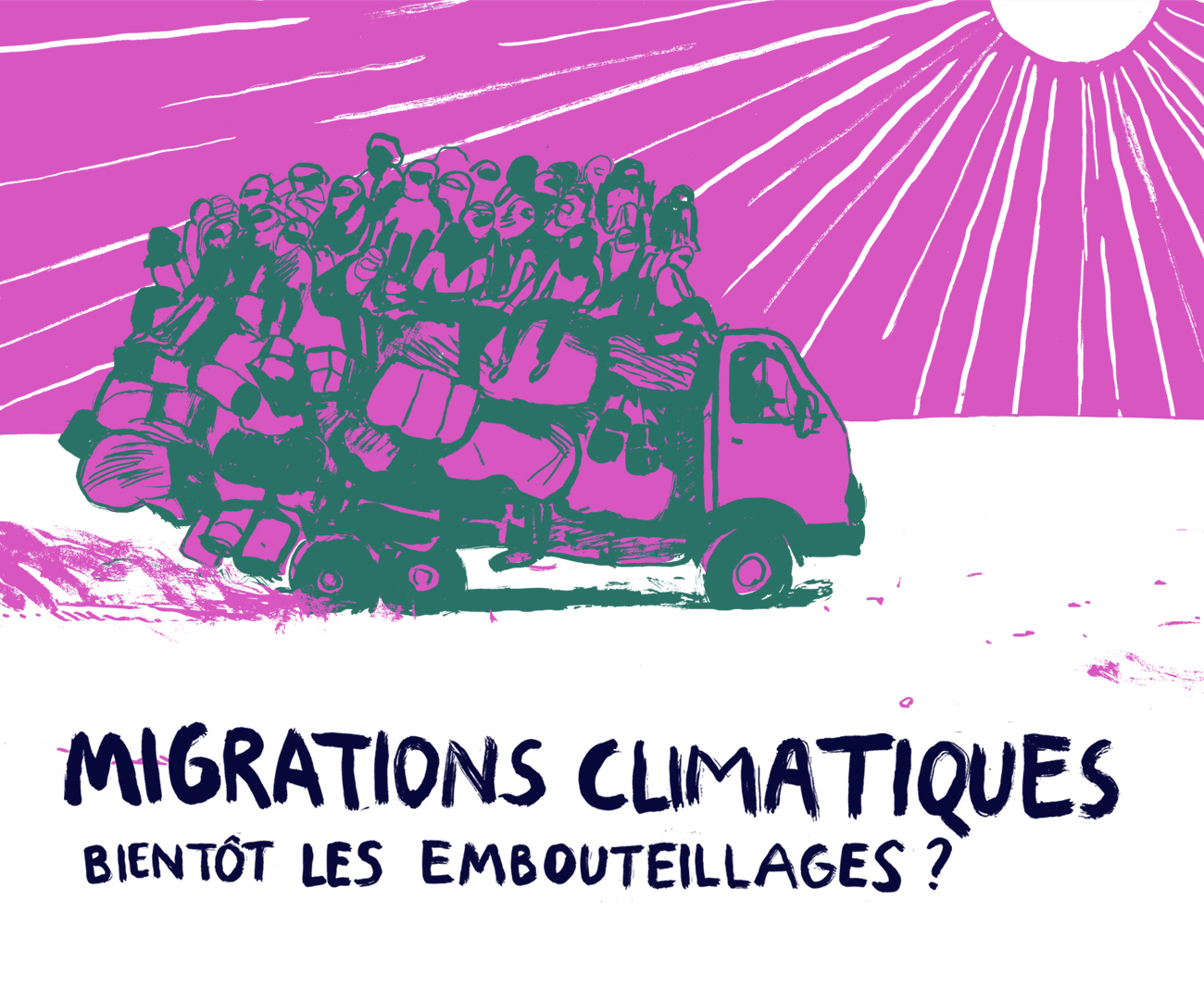
Climate migration: traffic jams on the horizon?
Les Procès du siècle - Shared struggles
With Marine de Guglielmo Weber (researcher) and Najat Vallaud-Belkacem (president of France terre d’asile)
Moderator: Paloma Moritz
With the participation of Julia Ferloni, heritage curator, head of the Crafts, Trade and Industry section at Mucem.
Last September, more than 11,000 migrants landed in Lampedusa in the space of a few days, doubling the population of this tiny 20-square-kilometer island and plunging the European Union into yet another existential crisis.
This scenario is likely to be repeated, and even intensified, in different regions of the world, due to global warming and the migration it is likely to generate: while in 2021, 24 million people were displaced by climatic events, World Bank figures predict 260 million climate-displaced people in 2030, and up to 1.2 billion in 2050!
So what to do? Build walls and fortresses? Or think about setting up global governance on these issues?
The episode in newspaper and podcast
Marine de Guglielmo Weber (researcher)
Marine by Guglielmo Weber © IRIS
Marine de Guglielmo Weber is a professor in the Climate, Energy and Security program at IRIS, and Scientific Director of the Observatoire Défense et Climat. She produces analysis notes and prospective reports on security issues linked to climate change. She holds a doctorate in information and communication sciences, and is the author of a futuristic novel about France in the 2040s, as it faces the political and social consequences of climate change (L’Eau qui reste).
Najat Vallaud-Belkacem (president of France terre d'asile)
Najat Vallaud-Belkacem © JDD
In recent years, Najat Vallaud-Belkacem, a politician at both local and national level, notably as Minister for Women’s Rights and then Minister of Education, has pursued her commitment in a new way, serving the most vulnerable populations. Director of France for ONE, an international NGO working to combat extreme poverty and preventable diseases worldwide, she is also involved with refugees through the Tent Partnership for Refugees, whose Strategic Council she has chaired for the past 4 years. Tent is a foundation that mobilizes major private-sector companies to offer employment to refugees in the countries where they settle. In July 2022, Najat Vallaud-Belkacem was elected President of France terre d’asile (FTDA), an association dedicated to welcoming and supporting exiles.
Paloma Moritz (journalist, director)
Paloma Moritz © Photo Thomas Decamps
Paloma Moritz is a journalist and film-maker. She worked for four years for the independent media Spicee, where she developed an editorial line based on impact and solutions journalism. She produced a dozen reports and documentaries. Her favorite themes: the overhaul of our democracy, gender inequality and the ecological emergency.
Today, she runs the Ecology section of the independent media outlet Blast, and every week she produces short videos, reports and interviews with personalities and scientists to help people better understand current events, political discourse and ecological issues: How can we adapt? How can we act? How can we reduce our emissions? How can we invent another, more sustainable and fairer society?
With Marine de Guglielmo Weber (researcher) and Najat Vallaud-Belkacem (president of France terre d’asile)
Moderator: Paloma Moritz
With the participation of Julia Ferloni, heritage curator, head of the Crafts, Trade and Industry section at Mucem.
Last September, more than 11,000 migrants landed in Lampedusa in the space of a few days, doubling the population of this tiny 20-square-kilometer island and plunging the European Union into yet another existential crisis.
This scenario is likely to be repeated, and even intensified, in different regions of the world, due to global warming and the migration it is likely to generate: while in 2021, 24 million people were displaced by climatic events, World Bank figures predict 260 million climate-displaced people in 2030, and up to 1.2 billion in 2050!
So what to do? Build walls and fortresses? Or think about setting up global governance on these issues?
The episode in newspaper and podcast
Marine de Guglielmo Weber (researcher)
Marine by Guglielmo Weber © IRIS
Marine de Guglielmo Weber is a professor in the Climate, Energy and Security program at IRIS, and Scientific Director of the Observatoire Défense et Climat. She produces analysis notes and prospective reports on security issues linked to climate change. She holds a doctorate in information and communication sciences, and is the author of a futuristic novel about France in the 2040s, as it faces the political and social consequences of climate change (L’Eau qui reste).
Najat Vallaud-Belkacem (president of France terre d'asile)
Najat Vallaud-Belkacem © JDD
In recent years, Najat Vallaud-Belkacem, a politician at both local and national level, notably as Minister for Women’s Rights and then Minister of Education, has pursued her commitment in a new way, serving the most vulnerable populations. Director of France for ONE, an international NGO working to combat extreme poverty and preventable diseases worldwide, she is also involved with refugees through the Tent Partnership for Refugees, whose Strategic Council she has chaired for the past 4 years. Tent is a foundation that mobilizes major private-sector companies to offer employment to refugees in the countries where they settle. In July 2022, Najat Vallaud-Belkacem was elected President of France terre d’asile (FTDA), an association dedicated to welcoming and supporting exiles.
Paloma Moritz (journalist, director)
Paloma Moritz © Photo Thomas Decamps
Paloma Moritz is a journalist and film-maker. She worked for four years for the independent media Spicee, where she developed an editorial line based on impact and solutions journalism. She produced a dozen reports and documentaries. Her favorite themes: the overhaul of our democracy, gender inequality and the ecological emergency.
Today, she runs the Ecology section of the independent media outlet Blast, and every week she produces short videos, reports and interviews with personalities and scientists to help people better understand current events, political discourse and ecological issues: How can we adapt? How can we act? How can we reduce our emissions? How can we invent another, more sustainable and fairer society?